The short answer
A used car with a tow bar can be a good choice in 2026 if you need to tow a small trailer, a bike carrier, a light platform or a caravan compatible with the car. Do not treat the tow bar as a trivial accessory. At purchase you must check whether it is fitted correctly, whether the electrical socket works, whether there are documents for the fitment, what towing mass is entered in the car’s papers and whether the transmission, brakes, clutch, suspension and body have been stressed by heavy towing.
Short checklist:
- ask for the VIN and check towing mass in the car’s documents, not only in the advert;
- inspect the tow bar, mountings, rust, bolts, crossmember and the cut-out in the rear bumper;
- test the socket with a trailer or a tester, not only visually;
- ask what the car towed and how often;
- check the clutch or automatic gearbox in traffic, cold and hot;
- check brakes, rear suspension, tyres, wheel bearings and geometry;
- look for impact traces, deformations, repairs in the boot and floor;
- calculate the licence required, combination mass and trailer limits before purchase;
- do an inspection on a lift if you intend to use the tow bar, not just leave it as decoration.
The practical rule: the tow bar is useful only if the car, trailer, papers, licence and technical condition match each other. An SUV with a tow bar cannot automatically tow anything, and a compact with a tow bar does not become a heavy-duty working vehicle.
Why this is a useful subject for Carboratory
The Carboratory archive has many guides on engines, automatics, 4x4, suspension, brakes, rust, paperwork and used models. The tow bar appears mostly in passing, in articles about SUVs, pick-ups or family cars. A dedicated guide was missing for the buyer who sees “has a tow bar” in an advert and does not know whether it is an advantage, a risk or just a detail.
The search intent is clear: many Romanian buyers want a used car for family, house, yard, trailer, bikes, a small boat, light caravans or weekend trips. At the same time, the tow bar can show that the car was used under load, and that changes the technical inspection.
Legal and technical references must be read from up-to-date sources and from the papers of the specific car. The highway code defines category B and trailer combinations by maximum authorised masses, and technical regulations limit towing mass according to the manufacturer’s declared values, trailer braking and vehicle category. For documentation, see OUG 195/2002 on the Legislative Portal, RNTR 2 rules on towing mass, EU Regulation 1230/2012 and RAR information on fitting work and structural modifications on road vehicles, available on rarom.ro.
Factory tow bar or fitted later?
The first thing to establish is whether the car had a tow bar from the factory or whether it was fitted later. The difference matters for documents, wiring, electronic integration and, sometimes, for cooling or calibration of assistance systems.
On a car with a factory tow bar, check:
- whether it appears in the car’s equipment by VIN;
- whether it is fixed, detachable or retractable;
- whether it has a key or locking mechanism;
- whether the electrical installation works correctly;
- whether the car’s systems recognise the trailer;
- whether there is a trailer-stabilisation mode;
- whether parking sensors behave normally with a trailer attached.
On a later-fitted tow bar, the check must be more careful. Ask for the fitting invoice, the device documents, proof that the part is suitable for that model and any mention in the car’s papers, if applicable. Do not rely on the phrase “that’s how I bought it”.
Where towing mass is checked
Towing mass is not guessed from the size of the car. It is read from the example’s papers, the certificate of conformity, the vehicle identity card and the model handbook. The same generation can have different values depending on engine, transmission, drive, equipment, type approval and year of manufacture.
For trailers, the large difference is between:
- unbraked trailer;
- braked trailer;
- maximum authorised mass of the trailer;
- real loaded mass;
- maximum mass of the combination;
- vertical load on the tow ball;
- licence category.
Technical regulations indicate general limits, but the buyer must not make the purchase from a general rule alone. The legal value for the car being bought is the one applicable to that vehicle. If you want to tow a caravan, a platform or a loaded trailer, check the combination mass before you buy the car, not after.
A category B licence does not cover every combination
A frequent myth is that a category B licence allows any small trailer, as long as the car “can”. In reality, the maximum authorised masses of the combination matter, not only the approximate weight of the things put in the trailer.
For a safe decision, note:
- the car’s maximum authorised mass;
- the trailer’s maximum authorised mass;
- the combination mass;
- which licence category you hold;
- whether extra training or category BE is needed for your scenario.
Do not buy a car for a caravan only because the seller says it “works with B”. Check the exact mass combination and ask for confirmation from a driving school, competent authority or specialist if you are close to the limit.
The electrical socket is a test, not a quick glance
The towing socket can have 7 pins or 13 pins, depending on the car, tow bar and use. For a simple trailer a simpler installation may be enough, but for a caravan, modern carriers or extra functions the available feeds and signals can matter.
At the viewing, do not settle for seeing the socket cover. Test:
- sidelights;
- brake lights;
- indicators;
- hazard lights;
- fog lamp;
- reverse, if it is wired;
- any dashboard messages;
- parking sensors;
- reversing camera;
- trailer recognition, if the car has this function.
An oxidised, broken or improvised socket can hide cheap fitting, water in the connections or electrical errors. On modern cars, incorrect wiring can affect electronic modules, not only the trailer bulbs.
The tow bar must be inspected from underneath
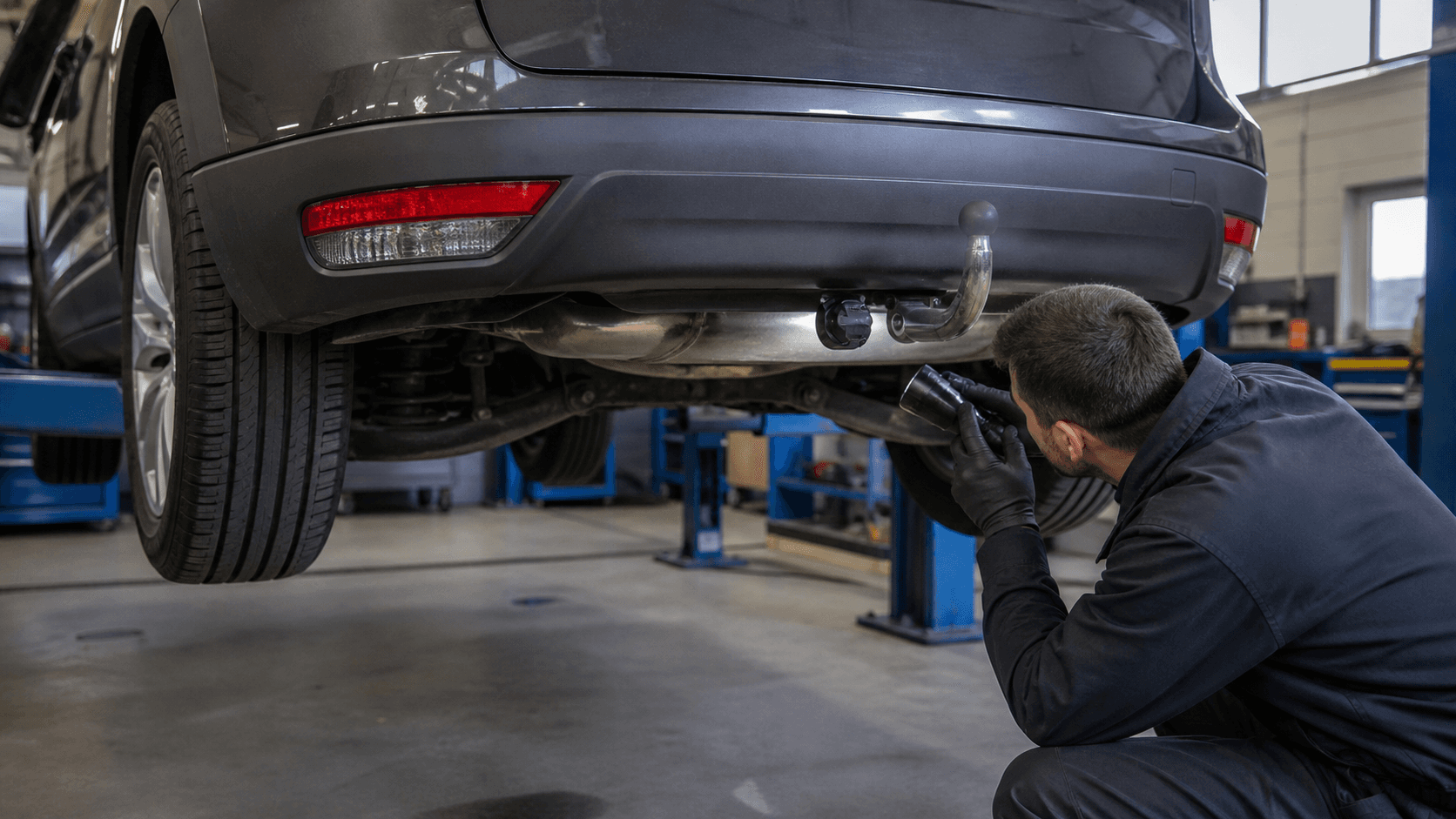
Advert photographs usually show only the tow ball. The important part is underneath: crossmember, mountings, bolts, body areas, floor, chassis rails, cut-outs and wiring.
On a lift, check:
- rust on the tow bar and mountings;
- missing, mixed or previously removed bolts;
- unclear welds;
- holes made unprofessionally;
- deformations of the crossmember;
- cracks in the mounting area;
- a poorly cut rear bumper;
- cables tied with random clips;
- unprotected connectors;
- traces of a rear impact;
- moisture in the boot.
Surface rust on the tow bar does not automatically mean a serious problem, but advanced rust at the mountings, play or deformations are stop signs. If you want to use the tow bar seriously, ask a workshop for an assessment.
Traces of heavy towing show up in several places
A car that has occasionally towed a small trailer is not automatically to be avoided. The problem appears when it has frequently pulled large loads, when it has run overloaded or when it has been used without adapted maintenance.
Signs to watch:
- a slipping clutch;
- clutch smell after manoeuvres;
- an automatic that jerks when hot;
- gearbox oil with no change history;
- vibrating brakes or heavily worn discs;
- tired rear dampers;
- uneven tyre wear;
- noisy wheel bearings;
- rear joints with play;
- a hit boot floor;
- a rear bumper with pressure marks or repairs;
- a neglected cooling system.
Towing stresses the car differently from running alone. Hill starts, slow manoeuvres, braking with a loaded combination, high temperatures and long journeys can wear the transmission, brakes and suspension faster.
Manual gearbox: the clutch is the first suspect
On a manual car with a tow bar, the clutch deserves a careful check. Do not test only on a straight, open road. Include take-offs from rest, a hill, slow running and moderate acceleration in higher gears.
Watch for:
- a very high bite point;
- slip under acceleration;
- vibration on take-off;
- noise when the pedal is pressed;
- gears that are hard to engage;
- smell after manoeuvres;
- change history for clutch and flywheel.
If the car towed often, a tired clutch is not surprising. The question is whether the price reflects this risk and whether you have proof of work done.
Automatic gearbox: hot test and oil history
On an automatic, towing can raise oil temperature and stress the converter, clutches, mechatronics or cooling system, depending on transmission type. The test must be done cold and hot.
Check:
- jerks on take-off;
- delay into D or R;
- vibration on a hill;
- harsh shifts after warm-up;
- stored errors;
- leaks;
- history for gearbox oil;
- the manufacturer’s towing recommendations.
If the seller says the automatic never needs maintenance, be cautious. For a car that has towed, service history becomes even more important.
Brakes, tyres and rear suspension
The tow bar justifies a closer inspection of the running gear. Even if the trailer has its own brakes, the towing car works harder, especially on descents, winding roads and repeated stops.
On the test drive and on a lift, check:
- discs with large lips;
- vibration under braking;
- a soft pedal;
- seized calipers;
- weak rear dampers;
- sagged springs;
- cracked bushes;
- incorrect geometry;
- tyres with a suitable load index;
- inner-edge wear.
A car that sits “dropped” at the rear, has oddly worn tyres and tired brakes can hide years of use with a large load.
SUV, estate or MPV: what makes sense
For occasional towing, you do not necessarily need a large SUV. A suitable estate, an MPV or a crossover can be enough for small trailers and bike carriers. For a caravan, platform or large load, you need mass, engine, brakes, cooling, transmission and suitable type-approved values.
Think of the choice by use:
- bike carrier: vertical load on the tow ball and boot access matter;
- small household trailer: socket, brakes, tyres and unbraked mass matter;
- caravan: combination mass, stability, torque, consumption and licence matter;
- car transporter: you need rigorous calculations, not estimates;
- boat or ATV: terrain, ramp, 4x4 and corrosion matter.
For choosing the type of car, see also the guide on used 4x4 cars and the article on cheap and practical SUVs.
Questions for the seller
Before you book the inspection, ask directly:
- Is the tow bar original or fitted later?
- Is there an invoice or documents for the fitment?
- What did the car tow?
- How often did it tow?
- Was it used with a caravan, platform or heavy trailer?
- Does the socket work?
- Is there a 7/13-pin adapter?
- Have the clutch, gearbox oil, brakes or dampers been changed?
- Has it had rear impacts?
- Is the tow bar detachable and is there a key?
Evasive answers do not automatically prove a problem, but they increase the need for an independent check.
When it is a real advantage
The tow bar is an advantage when:
- you have a concrete need for a trailer or carrier;
- the fitment is documented;
- the socket works;
- the car has suitable towing values;
- technical condition is good;
- the price does not hide heavy wear;
- transmission and brakes have a clear history;
- the car has no deformations or rust in the mounting area.
For a buyer who will never use the tow bar, the accessory can be neutral or even a signal to check. For someone who tows, it can save money and time, but only if it is safe and legally usable.
When it is better to look for another example
It is better to look for another car if:
- the tow bar has play;
- the mountings are rusty or deformed;
- the electrical installation is improvised;
- there is no document at all;
- the car jerks, slips or vibrates;
- the brakes are weak;
- the rear suspension is tired;
- the seller refuses a check on a lift;
- towing mass does not match your need;
- you need a licence category you do not hold.
A cheap tow bar to fix can become an expensive problem if it hides a worn transmission, rear damage or unclear papers.
Frequently asked questions
Can I tow with any car that has a tow bar?
No. You must check the car’s towing mass, the trailer mass, the combination mass, the load on the tow ball, the licence category and the technical condition.
Is a factory tow bar better?
As a rule, it is easier to check and may be better integrated electronically. A later-fitted tow bar can be fine if the part, fitment and documents are correct.
Does a tow bar show that the car was abused?
Not necessarily. It only shows that you must check the transmission, brakes, suspension, mountings and use history more carefully.
Does a 7-pin or 13-pin socket matter?
Yes, depending on the trailer or caravan. For simple use a 7-pin socket may be enough, but caravans and some modern functions may need 13 pins.
What do I check before I pay a deposit?
VIN, papers, towing mass, documents for the tow bar, socket function, inspection on a lift, a full test drive and diagnosis. If you want to tow, test with a trailer or ask for a specialist check.
Conclusion
A tow bar can make a used car much more useful, but it must not be treated as a simple bonus in the advert. In 2026, the careful buyer checks papers, fitment, socket, masses, licence and traces of heavy use before negotiating.
A good car with a tow bar is one that can clearly prove what it is allowed to tow and that does not show signs of being used beyond its limits. If those things are not clear, the advantage can quickly become a cost.