Short answer
If the coolant level drops repeatedly, measured with the engine fully cold and the car parked in the same place, the fluid is leaving the circuit or being expelled from it. The absence of a puddle under the car does not rule out a loss: a fine crack can leak only when hot and under pressure, fluid can stay in the undertray, it can enter the cabin through the heater matrix, or it can go internally into the intake, exhaust, oil or combustion chamber.
Do not open the expansion-tank cap when the engine is hot. Ford warns in its manuals that the circuit is under pressure and that steam or hot fluid can escape with force. Check the level only after cooling, according to the car’s handbook. If the red temperature warning appears, steam comes from under the bonnet, cabin heating stops suddenly or the engine runs unevenly, stop in a safe place and do not continue until the cause is clear.
First, confirm that the level really is dropping
Coolant expands when hot. The tank level can be higher after driving and lower in the morning without that automatically meaning a loss. The correct comparison is made in the same conditions:
- park the car on a level surface;
- let the engine cool completely, preferably until the next day;
- photograph the level against the MIN and MAX marks;
- note the date and mileage;
- repeat the observation after a few journeys, without opening the tank while hot.
A single drop after a fluid change or after work on the circuit can appear when remaining air is purged and fluid occupies the freed volume. The level should not, however, keep falling from one check to the next. A hot reading is not compared with a cold one.
1. A hose, radiator or joint leaks only when hot
A fine crack in a hose, a loose clamp, an aged plastic fitting or a corroded area of the radiator can stay dry when the engine is cold. After warm-up, pressure rises, materials expand and a small leak appears. Droplets can land on a hot part and evaporate before they form a puddle.
Look for dry white, pink, purple, blue or green deposits around fittings, depending on the fluid used. Colour alone does not identify the coolant specification and is not a reliable criterion for topping up. Check the handbook or the product code required by the manufacturer.
The large plastic undertray fitted under the engine can hide the traces. A car that looks dry on the tarmac can still hold fluid in the undertray, on a crossmember or on heat shields. The guide on checking the underside of a car shows why an inspection on a lift says more than the parking space.
2. The water pump or thermostat housing has a fine leak
The water pump has seals and, on some designs, a weep hole that can leave traces when the seal starts to fail. Thermostat housings and plastic cooling modules have gaskets that can leak only after they reach operating temperature.
HELLA describes, for certain Volkswagen 1.4 TSI engines, a leak at the pump-thermostat module seal that becomes visible mainly when hot. The example is specific to that engine, not proof that every pump or every 1.4 TSI has the same fault. It does show why a check made only in the morning can miss the source.
A workshop can inspect the area after a road test and carry out the pressure test at the value specified by the manufacturer. Do not put your hand near belts, fans or hot components to hunt for a droplet yourself.
3. The cap or expansion tank no longer holds pressure
The cap is not a simple stopper. It includes valves that control pressure and the return of fluid into the circuit. A damaged gasket, a stuck valve or a fine crack in the tank can allow fluid to escape as droplets or vapour.
Traces are often found on the tank neck, under the cap, on the container seam or on the surrounding panel. A level above MAX can be pushed out when the fluid expands. If the level then settles between the marks, the cause may be overfilling; if it keeps dropping, the circuit must be tested.
The cap can be checked separately with the correct adapter. Replacing it at random is cheap on some cars, but it does not prove that the pump, radiator or engine are sealed.
4. The heater matrix is leaking into the cabin
The engine circuit also sends fluid through the small radiator used to heat the cabin. A leak here does not necessarily reach the engine bay. Possible signs are:
- a persistent sweet smell when the heating is switched on;
- a greasy film or unusual misting on the inside of the windscreen;
- a wet carpet, often on the passenger side;
- weak or variable heating, especially once the level has dropped a long way.
These symptoms alone do not confirm the heater matrix. Rainwater, air-conditioning drainage and other leaks can wet the carpet, and misting has many causes. The workshop must identify the fluid and check the circuit’s tightness before the dashboard is dismantled.
5. The circuit was not bled correctly after a repair
After changing the coolant, water pump, thermostat, radiator or a hose, air can remain in the system. As bubbles are purged, the tank level drops. Air also reduces local fluid circulation, which can produce uneven heating and temperature swings.
The procedure is not the same for every car. Some have bleed screws, electric pumps that must be commanded through a sequence or a diagnostic tool, and several thermal circuits. HELLA recommends filling and bleeding according to the manufacturer’s instructions, then checking tightness.
If the level keeps dropping after one or two documented corrections, the “it still had air” explanation should not be accepted indefinitely. Ask for the bleed to be repeated and for a leak test.
6. Fluid is entering the engine through the head gasket or a crack
A leak between the cooling circuit and a cylinder can send combustion gases into the coolant or fluid into the combustion chamber. Another internal path can connect the fluid with the oil. Possible clues include rapid pressurisation from cold, persistent bubbles in the tank, overheating, dense white smoke after the engine has warmed up, uneven running at start-up, or contamination in the oil and coolant.
None of these signs on its own diagnoses a “head gasket”. Condensation can produce white vapour at start-up in cold weather, and a light emulsion under the oil filler cap can also appear after many short trips. Diagnosis may require a pressure test, a check for combustion gases in the coolant, a compression or cylinder-leakage test, and inspection of the oil.
MAHLE includes coolant loss and exhaust gases entering the circuit among the possible effects of a defective head gasket. Continuing to drive with an overheated engine can turn a sealing problem into a cylinder-head or engine repair.
7. An EGR cooler or heat exchanger is leaking internally
Some diesel engines cool recirculated gases through an exchanger traversed by engine coolant. If this cracks internally, coolant can reach the intake or exhaust path without leaving traces on the ground. Other engines use oil-water exchangers or auxiliary circuits that open leak paths specific to the layout.
The fault is not assumed merely because the car is a diesel. A Ford technical bulletin for certain 3.2 diesel Transit models from 2015–2019 describes overheating through an internal leak at the EGR cooler, with no external leak. The document is useful as an example of diagnosis that depends on model, engine and year, not as a rule for every Transit or every diesel.
The workshop must consult the bulletins applicable to the VIN and isolate components according to the manufacturer’s procedure. Replacing the EGR cooler preventively without a test can leave the real cause unresolved.
8. Fluid is expelled when the engine overheats
A stuck thermostat, a fan that does not start, a blocked radiator, a pump that no longer delivers flow, or a control problem can raise temperature and pressure until fluid is expelled through the cap or overflow. After cooling you see only a low level, not necessarily the cause that triggered the loss.
Watch whether temperature rises in traffic, on a climb, with a trailer or at speed, whether the fan behaves differently and whether cabin heating suddenly becomes cold. Do not try to confirm that the fan is running by putting your hand near it: an electric fan can start without warning.
The article on engine overheating explains the path from insufficient circulation to boiling. For the red temperature warning, also follow the rules in the guide on dashboard warnings that require an immediate stop.
What you can check without opening the circuit
With the engine fully cold, you can inspect without tools and without removing parts:
- compare the level with the earlier photograph, in the same conditions;
- look for dry traces on the tank, cap, hoses, radiator and around the thermostat housing;
- check under the car and in the undertray, if it is visible without improvised lifting;
- check the carpet and the inside of the windscreen;
- note any unusual smell, when the warning light appears and on which route the temperature rises;
- check the dipstick and oil filler cap, without concluding the cause from appearance alone;
- read in the handbook the exact fluid specification and the topping-up procedure.
A visual inspection does not replace a test. Do not go under a car supported only on a jack, and do not undo pipes, hoses or the cap while the circuit is hot.
What tests to ask for at a workshop
The useful order starts by confirming the loss and avoids changing parts on assumptions:
- visual inspection cold and after warm-up, including with the undertray removed;
- circuit pressure test, at the pressure specified for the car;
- testing the cap and examining the expansion tank;
- compatible tracer and UV lamp, if the external leak is too small to locate directly;
- check for combustion gases in the coolant, when symptoms indicate a possible internal leak;
- checking the oil, cylinders and exhaust, if the first tests do not establish the cause;
- checking the EGR cooler and exchangers, only where the engine has such components;
- reading faults and actual temperatures, for the sensor, fan, controlled thermostat and electric pumps;
- bleeding to the manufacturer’s procedure, followed by a new level check.
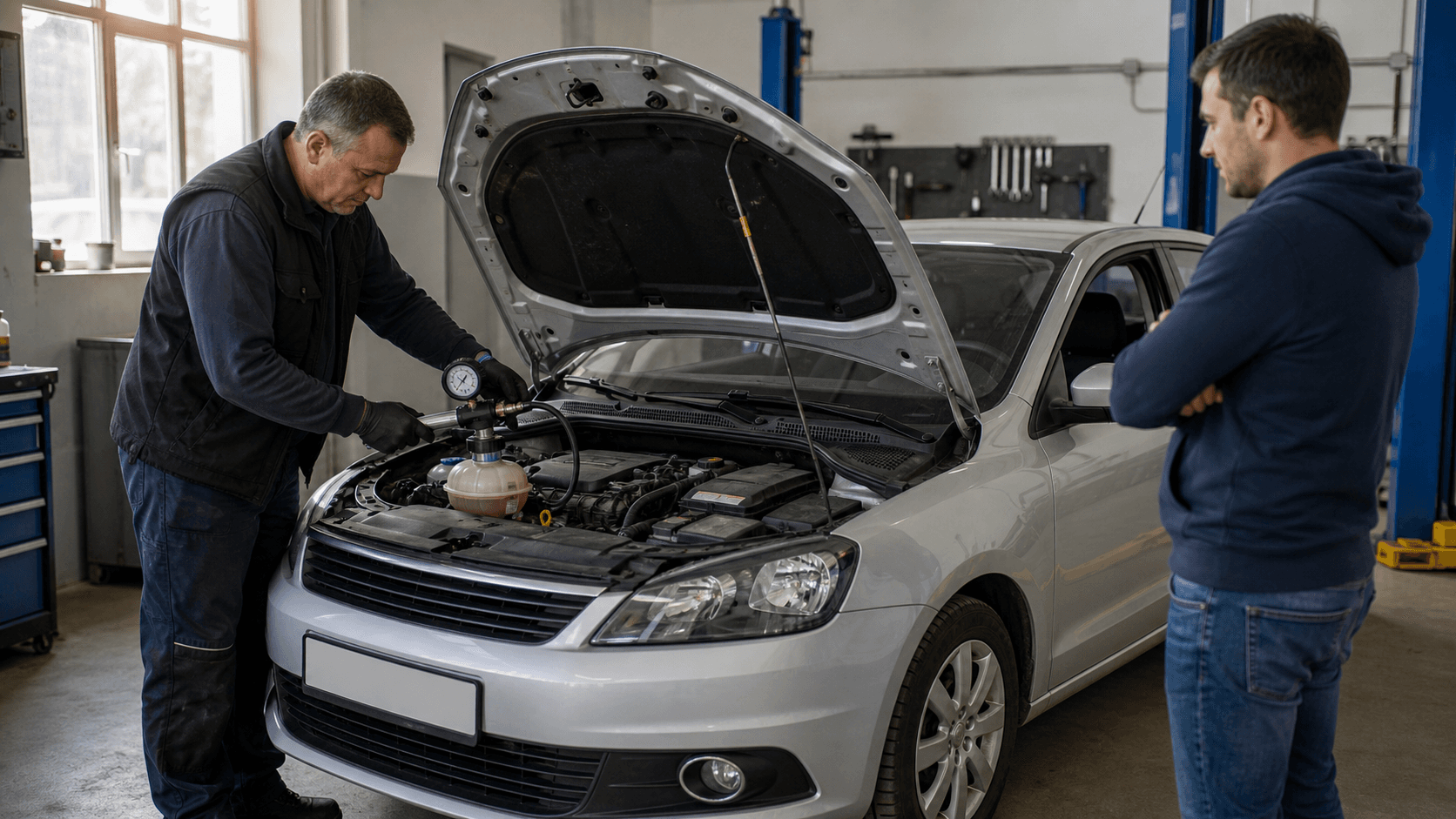
HELLA recommends the pump-and-gauge test: a pressure drop can indicate a leak, and a tracer can help with losses that are hard to see. The test value and duration are not chosen generically; pressurising above the manufacturer’s limit can cause other damage.
What not to do when coolant is dropping
- Do not open a hot tank, even if the level looks empty.
- Do not automatically pour cold water into an overheated engine.
- Do not mix products by colour; confirm the specification in the handbook.
- Do not exceed the MAX mark with the engine cold.
- Do not use sealant solutions as a diagnosis. Ford warns that “stop leak” additives can affect circuit passages, and HELLA shows that sealing materials can block the radiator and exchangers.
- Do not clear faults before the workshop saves the diagnostic report.
- Do not buy a pump, thermostat or head gasket only from a symptom described online.
- Do not continue driving if the temperature rises, steam appears or the engine runs abnormally.
Checklist for a used car that is losing coolant
- The level has been checked with the engine cold, on level ground.
- There are dated photographs of the level and mileage.
- The owner can say how much fluid was added and over what distance.
- The specification of the fluid used appears on an invoice or container.
- The tank and cap have no cracks or dry deposits.
- Hoses and fittings have no fluid traces.
- The radiator, thermostat housing and pump have been inspected.
- The undertray has been removed for inspection.
- The carpet is not wet and the windscreen has no suspicious film.
- The engine starts fully cold, without preparation before the visit.
- Temperature stays stable at idle and on the road test.
- Cabin heating works consistently.
- There are no persistent bubbles, abnormal smoke or a burnt-fluid smell.
- The oil and coolant have been checked for contamination.
- The circuit and cap have been pressure-tested.
- The workshop has checked for combustion gases if there is an internal suspicion.
- On a diesel, the EGR cooler has been checked if the engine procedure requires it.
- Invoices explain any recent pump, radiator or thermostat change.
- After repair, the circuit was filled and bled to the manufacturer’s method.
- The workshop report identifies the source, not only a recommendation to top up.
When buying, fold these points into the full engine check and the step-by-step car inspection. A top-up made before the viewing can temporarily hide the rate of loss.
Frequently asked questions
Is it normal for the coolant to drop a little?
The level changes between cold and hot, and after work it can fall when remaining air is purged. A repeated drop, measured in the same cold conditions, must be investigated. The car’s handbook takes priority for marks and procedure.
Can I drive if the level is below MIN?
There is no universally safe distance. If the temperature warning, steam, uneven running or a lack of cabin heat appears, stop the engine in a safe place. With the engine cold, follow the handbook instructions and ask for assistance if the loss is large or the cause is unknown.
Can I top up with a different colour of coolant?
Colour does not guarantee chemical compatibility. Use the product with the specification required by the manufacturer and respect the concentration or premixed variant indicated. If you do not know what is in the circuit, ask the workshop to identify and correct the mix.
Does white smoke automatically mean a head gasket?
No. Vapour can be normal when cold, especially in damp weather. Suspicion rises if dense smoke persists after warm-up and appears together with fluid loss, abnormal pressure, misfires or overheating. Diagnosis needs tests, not only watching the exhaust.
Why is there no puddle under the car?
A leak can appear only when hot, evaporate on the engine, be held by the undertray, reach the cabin or be internal. Removing the undertray and a pressure test are more relevant than dry tarmac.
Is a “stop leak” solution worth using?
Not as a diagnostic method or a permanent repair. Such products can block narrow passages and exchangers. If the handbook does not explicitly provide a product and procedure, locate the leak and repair the defective part or seal.
Technical sources
- Ford Owner's Manual — precautions when checking coolant
- Ford Focus Owner's Manual — compatible fluid, mixtures and sealing additives
- HELLA TechWorld — checking the cooling circuit and components
- HELLA TechWorld — bleeding, pressure test and leak tracer
- HELLA TechWorld — leak at the pump-thermostat module that appears when hot
- MAHLE Aftermarket — coolant loss and the effects of a defective head gasket
- Ford SSM 48543, published by NHTSA — internal leak at the EGR cooler on certain 3.2 diesel Transit models