Quick answer
A used driving-school car should not be rejected automatically, but it must be checked more carefully than a car used normally. The most stressed areas are the clutch, flywheel, manual gearbox, brakes, steering, suspension, pedals, driver’s seat, doors, mirrors and the electrical installation for dual controls. If the service history is complete, the price reflects the wear, and an independent inspection finds no problems, it can be an acceptable purchase. If the seller hides previous use or refuses an inspection, walk away.
Short checklist:
- ask for the service history and invoices, not just the mileage;
- check whether the car had dual controls and how they were removed;
- test the clutch cold, hot, on a slope and in high gears;
- watch for vibration, slipping, a hot smell and flywheel noises;
- check the brakes for vibration, worn discs, a soft pedal and seized calipers;
- listen to the steering and suspension over bumps;
- inspect the pedals, driver’s seat, steering wheel, gear lever and seat belts;
- ask for a diagnosis on all modules;
- budget for an initial service, clutch, brakes, tyres and possible bushes.
The simple rule: the “driving school” label does not matter as much as the actual condition of that car. But this kind of use produces a type of wear you have to look for on purpose.
Why these cars reach the used market
Driving schools replace cars periodically because pupils, instructors and exams need vehicles that work, behave predictably and are easy to maintain. Many are compact models, with small engines, reasonable consumption and available parts. For a buyer, that can sound good: the car was used in a known regime and, in theory, serviced often.
The less comfortable part is how it was worked. A school car starts often, spends a lot of time in town, idles, makes repeated pull-aways, frequent gear changes, frequent braking and parking manoeuvres with the steering loaded at low speed.
That is why you do not inspect it like a car that mostly did long journeys. The kilometres may be lower, but the duty cycles can be many.
How to tell it was used as a school car
Sometimes the listing says so directly. Sometimes the seller avoids the detail. Look for clues, but confirm with documents and questions.
Possible signs:
- traces of mounting for extra pedals on the passenger side;
- cut-outs, holes or covers in the floor area;
- marks on the centre console or under the dashboard;
- heavy pedal wear relative to the mileage;
- a very worn driver’s seat;
- a shiny steering wheel, gear knob and door handles;
- extra mirrors or accessories fitted previously;
- a company, sole-trader or auto-business history;
- frequent services at the same short intervals.
No single trace is decisive on its own. What matters is the combination and how the seller explains them.
The clutch is the first serious check
On a manual school car, the clutch works hard. Pupils may hold it down too long, pull away abruptly, stall often or slip the clutch on a slope. The instructor can correct, but the wear still adds up.
On the test drive, check:
- where the pedal bites;
- whether the car pulls away smoothly or shudders;
- whether the clutch slips in a high gear;
- whether a hot smell appears after light manoeuvres;
- whether the pedal is heavy or inconsistent;
- whether there is noise when you press the pedal;
- whether shifts become stiff when the car warms up.
A recently replaced clutch is not necessarily a minus, if there is an invoice and the parts are correct. Lack of history, by contrast, turns the clutch into a probable cost.
For a more detailed check, see also the guide on the used manual gearbox.
The manual gearbox and linkage
A school car makes many gear changes. That stresses the linkage, synchromesh, engine/gearbox mounts and control cables, depending on the model.
Test:
- first gear when cold;
- reverse;
- the 1-2 and 2-3 shifts;
- a quick change, without forcing;
- noises on deceleration;
- vibration in the lever;
- excessive play in the lever.
If gears go in with difficulty, do not accept “they all do that”. Compare with another example or ask for a workshop assessment.
Brakes can be more worn than the mileage suggests
In town, especially in instruction, the brakes are used often. Pupils brake late, suddenly or too hard, and the instructor may intervene through the extra pedal.
Check:
- discs with large lips;
- thin pads;
- vibration in the steering wheel under braking;
- a soft or long pedal;
- a car that pulls to one side;
- seized calipers;
- old brake fluid;
- a weak handbrake.
Brakes are consumables, but the cost must go into the negotiation. If there is vibration, a metallic noise or ABS/ESP warnings, inspection becomes mandatory. Also read the guide on brakes on a used car.
Steering and suspension, stressed by manoeuvres
Driving lessons often start with parking, turning, pull-aways and low-speed manoeuvres. That can wear bushes, track-rod ends, drop links, dampers, bearings and sometimes the steering column or rack.
On the move, watch for:
- knocks over bumps;
- a steering wheel that does not self-centre correctly;
- play in the steering;
- noises when you turn on the spot;
- unevenly worn tyres;
- a car that does not track straight;
- vibration at speed.
On the lift, ask for play to be checked. A recent geometry alignment does not repair worn parts; it can only hide a problem temporarily.
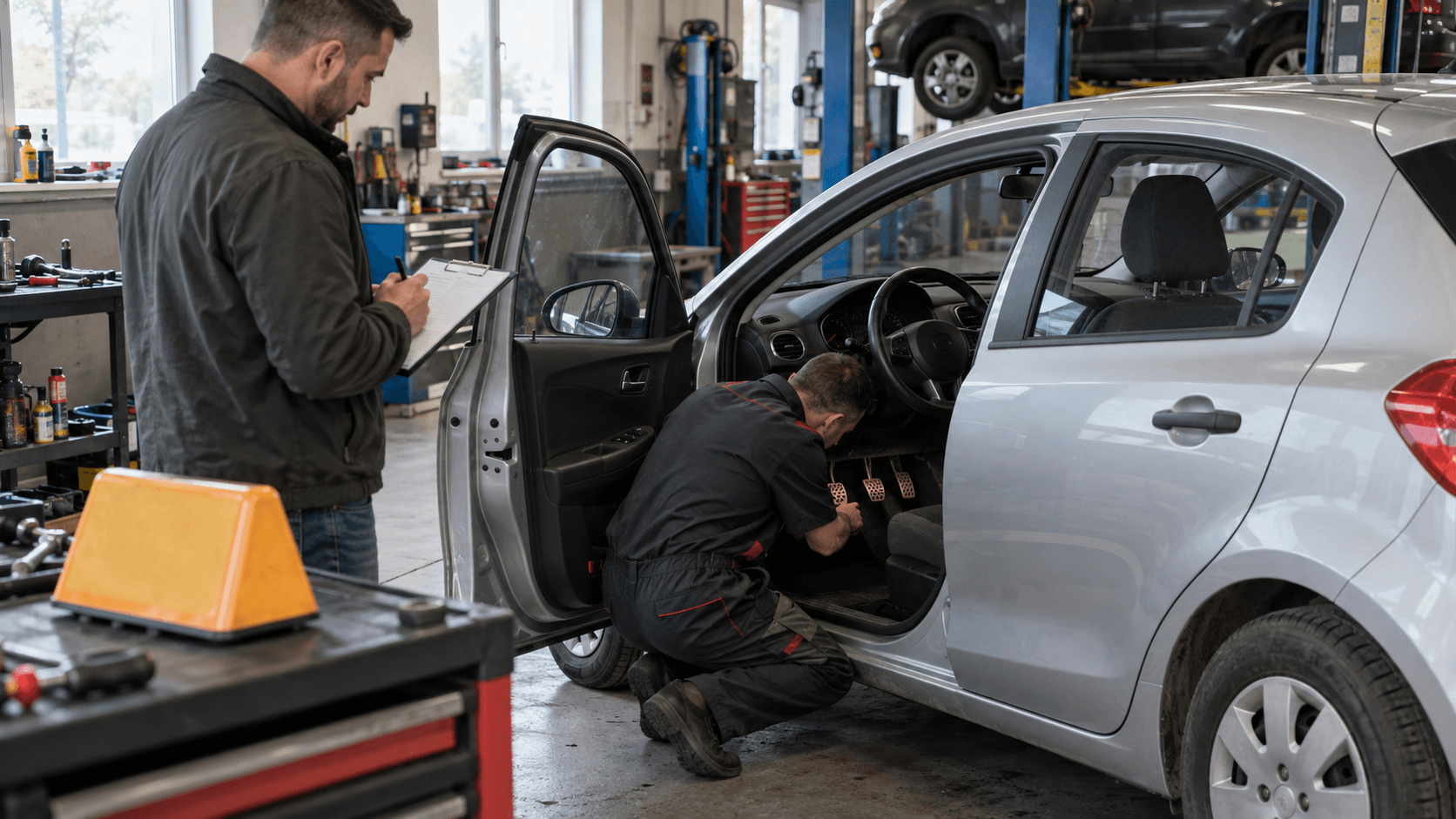
Pedals, seat, steering wheel and controls
The interior says a lot about the real number of users. A school car can have hundreds of pupils who have adjusted the seat, pressed the pedals, pulled the belt and used the gear lever.
Look at:
- the pedal rubbers;
- play in the clutch pedal;
- the driver’s seat and its adjustments;
- the driver’s seat belt;
- the steering wheel;
- the gear lever;
- the door handles;
- the window and mirror buttons;
- the headliner and sun visors.
Interior wear is not only cosmetic. It can confirm the duty cycle and help in negotiation.
Dual controls must be removed properly
A car used at a school usually has dual controls for the instructor. After it leaves service, the system must be removed correctly, without improvisation in the floor, pedals, wiring or trim.
Check:
- traces in the passenger area;
- extra mounting points;
- holes covered superficially;
- noises or play at the pedals;
- cables cut or poorly insulated;
- documents or invoices for fitting/removal.
If the work looks improvised, the problem is not only cosmetic. The pedal box, brake, clutch and electrical system must be safe.
The engine: frequent starts, idle and short trips
A school car is not necessarily used aggressively at high speed, but it can have many starts, stops, idling and short journeys. On diesel, that regime can be unfriendly to the DPF, EGR and AdBlue system. On petrol, check the timing, oil consumption, coils, spark plugs and cold running.
At the viewing:
- ask for a cold start;
- watch for smoke, shuddering and unstable idle;
- check the oil level;
- ask for the service history;
- run a diagnosis;
- check whether faults return after being cleared and a test drive.
Do not buy just because the engine is small and simple. A simple engine can be very good, but maintenance remains decisive.
Paperwork, owner and history
Identify the real seller and the ownership history. If the car belonged to a company, ask for invoices, service sheets and explanations of use.
Ask directly:
- was it a driving-school car?
- when was it taken out of service?
- who removed the dual controls?
- what parts were replaced in the last year?
- are there invoices for clutch, brakes, suspension?
- is the mileage supported by periodic inspections and service?
For VIN and history checks, also read the guide on checking the chassis number.
When it can be an acceptable choice
It may be worth it if:
- the price is fair relative to the wear;
- the service history is complete;
- the clutch and brakes are good or replaced with documentation;
- the dual controls were removed professionally;
- the diagnosis is clean;
- the body does not hide serious accidents;
- the seller accepts an independent inspection.
A possible advantage is that a professionally used car has, in many cases, had more predictable services than a private car with a missing history. But the advantage disappears if the documents are missing.
When it is better to walk away
Walk away if:
- the seller denies obvious school traces;
- the pedals or seat are very worn at low mileage;
- the clutch slips;
- the gearbox is hard to engage;
- the brakes vibrate or pull to one side;
- the steering has play;
- the dual controls were removed in an improvised way;
- there are no invoices;
- the car has multiple diagnostic faults;
- a workshop inspection is refused.
A cheap car can become expensive immediately if after purchase you replace clutch, flywheel, brakes, tyres and bushes.
Frequently asked questions
Is it a bad idea to buy a driving-school car?
Not automatically. It is a bad idea to buy it without a serious inspection. If the history is clear and the technical condition is good, it can be acceptable. If the use was hidden, the risk rises.
Which part wears out fastest?
Usually the clutch is the first suspicion on manuals. Brakes, tyres, bushes and the interior can also be more worn than on a car used on long journeys.
Does low mileage help?
It helps only if it is real and supported by documents. On a school car, the number of pull-aways, braking events, idle hours and manoeuvres can matter more than raw mileage.
Is it worth it if the clutch has been replaced?
Yes, if there is an invoice, the parts are suitable and the test confirms correct operation. A documented new clutch can be better than an original one that is tired.
Conclusion
A used driving-school car needs an inspection matched to its real working regime: clutch, gearbox, brakes, steering, suspension, pedals, interior and dual-control removal. If everything checks out and the price reflects the history, it can be a rational purchase. If there are hidden signs, vague explanations or a refused workshop visit, do not turn a low price into a large repair.