The short answer
A sunroof or panoramic roof can make a car brighter and more pleasant, but on a used example it needs a careful check. Before you buy, test opening and closing, listen for noises, inspect the rails, seals, drains, interior sunshade, headliner stains, dampness under the carpet and any electrical faults. A jammed roof or a water leak can turn an attractive extra into an expensive repair.
Short checklist:
- open and close the roof several times;
- test the tilt/vent position, if fitted;
- check the sunshade or roller blind;
- look for stains on the headliner, pillars and trim;
- lift the carpet in the low areas, especially at the front and in the boot;
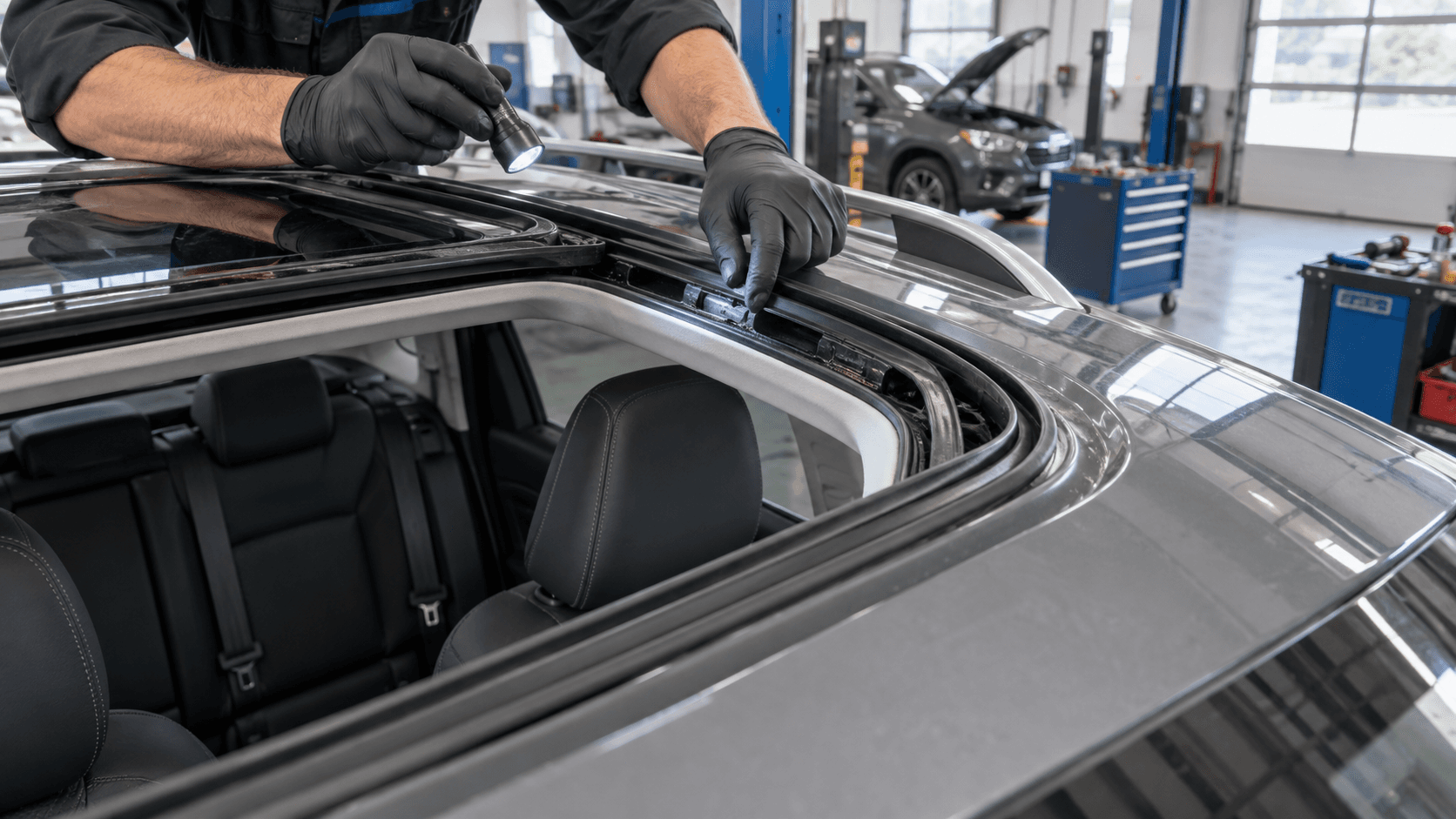
- look at the rails, seals and roof corners;
- listen for clicks, creaks or a strained motor;
- check for wind noise on the road;
- ask whether the drains have been cleaned;
- request a workshop inspection if you see dampness or electrical faults.
Simple rule: do not pay extra for a panoramic roof until you treat it as a complete technical system, not just a piece of glass.
Why this extra needs a separate check
Many buyers are pleased when an advert lists “panoramic sunroof”, “panoramic roof”, “sunroof” or “glass roof”. The feature looks good in photos, lights the cabin and can raise the car’s perceived value. The problem is that, on a used car, a panoramic roof has moving parts, seals, rails, drain channels, an electric motor, a sunshade and sealing areas that age.
The risks are not the same on every car. A fixed glass roof has different issues from a large sliding sunroof. A small sunroof can have blocked drains. A panoramic roof with an electric sunshade may work fine at the glass and still have a jammed blind. A car with a dry interior may only have wind noise, while another may hide water in the floor.
That is why the check should be done before negotiation, not after purchase.
Sunroof, fixed panoramic roof or sliding panoramic roof?
In adverts, the terms are sometimes mixed. Ask and check exactly what the car has.
You may find:
- a small glass or metal sunroof, with tilt and slide;
- a fixed panoramic roof, with no opening;
- a sliding panoramic roof, usually over a large area;
- a panoramic roof with a moving front section and a fixed rear section;
- a roof with electrochromic glass or adjustable opacity;
- a manual or electric sunshade.
The more complex the system, the more careful the inspection needs to be. Fixed glass may need a check for cracks and sealing. A sliding sunroof adds a mechanism, rails, motor and drains.
Test opening and closing
The first test is simple: use the roof as an ordinary owner would. Do not press once and move on.
Test:
- full opening;
- full closing;
- the vent position;
- one-touch, if fitted;
- anti-pinch auto-stop;
- the key fob command, if the car has it;
- the sunshade or roller blind;
- the response after restarting the car.
Movement should be smooth. If the roof stops, reverses on its own, squeaks, tracks to one side, needs a hand or sounds as if the motor is struggling, do not accept “it just needs lubrication” without inspection.
Listen to the mechanism, do not only look at the glass
A worn mechanism can be heard. With the car stopped, in a quiet place, listen while the roof moves.
Signs to watch:
- clicks;
- creaks;
- metallic squeaks;
- vibration;
- a motor that revs while the glass moves slowly;
- sudden stops;
- jerky movement;
- a different noise between opening and closing.
Sometimes dirty or dry rails can be fixed with proper maintenance. Other times the problem is cables, guides, sliders or the motor. A workshop decides that difference, not the seller in the car park.
Check the drains and the roof corners
Many sunroofs are not sealed like a welded panel. The system is designed to catch water that gets past the first seal and send it out through drain channels. If those channels clog with dust, leaves or deposits, water can reach the pillars, headliner, floor or boot.
Do not pour water aggressively at a viewing without the seller’s agreement. You can still check the signs:
- dirty corners at the sunroof frame;
- leaves or deposits in the rails;
- stains on the headliner near the pillars;
- discoloured interior pillars;
- a damp smell;
- dampness under the mats;
- a wet boot;
- windows that fog quickly.
If the seller says “a little water got in only once”, treat that as a problem to investigate, not a minor detail.
The seal does not have to look new, but it must work
Seals age. Sun, frost, frequent washes and lack of care can dry the material. A slightly aged seal is not automatically a disaster, but one that is torn, cut or stuck down as a DIY fix can point to trouble.
Look for:
- cracks;
- flattened areas;
- broken edges;
- traces of silicone applied unevenly;
- visible glue joints;
- differences between corners;
- glass that does not sit level with the roof;
- dried water marks on the inner frame.
Silicone applied in plain view is a bad sign. It can mean a quick attempt to stop a leak without repairing the cause.
Stains on the headliner, pillars and sun visors
The headliner trim says a lot. Look for yellow or brown stains, or darker patches around the sunroof, near the pillars and towards the windscreen or tailgate.
Check:
- the headliner above the driver and passenger;
- the interior light area;
- the sun visors;
- the A, B and C pillars;
- the area next to the grab handles;
- the rear corners;
- the tailgate edge, on estates and SUVs.
An isolated stain can have several explanations. Several stains, a damp smell and cold carpets point to a more serious problem.
Carpet and electrical modules: the part you do not see in photos
Water that enters through the sunroof does not always stay at the top. It can run down the pillars and reach the floor, under the seats, in the boot or in areas with electrical modules.
Lift the mats as far as you can and check:
- the driver’s floor;
- the passenger’s floor;
- behind the front seats;
- the sill areas;
- the spare-wheel well;
- the sides of the boot;
- visible connectors and wiring under the seats.
If you see dampness, corrosion or a strong smell, it is also worth reading the guide on the electrical system and 12 V battery on a used car. Water and electronics can create intermittent faults that a short test drive will miss.
The interior sunshade and a fixed glass roof
Do not ignore the sunshade. On some cars the electric blind is expensive to repair and awkward to remove. Test it fully, not just a few centimetres.
Watch whether:
- the sunshade runs crooked;
- the fabric has come loose;
- it jams halfway;
- the motor can be heard but the fabric does not move;
- there are creases, tears or stains;
- the switch responds slowly.
On a fixed panoramic roof, check for cracks, stone chips, wind noise, interior condensation and sealing. Even without an opening mechanism, replacing panoramic glass can be costly.
The road test: wind noise, creaks and stiffness
On the road, a problematic sunroof can make noises you will not hear in a car park.
On the test drive, watch for:
- whistling at national-road speeds;
- vibration over bumps;
- creaks in the body;
- glass or frame noise;
- changes in noise when you press lightly on the roof;
- rapid fogging after the air conditioning starts.
Do not force the car. You need a normal run, on uneven tarmac and at a legal speed high enough to notice aerodynamic noise.
Direct questions for the seller
Ask straight:
- Has water ever entered through the sunroof or roof?
- Have the drains been cleaned?
- Has the seal been replaced?
- Has the mechanism ever jammed?
- Has the interior headliner been removed?
- Has the glass been replaced?
- Is there an invoice for the work?
- Does the sunshade travel fully?
- Has the car spent a long time under trees?
- Will they accept a workshop inspection for leaks?
Vague answers do not condemn the car, but they justify the check. A comfort extra should not become a source of water in the cabin.
When you can negotiate and when it is better to walk away
You can negotiate if:
- the roof works but needs cleaning and maintenance;
- the sunshade has only minor cosmetic wear;
- the seal is aged but there is no water inside;
- the noise is slight and a workshop can identify the source;
- there are invoices and a clear history.
Walk away, or ask for a repair before payment, if:
- water is visibly coming in;
- the roof jams;
- the headliner has large stains;
- the carpet is wet;
- electrical faults appear;
- the seals have been stuck with silicone;
- the seller refuses an inspection;
- the repair cost is unclear.
A panoramic roof repaired properly can be acceptable. A hidden leak, combined with damaged electronics, can become a much larger problem than the extra itself.
What a workshop checks
A proper inspection can include:
- sunroof mechanism test;
- drain cleaning and inspection;
- seal check;
- stain and dampness inspection;
- carpet and boot check;
- diagnosis of affected modules;
- body noise check;
- a quote for parts and labour.
Ask for a written quote before you decide. On some models, repairing a panoramic sunroof means a lot of labour, removal of the interior headliner and parts that are not cheap.
Frequently asked questions
Is it worth buying a used car with a sunroof?
Yes, if the system works correctly, there are no leaks, the drains are clean and any repair cost is accepted. Do not buy for the extra alone.
Are blocked drains a serious problem?
They can be minor if they are cleaned in time. They become serious if water has already reached the headliner, floor, boot or electrical modules.
Can I test the sunroof with water at a viewing?
Only with the seller’s agreement and without high pressure. It is safer to check existing traces and ask for a workshop inspection.
Does a fixed panoramic roof have the same risks?
It has fewer moving parts, but it can still have cracks, sealing issues, wind noise, condensation or a high replacement cost.
If the sunroof does not work, can I negotiate the price?
You can negotiate only after a quote. An apparently simple problem can mean a motor, rails, cables, a module, a sunshade or removal of the interior headliner.