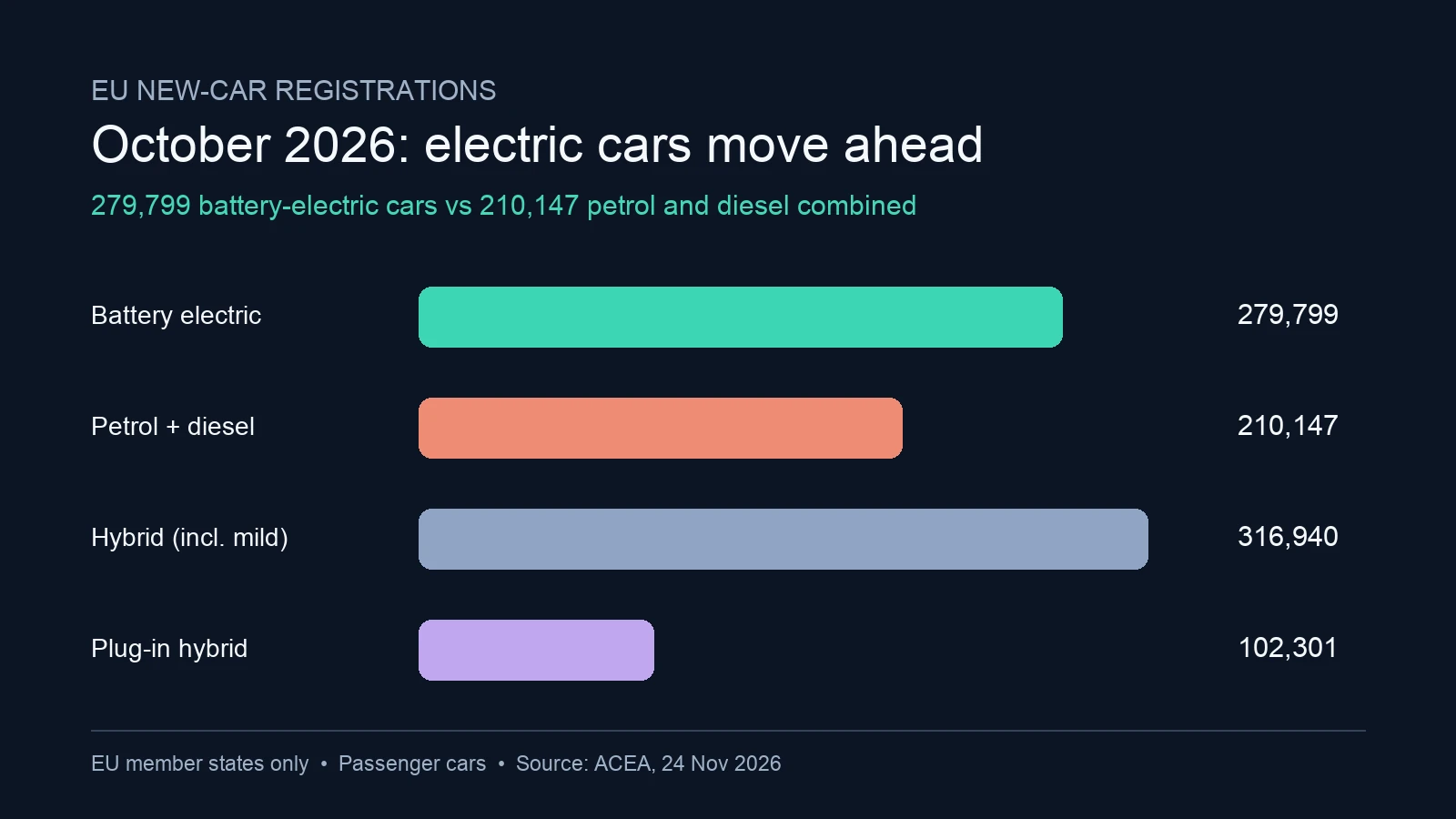
The EU registered 279,799 new battery-electric passenger cars in October 2026, against 158,970 petrol and 51,177 diesel cars. Petrol and diesel together accounted for 210,147 registrations, leaving battery-electric cars ahead by 69,652. These are October figures for the EU's member states in the European Automobile Manufacturers' Association (ACEA) table, published on 24 November. They do not include the UK, Norway or the rest of the year.
A reversal driven by both sides of the comparison
In October 2025, the EU recorded 173,309 battery-electric cars, 226,323 petrol cars and 73,845 diesels. The two conventional categories then exceeded electric cars by 126,859. Twelve months later, electric registrations had grown 61.4%, while petrol fell 29.8% and diesel 30.7%. The new lead is therefore not simply a function of more electric cars entering the market; the two categories used as the comparison have shrunk substantially.
The whole EU new-car market registered 939,447 passenger cars in October, up 2.6% year on year. Battery-electric cars represented about 29.8% of that monthly total. Petrol and diesel combined accounted for about 22.4%. ACEA's prominent 23.4% battery-electric share refers to January through October, rather than October alone. Mixing those two time windows produces a misleading account of what changed in the latest month.
Hybrid-electric vehicles remained the largest single ACEA powertrain category in October at 316,940 registrations. The association includes full and mild hybrids in that group. Plug-in hybrids are a separate category with 102,301 registrations. Many of these vehicles still have a combustion engine. The comparison in the headline concerns battery-electric cars versus the specific petrol and diesel classifications, not every new car capable of burning fuel.
Germany and France account for much of the increase
Germany registered 94,086 battery-electric cars in October, up from 52,425 in the same month of 2025. France increased from 34,108 to 61,958. Their combined gain was 69,511 registrations. The EU-wide battery-electric gain was 106,490, so these two markets supplied roughly 65% of the increase. That proportion is calculated from ACEA's country rows; it is not a claim that German and French markets grew at the same rate.
Battery-electric cars made up about 37% of Germany's 254,492 October registrations and roughly 41.5% of France's 149,338. France also registered fewer full and mild hybrids, 55,355, than battery-electric cars that month. Elsewhere the relationship was different. Italy counted 7,768 battery-electric cars but 23,674 petrol cars; Poland had 3,443 electric registrations and 15,325 petrol. One EU aggregate can therefore hide very different local mixes.
Denmark illustrates the other extreme: 16,679 battery-electric cars out of 18,875 new passenger cars in October. Such a result should not be projected onto buyers across the EU. ACEA identifies demand-support measures and a broader selection of models as factors in electrified growth, but its table by itself does not isolate the effect of each policy or model in each country.
Romania crossed petrol by just seven cars
Romania registered 1,495 battery-electric cars in October 2026, up 46.7% from 1,019 a year earlier. Petrol registrations fell to 1,488, seven fewer than electric. Add the 529 diesels, however, and conventional petrol plus diesel stood at 2,017, still above battery-electric cars. The EU-wide headline result does not hold for that Romanian comparison.
The dominant Romanian category was full and mild hybrid, at 6,635 registrations. Total new passenger-car registrations were 12,116, down 5.6% year on year. Battery-electric cars therefore represented about 12.3% of the monthly Romanian market, far below the roughly 29.8% EU share. A nearly 47% annual increase can coexist with a relatively small market share when the starting volume is limited.
Registrations measure vehicles newly placed on the road. They do not include the existing fleet, used-car transactions, orders awaiting delivery or cars that may never have been bought. The seven-car difference between electric and petrol in Romania is an observed monthly count, not evidence that every individual shopper suddenly prefers an electric vehicle. It also says nothing by itself about prices, charging access or the cost of ownership.
The first ten months have a different leader
For January to October 2026, ACEA recorded 2,211,071 battery-electric EU cars, a 23.4% share of the 9,455,704 total. Petrol counted 1,962,607 and diesel 652,364, or 2,614,971 combined. On this cumulative measure, petrol and diesel together still lead battery-electric vehicles. Full and mild hybrids were larger again at 3,407,062, equal to 36% of all registrations.
Plug-in hybrids accounted for another 961,959 registrations, or 10.2% of the ten-month total. Their inclusion with battery-electric cars would answer a different question from the one addressed here. EU registrations across all powertrains were 5.4% higher than in the same ten months of 2025, but growth and the powertrain mix differed substantially by market.
The precise finding is that battery-electric cars overtook the combined petrol and diesel categories in the EU for October. Hybrids still led the monthly mix, and the cumulative petrol-diesel total remained ahead of battery-electric cars. Romania's narrower result also shows why an EU total should be accompanied by national detail. Later monthly releases will show whether October's margin persists.