A Nissan off-road passenger vehicle associated with the new Terrano has appeared in China's latest public vehicle filing. The Ministry of Industry and Information Technology, or MIIT, lists Zhengzhou Nissan as its manufacturer and identifies the submitted vehicle as a plug-in hybrid. The entry supplies unusually detailed measurements ahead of a full commercial announcement, but it sits in a public consultation for proposed new products. It is not, by itself, evidence that a European launch or final approval has been secured.
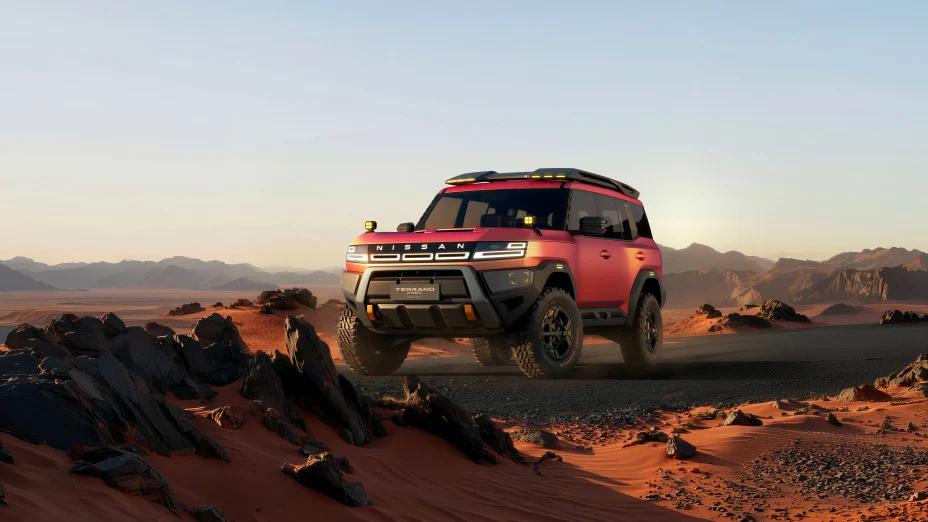
Nissan introduced the Terrano PHEV Concept at Auto China in Beijing on 24 April 2026. Its own announcement said the production model was scheduled to be unveiled within a year. The official photograph used here shows that April concept. The filing includes pictures of a vehicle submitted for Chinese approval; the two sets of images should not be treated as interchangeable depictions of the final specification.
What the government record identifies
The MIIT detail page names the applicant as Zhengzhou Nissan Automobile and gives the model code ZN2030WBFPHEVC. It classifies the vehicle as a plug-in hybrid off-road passenger car, with five approved seats. A 1,992 cc petrol engine is rated at 152 kW in one field, while a separate note states 150 kW net engine output. The electric drive motor is listed at 57 kW rated and 200 kW peak. Those numbers refer to different test descriptions and components; MIIT does not supply a combined system output. Adding the petrol and electric peaks would create a figure the authority has not certified.
The energy storage system is identified as a lithium iron phosphate battery. External charging is explicitly permitted in the filing. Neither battery capacity nor an electric-only driving range appears on the public detail page. It also provides no charge-time figure. Consequently, the record cannot yet answer the question a prospective plug-in hybrid owner would ask first: how much of a typical journey the Terrano could complete on electricity.
MIIT records a top speed of 180 km/h. That is a declared maximum for the submitted configuration, not a road-test result and not a substitute for acceleration, energy-use or long-distance range data. Nissan has yet to publish a full production specification alongside a market-by-market price list. Figures on equipment and consumption should therefore wait for that material rather than be inferred from the vehicle's size or drivetrain label.
Dimensions and off-road geometry
The recorded length is 5,098 mm, width 1,980 mm and height 1,960 mm. Wheelbase is 2,850 mm. These dimensions describe a substantial five-seat SUV, although they do not tell us how much usable passenger or luggage space its cabin provides. A long exterior does not establish boot volume, seat comfort or visibility without further measurements. Likewise, the filing does not establish which exterior fittings would be standard in each country.
The stated approach and departure angles are 36 and 31 degrees respectively. Tyres are specified as 265/65 R18. These are relevant numbers for a vehicle intended to travel beyond sealed roads, but they cannot establish its real terrain ability in isolation. Ground clearance, breakover angle, tyre choice, traction control calibration and the exact four-wheel-drive hardware would all matter. The public page does not contain an independent off-road test, so describing a particular obstacle the Terrano can clear would go beyond the evidence.
Kerb weight for this submitted variant is 2,800 kg, and the listed maximum permitted vehicle mass is 3,315 kg. The simple difference is 515 kg. Interpreting that as a usable payload for a particular family requires care: the treatment of passengers, accessories and optional equipment depends on the market's documentation. Nissan has not published a European certificate for this model. Any eventual local version could also carry a different standard-equipment package and mass.
The Chinese record lists 2,500 kg as permissible trailer mass and mentions an optional towing device. It also specifies conditions for the trailer connection. That makes the number more informative than an unqualified headline towing claim, yet it does not mean every Terrano will be rated for 2,500 kg in every market. A buyer would need the actual vehicle plate and local registration documents, plus the permitted trailer and licence combination, before using the rating.
Where this sits in Nissan's plans
MIIT's notice identifies this as batch 414 of proposed new vehicles. Its consultation period runs from 26 November to 2 December 2026. Public exhibition of the application is a formal step in the Chinese process, but the notice does not announce retail deliveries. A future Nissan launch can confirm the production name, variant range and timing; the filing alone cannot do that work.
Nissan's Beijing press release described a production Terrano intended for selected global markets. It did not name the UK or any European country. An investor presentation subsequently said Nissan was exploring plans to export the production version of the Terrano Concept. That wording leaves the destination and decision open. Claims that the SUV is confirmed for British dealers, or that it is already a Toyota Land Cruiser rival on sale in Europe, would turn a possible positioning into an announced product plan.
There is a practical distinction for European readers. A Chinese filing establishes that a manufacturer has submitted technical data for a Chinese-market vehicle. It does not provide a European type approval, a UK or EU price, warranty arrangements, servicing network or order date. Even if Nissan later chooses to export the Terrano, its powertrain, towing rating and equipment would need to be checked against the specification released for that destination. For now, the confirmed story is a sizeable plug-in hybrid Nissan on the Chinese approval path, with a global ambition that still lacks named European markets.
Image credit: Nissan Motor Co. official Nissan Global Newsroom press photograph of the April 2026 Terrano PHEV Concept.