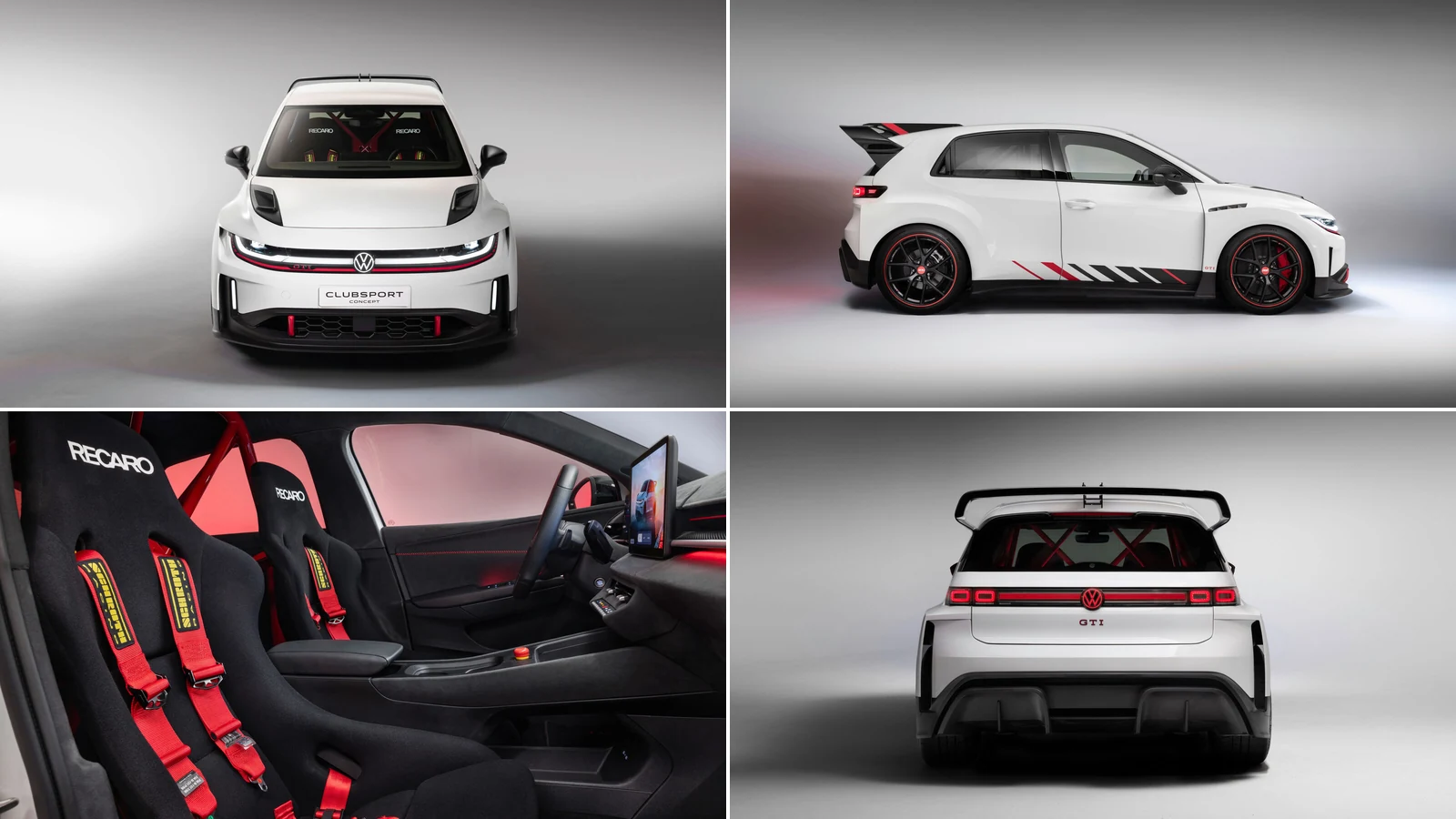
Volkswagen has revealed the ID. Polo GTI Clubsport Concept, a two-seat electric track car producing 270 kW (367 PS) and 550 Nm through its front wheels. The company claims 0–100 km/h in 4.7 seconds and a 240 km/h top speed. It will make its public debut at the Essen Motor Show from 27 November to 6 December 2026, but Volkswagen calls it a one-off concept. There is no announced price, production run or sales date.
The big engineering change sits over the front axle
The road-going ID. Polo GTI uses an APP290 motor rated at 166 kW and 290 Nm. The Clubsport Concept substitutes the much larger APP550 unit, adding 104 kW and lifting maximum torque to 550 Nm. That motor normally drives the rear axle of larger Volkswagen Group EVs, including the ID.7 and ID. Tiguan. Here it has been turned into a front-drive installation and paired with an electronically controlled multi-plate differential lock.
Volkswagen says packaging the APP550 required far more than new mounts. The point where power exits the motor and reduction gear sits 5 mm farther rearward and 55.5 mm higher than with the APP290. Engineers redesigned the subframe, longitudinal members, anti-roll bar, powertrain mounts and several suspension interfaces. The high-voltage charger, air-conditioning compressor, thermal-management module and water pump moved, while the coolant, refrigerant and electrical connections had to be rerouted.
Launch Control manages the standing start, while the front differential varies its locking force and produces a torque-vectoring effect in corners. Volkswagen has not disclosed tyre dimensions, kerb weight or lap times. Those missing figures make it impossible to judge how effectively a small front-driven chassis can deploy 550 Nm beyond the quoted straight-line acceleration.
A production-sized battery with a wider operating window
The concept retains the production GTI's 52 kWh net nickel-manganese-cobalt battery. It uses Volkswagen Group's unified cells in a cell-to-pack arrangement and accepts up to 105 kW at a DC charger. Volkswagen provides no range, consumption or 10–80 per cent charging time for the track car, so figures published for the road model should not be applied to this configuration.
Hardware and software changes allow the pack to supply as much as 290 kW for short periods. Volkswagen opened the usable state-of-charge window beyond the production limits intended to protect the battery. The company also recalibrated the control system for sustained high motor speeds and added a higher-capacity heat exchanger. The wording matters: this is short-duration output supported by more aggressive thermal management, not evidence that the standard 52 kWh pack can continuously deliver the same performance without trade-offs.
The 105 kW charging ceiling is modest beside the motor's output, but the car is conceived around track sessions separated by charging stops. Volkswagen has not said how many full-power laps it can complete, how quickly output reduces as temperature rises, or how much energy remains protected outside the expanded usable window.
Familiar suspension architecture, competition-focused calibration
Underneath, the Clubsport shares the production model's MacPherson front suspension and torsion-beam rear axle. It sits 15 mm lower than the ID. Polo GTI and 30 mm below a regular ID. Polo. Wider tracks and larger wheel-and-tyre assemblies required new camber settings, wheel housings, wings and suspension turrets. Steering angle is restricted to make room for the new front hardware.
Adaptive DCC damping remains, but every relevant calibration is aimed at circuit use. The control system calculates damping demand at each wheel and adjusts the shock absorbers within fractions of a second. Volkswagen also changed the electronic differential's parameters. Unlike a fixed mechanical lock, its multi-plate clutch can alter the locking degree, seeking traction without introducing the same steering penalties.
A one-box braking system with ceramic discs replaces ordinary road-car hardware. Volkswagen does not provide disc sizes, stopping distances or brake temperatures, and no independent test has been performed. The presence of ceramics therefore identifies the intended duty cycle rather than proving a measured advantage.
Two doors, two seats and a body 100 mm wider
Each wheelarch extends by 50 mm, making the body 100 mm wider overall. The extra width is not simply cosmetic: the reshaped rear wings prevent conventional rear doors from opening. Volkswagen therefore turned the five-door road car into a two-door concept. The rear seats and luggage area have been removed, leaving a Tornado Red protective bar behind the occupants.
The front splitter, flow-through front wings, widened sills, large rear diffuser and roof-height wing are presented as functional aero devices. The central roof section and wing use carbon to save mass. Black 19-inch BBS wheels fill the enlarged arches. Volkswagen says the parts increase downforce but publishes neither a downforce figure nor a drag coefficient, so the aerodynamic claim cannot yet be quantified.
Inside are two Recaro racing buckets and red five-point harnesses. Dark, non-reflective ArtVelours microfleece covers the dashboard and several trim panels, with red stitching and a Clubsport badge. Volkswagen's vocational trainees worked with engineers and designers to execute these surfaces. The rear compartment is stripped, and the cabin is described as focused on driving rather than everyday convenience.
The official briefing says the concept dispenses with an infotainment system. Press photographs nevertheless show a central screen used for vehicle functions and settings; Volkswagen does not describe it as a normal entertainment interface. That distinction is consistent with a demonstration car built around circuit operation rather than production usability.
What this concept does — and does not — confirm
Volkswagen notes that concept development can leave a theoretical route to a production derivative. It does not say that such a derivative has been approved. A showroom Clubsport could adopt selected elements while losing the two-door body, ceramic brakes or extreme aero package. Its power, battery management and price would require separate confirmation.
For buyers, the relevant production car remains the 166 kW ID. Polo GTI. The concept demonstrates that Volkswagen can package the APP550 at the front of MEB+ and control much more torque in a small hatchback. It does not provide homologated range, an order book or a delivery schedule. Treating its 367 PS specification as an imminent road-car offer would go beyond Volkswagen's announcement.