
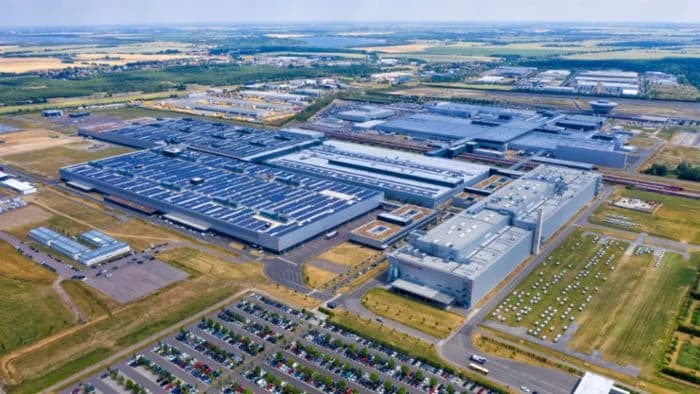
Audi is reportedly considering building the next-generation A8 at Porsche’s factory in Leipzig instead of continuing production at Neckarsulm. The possibility was reported by German media and picked up by Automotive News, but Audi and Porsche have not formally confirmed a production decision. There is therefore no confirmed launch date, powertrain plan or final assembly schedule for the next luxury saloon.
What is confirmed and what is not
Audi’s own information still lists the A8 among the models produced at Neckarsulm. The site currently builds the A5, A6, A8 and e-tron GT, and Audi has invested in dedicated halls for the current A8 generation. Neckarsulm remains the company’s German location for high-end and lower-volume production.
The new report points to an internal assessment of moving the successor to Leipzig, a plant operated by Porsche. Such a move would separate the next A8 from the location that builds the current car, but it would not by itself mean that Neckarsulm is closing. Audi has discussed the future product mix at the site, while its works council has asked for clearer commitments regarding an A8 successor and another electric volume model.
The distinction between a report and a company decision matters for employees, suppliers and customers. A plant transfer requires capacity planning, body-shop tooling, logistics, quality processes, training and agreements with workforce representatives. None of those details has been published for a possible A8 programme.
Why Leipzig is being considered
Porsche has expanded Leipzig to build vehicles with different powertrains on a flexible production system. The company says the factory can produce petrol, hybrid and fully electric cars. Its expansion for the second-generation electric Macan involved an investment of about €600 million, a new body shop, paint-shop work and changes to the final assembly process.
The plant began ramping up production of the electric Macan in 2024. Porsche identifies Macan, electric Macan and Panamera operations at Leipzig, including three body shops. More than 4,600 people work at the site, which also produces axle components for the Macan and Panamera.
That industrial flexibility could make Leipzig relevant to a future Audi flagship if the car shares manufacturing concepts or group architecture with the Panamera. It does not prove that an A8 has been allocated to the plant. The body structure, battery systems, electric motors, software, supplier network and quality requirements would still need a separate industrial decision.
Audi, Porsche and shared technology
Audi and Porsche developed the Premium Platform Electric architecture, known as PPE. Porsche uses it for the electric Macan, while Audi uses it for vehicles such as the Q6 e-tron. A shared platform does not mean shared dimensions, batteries, suspension calibration or software. It provides a technical basis; each brand retains responsibility for its vehicle design, driving character and production details.
German reports have linked the possible A8 move with the Panamera and Leipzig. The name of the future platform, the available powertrains and the existence of a battery-electric A8 have not been confirmed. Audi has described a broader electrification strategy, but a general strategy statement cannot confirm a specific model or factory assignment.
If the A8 were built at Leipzig, it could share industrial processes, suppliers or body-shop expertise with Porsche without becoming a rebadged Panamera. Audi and Porsche would still need different interiors, software interfaces, suspension tuning, quality standards and customer-order processes. Even common components would not establish that the two cars are mechanically identical.
The implications for Neckarsulm
Neckarsulm remains the official A8 production location in Audi’s available 2026 documents. The company has described investment in A8 production halls and continues to build several other model families there. If a successor moved to Leipzig, Neckarsulm would need a different product mix or another long-term role, but no public decision has assigned those products.
The site also produces the A5 and A6 families and the e-tron GT. Any reorganisation would have to account for their volumes, current tooling and existing investments. It would also have to consider how much of the workforce could move between programmes and which operations depend on local suppliers.
For employees, the difference between an industry report and a negotiated programme is substantial. A production transfer can affect shifts, training, logistics and supplier contracts, but the available information does not support a numerical estimate of job losses or gains. Those effects should not be presented as confirmed until Audi and Porsche publish a formal plan.
What to watch next
The next relevant announcements would clarify whether Leipzig has actually been selected, which A8 generation is concerned and whether the car will use a battery-electric, hybrid or mixed-powertrain strategy. The timing of the current A8’s end, the required investment and the capacity balance with Macan and Panamera would also be important.
For now, the careful conclusion is that Volkswagen Group is reportedly assessing a Leipzig production scenario for the next Audi A8. Audi has not confirmed that the car will be built there, and there is no evidence that current A8 production has already moved away from Neckarsulm.
The image shows the Porsche Leipzig factory and comes from Porsche Newsroom. It was converted locally to WebP for publication; image rights remain with Porsche.


