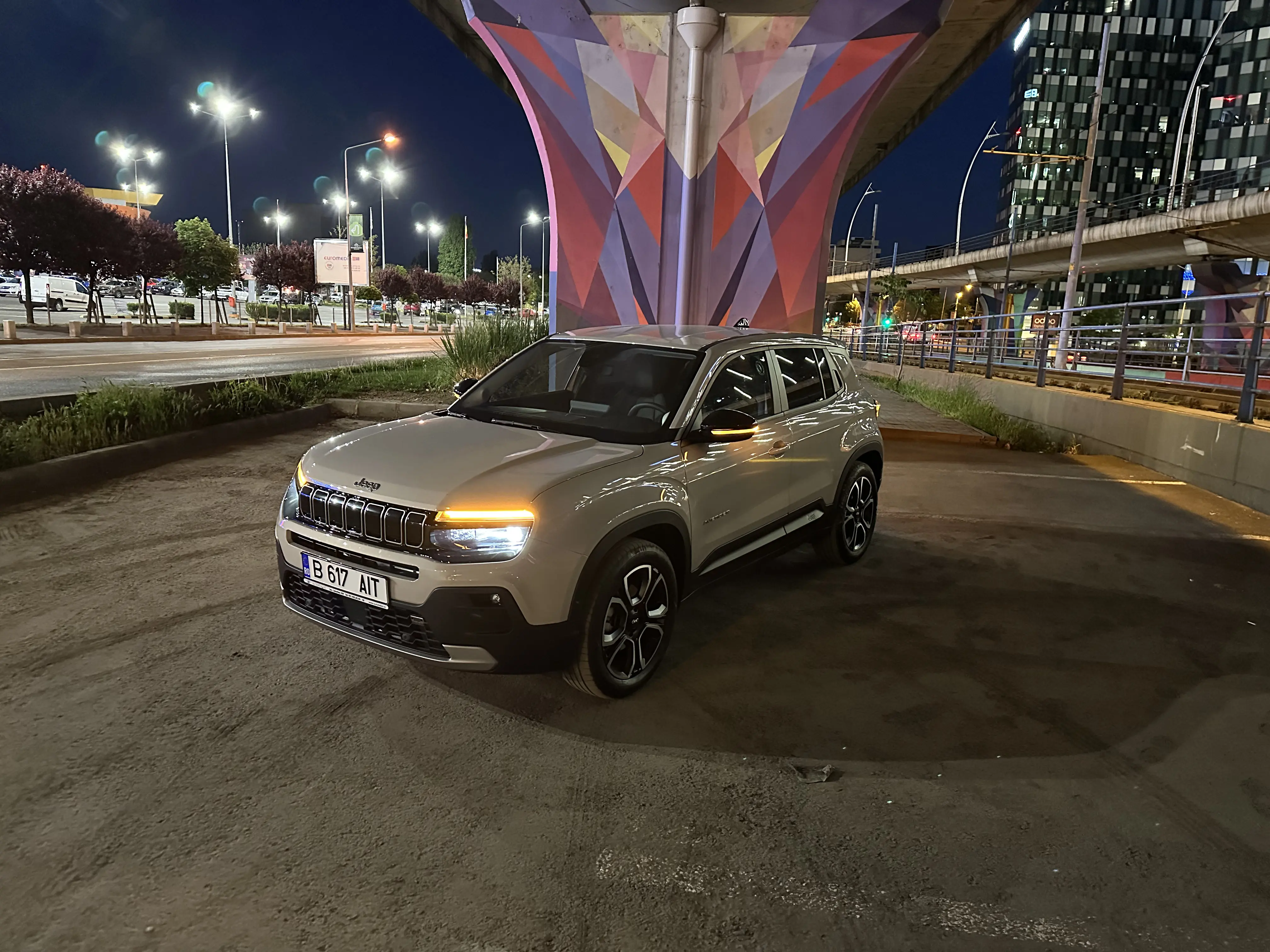
Jeep Avenger has passed 300,000 orders since its 2023 launch, according to a Jeep and Stellantis announcement dated 20 October 2026. The manufacturer also says electrified versions account for about 60% of total sales. The figure refers to orders reported by the brand; it is not presented as a count of vehicles delivered or registered.
A compact Jeep with a broad European brief
Avenger is the smallest vehicle in the Jeep range. It was designed and manufactured in Europe and is sold in more than 70 markets worldwide. Jeep describes it as a leader in the B-SUV segment across the main European countries. The company also says that, in Italy, Avenger is the best-selling SUV and ranks second across all segments and powertrains. The press release does not provide the period or a country-by-country table behind those rankings, so they should be read as manufacturer-reported market claims rather than as a complete independent European league table.
The 300,000-order milestone arrives less than four years after the model’s commercial launch. Jeep compares it with the 610,000 units accumulated by Renegade over its entire lifecycle, using what it describes as the same perimeter. That comparison has an important qualification: one number covers Avenger’s orders since launch, while the other covers Renegade’s whole career. It is therefore an internal reference point, not a forecast that Avenger will necessarily reach the same total.
Electrification without a single powertrain
The roughly 60% electrified share does not mean that 60% of Avenger customers chose the battery-electric version. In the announcement, Jeep does not split the figure between the BEV, e-Hybrid and 4xe versions. That distinction matters because the current range is deliberately multi-energy.
The offer includes a petrol model, a 48-volt e-Hybrid, a front-wheel-drive battery-electric version and the all-wheel-drive 4xe. The petrol car uses a manual gearbox, while the e-Hybrid uses a six-speed dual-clutch automatic. The electric version has a single-speed reduction gear. The 4xe combines a combustion engine with electric motors and an electrified dual-clutch transmission to drive both axles. Exact combinations and trim levels vary by market.
For a buyer, the model is therefore less a single technical proposition than a compact body available with different ownership compromises. The BEV can suit a driver with reliable access to charging and a mainly urban routine. The e-Hybrid keeps the convenience of liquid fuel while adding limited electric assistance and low-speed electric operation. Petrol remains the simplest choice for a customer who does not want a hybrid system. The 4xe is the option for all-wheel drive and more demanding surfaces. None of these statements changes the official sales figure: Jeep has not published a complete mix by powertrain.
What the 2026 update changes
Jeep says the Avenger was refreshed in May 2026. The update includes revised styling, Matrix LED headlights, a front camera that creates a 360-degree view, a new Selec-Terrain mode selector and revised interior materials. Two nature-inspired colours, Bamboo and Forest, are also listed among the changes that received positive customer feedback, although the manufacturer does not give a measured order count for those colours.
The 360-degree view is a driver-assistance display, not autonomous driving. It can help with parking and with placing the car on uneven ground, but the driver remains responsible for the manoeuvre. Jeep also refers to a Level 2 advanced driver-assistance suite. At SAE Level 2, the vehicle may assist with steering, acceleration and braking in defined situations, while the driver must continue to monitor the road and the system.
The standard Avenger is offered in Longitude, Altitude and Summit trims, plus an 85th Anniversary special edition. The 4xe is listed with Upland, Overland and 85th Anniversary versions. A European press release cannot establish which of these combinations is currently available in every local showroom, including Romania.
Electric range and off-road equipment
The original European electric Avenger was introduced with a claimed range of up to 400 km under WLTP and up to 550 km in urban driving. Those are manufacturer and test-cycle figures. They are not a promise of the same distance at motorway speed, in cold weather or with a fully loaded vehicle. The original electric model used a 400-volt powertrain and a 115 kW motor, according to Jeep’s launch material.
The compact dimensions help explain the car’s urban positioning. Jeep says Avenger is just over four metres long and uses short overhangs, protective cladding and ground clearance to preserve some off-road ability. The Selec-Terrain system is available even on front-wheel-drive versions and changes power delivery and traction-control calibration according to the selected terrain and weather mode.
For the 4xe, Jeep quotes 145 hp and maximum gradients of 40% on gravel and 20% when the front axle has no grip. Those figures describe a capability claim made under the manufacturer’s test conditions. Tyres, surface, slope length and driver input remain decisive in real use.
What the milestone does not tell us
The announcement does not state how many of the 300,000 orders have already become deliveries, how many were cancelled, or how the total is divided between Europe and other markets. It also does not disclose a complete country breakdown. The distinction between orders, registrations and deliveries should remain explicit when comparing this figure with public sales data.
The available information nevertheless gives a clear outline of Avenger’s commercial strategy. Jeep launched a small European-designed SUV, then expanded its appeal through petrol, mild-hybrid, battery-electric and four-wheel-drive versions. The reported electrified share indicates that the model’s result is not dependent on a single type of propulsion.
The next useful data point for Romanian buyers will be local availability: prices, equipment, delivery times and eligible powertrains are market-specific. For now, 300,000 is a brand-reported order milestone for a model sold across a broad international footprint, not a Romanian registration statistic.