The short answer
A used Nissan Juke is worth considering in 2026 if you want a small crossover that is easy to park, looks different from the usual urban SUVs and has a large supply on the Romanian market. Do not buy it for the looks alone. On the Juke, generation, engine, gearbox, history, real-world visibility, rear space and how the car was used in town matter far more.
Short checklist:
- identify the exact generation, engine, gearbox and equipment from the VIN;
- separate the first generation from the model launched in 2019 and from later facelifts;
- on the 1.0 DIG-T, check cold starting, idle, leaks, the turbocharger, oil consumption and servicing;
- on the DCT, test pull-away, slow stop-start traffic, a slope and parking manoeuvres;
- on Hybrid, check the traction battery, the switch between electric and petrol, regenerative braking and diagnostic faults;
- do not assume an SUV shape means plenty of space: try the rear bench, the boot and the view out;
- check the headlights, camera, sensors, assistance functions and calibration after any front-end damage;
- compare the price with similar cars by year, mileage, history and equipment, not with the cheapest advert.
Practical rule: the Juke is a good choice when you want a city car with character and you find a checkable example. It becomes risky when you pay a lot for the design while the history, gearbox, damage or real space remain unclear.
Why the Nissan Juke needs its own guide
The Carboratory archive already has dedicated guides for many small and compact SUVs: Renault Captur, Volkswagen T-Cross, Kia Stonic, Suzuki Vitara, Hyundai i30, Skoda Karoq, SEAT Ateca and other models of interest. The Nissan Juke appeared in comparisons and general pieces, but it did not have a dedicated guide for a buyer searching specifically for a “used Nissan Juke”.
Demand is there. When this article was researched, the CautiMasina page for the Nissan Juke showed 2,895 available results in the aggregated filter. A large supply can help, but it mixes very different cars: first generation, second generation, turbo petrol, older diesel, DCT, manual, hybrid, Romanian cars and imports.
That is the main risk: two Jukes with similar prices can have very different future costs.
Which Juke generation you are looking for
The first-generation Nissan Juke made the model known through its unusual design. On the used market you still find many older examples, with petrol and diesel engines, manual or automatic gearboxes and very different mileages. They can look attractive on a small budget, but age, rust, history, repairs and the running gear need an uncompromising check.
The second generation, launched in Europe in 2019, is the more interesting car for a buyer who wants modern technology, better safety and a more current cabin. On current versions, Nissan Romania lists petrol and hybrid Juke powertrains with 114-143 hp, combined WLTP consumption between 4.7 and 6.2 l/100 km and CO2 emissions between 107 and 141 g/km, depending on the version.
For a used car, do not treat the new-model figures as a promise. Use them as a benchmark. The actual car has to be checked against the VIN, service book, invoices and a diagnostic scan.
1.0 DIG-T: the most likely engine on the second generation
The 1.0 DIG-T is the usual choice on the newer Juke. It is suitable for town and a normal commute, but it is a small turbo engine. That means maintenance matters more than on a simple naturally aspirated unit.
On inspection, watch for:
- cold starting;
- a stable idle;
- unusual vibration;
- hesitation under acceleration;
- whistling or abnormal turbo noise;
- oil traces around the engine;
- coolant loss;
- invoices for oil, filters, spark plugs and work;
- a diagnostic scan before and after the test drive.
A 1.0 DIG-T can be a good buy if the servicing is clear and the car was used normally. An example with rare oil changes, an engine washed before viewing or warning lights recently cleared should be treated as a risk, not a bargain.
The DCT gearbox: convenient in town, but it must be tested slowly
Many new or nearly new Jukes come with a DCT automatic. It is convenient in traffic, yet slow traffic is exactly where wear or poor calibration shows. Do not test it only on an open boulevard at a constant speed.
On the test drive, check:
- shifting from P into D and R;
- a smooth pull-away;
- very slow stop-start traffic;
- parking forwards and backwards;
- a slope;
- shifts after the gearbox has warmed up;
- vibration, snatch or delay;
- dashboard error messages;
- the history of transmission work.
Do not accept “they all do that” without a diagnostic scan. Some behaviour can be normal on a dual-clutch gearbox, but repeated snatch, long delays and strong vibration are reasons to have it checked in a workshop.
Juke Hybrid: efficient, but the inspection is different
The Hybrid version changes the buying logic. It can use less fuel in town and can be more pleasant at low speed, but it adds components that must be checked separately: the traction battery, inverter, cooling system, regenerative braking and the integration between the petrol engine and the electric side.
On a used Juke Hybrid, watch for:
- the system starting without warnings;
- a smooth switch between electric and petrol;
- regenerative braking;
- the displayed state of charge;
- real consumption on an urban route;
- unusual noise or vibration when the petrol engine starts;
- a diagnostic scan of the hybrid system, not only the engine;
- remaining warranty and its conditions;
- servicing done at a dealer or a workshop competent with hybrids.
Do not buy a hybrid only because the advert promises low consumption. If your journeys are mostly fast extra-urban roads, the advantage can be smaller than in town. If you drive a lot in Bucharest, Cluj, Iași or Timișoara, the hybrid system can make sense, but only if the car is technically sound.
First generation: lower budget, tougher inspection
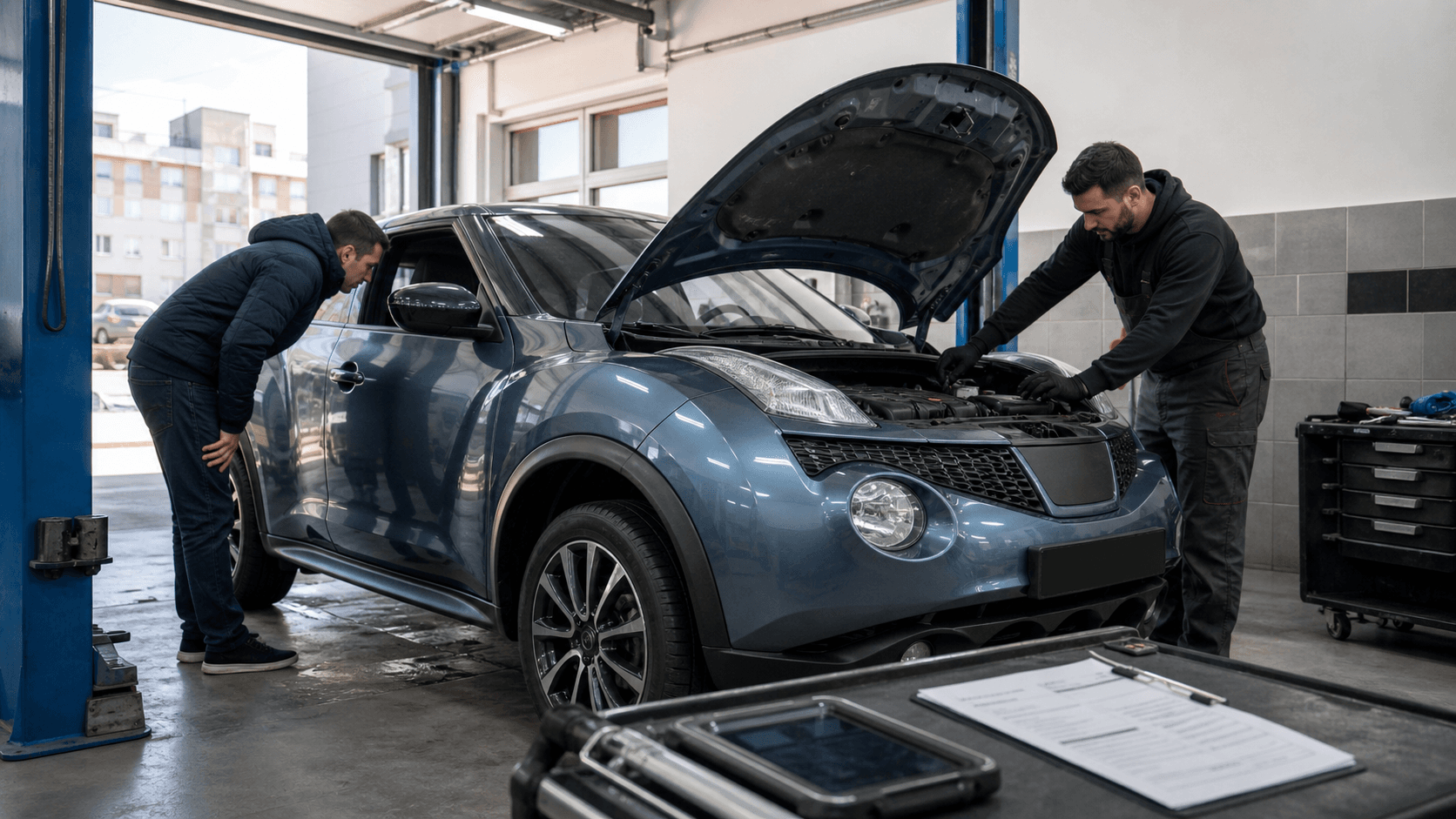
The first-generation Juke can look tempting on price. Many examples, though, have age, high mileage, city damage, incomplete servicing or modifications. Do not be sold by the design and equipment without an inspection on a lift.
Check carefully:
- rust on the sills, floor and wheel arches;
- kerbed wheels and uneven tyre wear;
- bushes, track-rod ends, dampers and wheel bearings;
- brakes;
- oil leaks;
- air-conditioning function;
- headlights, tail lights and the electrical system;
- cabin condition versus the mileage;
- damage and service history.
On older cars, a low purchase price can be used up quickly by tyres, brakes, suspension, air conditioning and a major service. Calculate the first year of use before you negotiate only the buying price.
Space and visibility: try them before you decide
The Juke is often bought for the higher driving position and the design. The body shape, though, comes with compromises. The rear window, C-pillar, low roof and boot can matter more in daily use than they do in photographs.
Before you pay, do simple tests:
- sit on the rear bench after you have set the driver’s seat for yourself;
- fit a child seat if you use one;
- check access for a child or an older passenger;
- load a suitcase, a pushchair or a large bag into the boot;
- reverse into a tight parking space;
- check the blind spots;
- test the camera and sensors in daylight and in rain, if you can.
For a couple or for town use, the space can be enough. For a family, it has to be checked with real objects, not from the spec sheet.
ADAS, camera, sensors and safety
Euro NCAP published a 5-star rating for the Nissan Juke in 2019, with 94% for adult occupant protection, 85% for child occupant protection, 81% for vulnerable road users and 73% for Safety Assist. The rating was extended in 2022 for the hybrid variant, and its validity appears as expired from 1 January 2026 in the Euro NCAP database. That does not make the car unsafe, but it means the result should be read in the context of the 2019 test protocol, not as a fresh score against 2026 standards.
On a used car, the actual equipment matters:
- autonomous emergency braking;
- collision warning;
- lane-keep assistance;
- traffic-sign recognition;
- reversing camera;
- parking sensors;
- LED headlights;
- blind-spot monitoring, if fitted;
- diagnostic faults;
- repairs to the front bumper, windscreen or mirrors.
If the car has had frontal damage, ask explicitly about sensor calibration. An ADAS system present in the menu but poorly recalibrated after a repair can be more dangerous than it looks.
City wear: where the costs appear
The Juke is positioned as an urban car. That means tight parking, kerbs, short trips, frequent braking and many pull-aways. A visual check in a car park is not enough.
On a lift, look for:
- wheels damaged on the inner rim;
- tyres with an old DOT date or uneven wear;
- discs and pads;
- calipers;
- scuffed undertrays;
- bushes and track-rod ends;
- dampers;
- impact marks under the sills;
- leaks;
- resprayed body panels.
A city car can have low mileage but high wear on the clutch, DCT, brakes, suspension and cabin. Low mileage does not replace an inspection.
What to ask the seller before viewing
Send the questions before you go to the car:
- What is the VIN?
- What engine and gearbox does it have exactly?
- Is it first generation or second generation?
- Is the car from Romania or an import?
- Are there service invoices?
- When was the last service?
- Has it had damage?
- Have the front bumper, windscreen, headlights or sensors been replaced?
- Do the camera and all assistance systems work?
- Are there two keys?
- What tyres does it have, and what DOT date?
- Will it accept an independent inspection?
If the answers are vague, do not rush. The supply is large enough to look for a clearer example.
When it is worth buying
The Juke is worth it if:
- you want a small crossover with a distinct design;
- you drive a lot in town;
- you do not need the space of a compact SUV;
- the engine and gearbox pass the cold and hot tests;
- the history is checkable;
- the equipment works;
- the price reflects the condition, not only the looks;
- you have calculated the first-year costs.
It is not worth it if:
- the rear space is too small for your family;
- the visibility bothers you when parking;
- the DCT snatches or delays;
- the hybrid has faults or an unclear warranty;
- the car has unexplained frontal damage;
- the seller refuses an independent inspection;
- the price is close to a more practical, better-maintained SUV.
Verdict
A used Nissan Juke is a good choice for someone who wants a different city car, with a high driving position and reasonable costs if the example is sound. The most important decision is not the colour or the design pack, but the combination of generation, engine, gearbox, history and how the car fits your life.
If you buy it for town, test the DCT or the hybrid in slow traffic. If you buy it as a family car, check the rear bench and the boot with your own items. And if the advert promises a very good price, look for the reason before you pay a deposit.