The short answer
A used SEAT Ateca is worth examining in 2026 if you want a compact Volkswagen Group SUV without the price of an equivalent Tiguan. Do not buy it only because it looks simpler than rivals. You must check the exact engine, the service history, the DSG gearbox, 4Drive, cabin electrics, ADAS equipment, tyre condition and any signs of hard use or towing.
Short checklist:
- ask for the VIN and identify the engine, gearbox, drivetrain and emissions standard;
- separate 1.0 TSI, 1.4/1.5 TSI, 1.6 TDI and 2.0 TDI before comparing cars;
- on TSI, check the timing drive that applies to that engine, the oil, cooling and turbocharger;
- on TDI, read the DPF, EGR, injection, turbocharger, AdBlue where fitted and regenerations;
- on DSG, test a cold start, slow manoeuvres, R-D changes and shifts after warm-up;
- on 4Drive, check tyres, uneven wear, leaks and transmission servicing;
- test the screen, camera, sensors, climate control, electric parking brake and assistance systems;
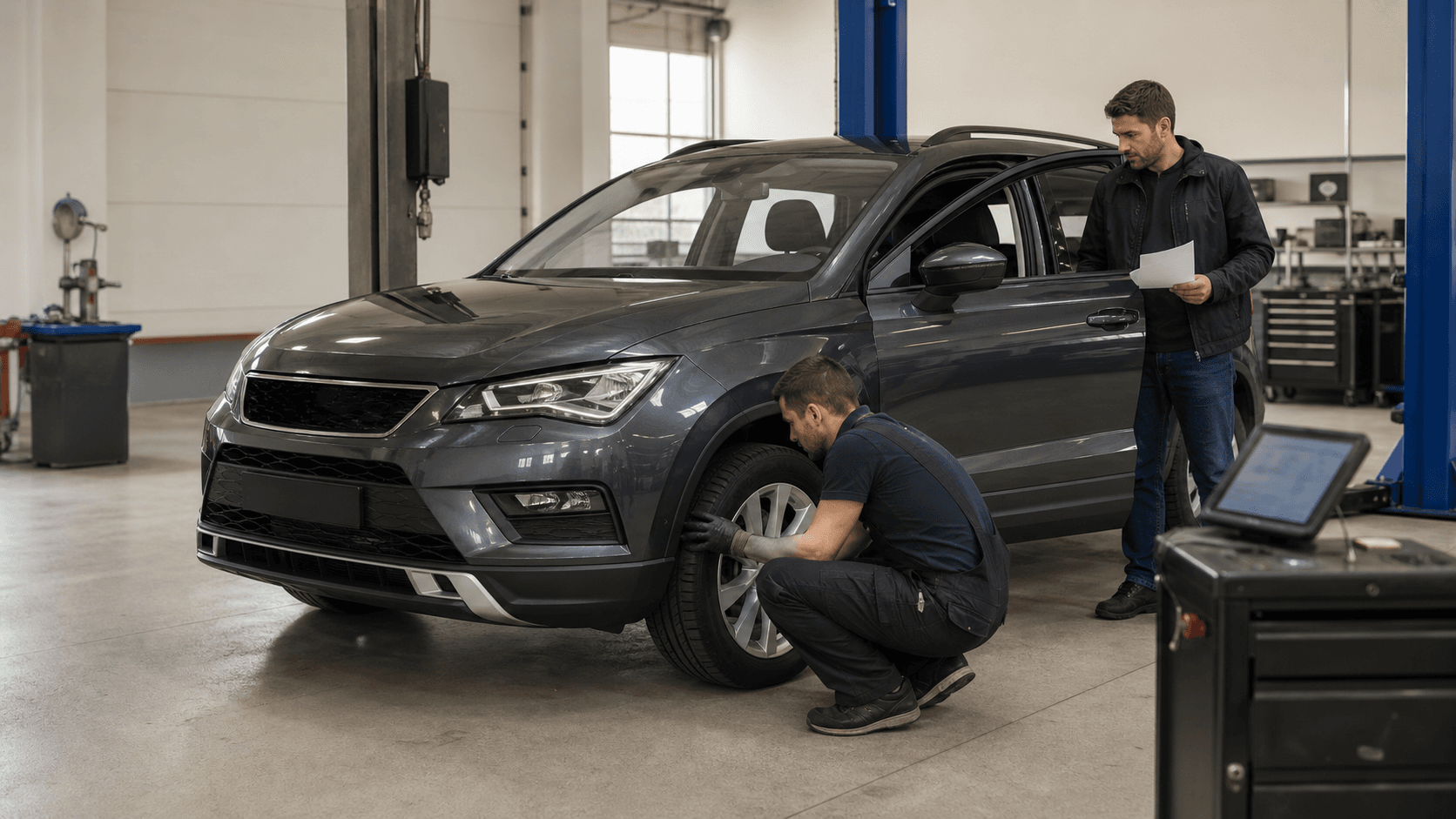
- inspect the body, floor, chassis rails, wheels, brakes and suspension on a lift;
- do not pay a deposit without invoices, diagnosis and a quote for the work found.
The practical rule: a good Ateca is a correct, spacious compact SUV that is easy to use every day. A cheap Ateca with no history and an unchecked DSG or diesel can quickly cost more than the gap to a car that looks stronger on paper.
Why this is a useful subject for Carboratory
The Carboratory archive already covers close models such as Volkswagen T-Roc, Tiguan, Škoda Karoq, Škoda Kodiaq, Nissan Qashqai, Kia Sportage, Hyundai Tucson and Peugeot 3008. The SEAT Ateca appeared mainly as an alternative in general compact-SUV articles, without a dedicated guide for the buyer comparing TSI, TDI, DSG and 4Drive.
There is also practical demand. The Ateca sits in the same broad technical family as other popular Volkswagen Group models, and adverts often use short labels: “1.5 TSI DSG”, “2.0 TDI 4Drive”, “Style”, “FR” or “X-Perience”. Those labels are not enough. Year, facelift, engine code, gearbox code, real servicing and the actual equipment matter.
SEAT Romania presents the Ateca as a compact SUV with petrol engines, a manual gearbox and different equipment lines, and Euro NCAP published the model’s test in 2016. On the European used market, AutoScout24 lists thousands of Ateca adverts, and in Romania used examples also appear through certified-car networks. That justifies a separate Romanian guide, not only a mention in a ranking.
Which Ateca are you actually looking for?
The SEAT Ateca was launched as a compact SUV before the segment became crowded. On the used market you will find pre-facelift cars, facelift cars, Style, Xcellence/X-Perience and FR versions, petrol engines, diesels, manuals, DSG gearboxes and, on some configurations, 4Drive all-wheel drive.
Before you go to view a car, clarify:
- year of manufacture, not only first registration;
- generation and facelift;
- the exact engine;
- the gearbox;
- front-wheel drive or 4Drive;
- the emissions standard;
- country of origin;
- documented mileage;
- the service history;
- the real equipment, not only the trim name.
A 1.0 TSI manual Ateca, a 1.5 TSI DSG and a 2.0 TDI 4Drive can look almost identical in photographs, but they are different purchases.
TSI engines: good when the history is clear
For town use, commuting and mixed roads, an Ateca TSI can be easier to justify than a diesel used on short trips. “Petrol” does not automatically mean low risk.
At the viewing, check:
- a fully cold start;
- oil level and oil quality;
- the real change intervals;
- the cooling system;
- any leaks;
- the turbocharger;
- ignition;
- the timing drive that applies to that engine;
- the history of spark plugs, coils and oil consumption;
- stored faults, not only warning lights that are on.
On 1.0 TSI, drive the car loaded and on a slope, to see whether the power is enough for your routes. On 1.4 TSI and 1.5 TSI, check idle, the cold-to-hot transition, any hesitation and the oil history. If the car has DSG, do not judge the engine apart from the gearbox; behaviour in slow traffic matters a great deal.
TDI: suitable for high mileage, sensitive to the wrong use
An Ateca diesel can be a logical choice for motorway work, a long commute and extra-urban roads. It makes less sense if it spent years only in town, with a cold engine, frequent stops and interrupted regenerations.
On 1.6 TDI or 2.0 TDI, ask for diagnosis of:
- particulate-filter loading;
- regeneration history;
- EGR;
- injectors;
- the turbocharger;
- pressure and temperature sensors;
- AdBlue and NOx, if the system exists on that specification;
- faults recently cleared;
- mileage differences between modules.
On the test drive the engine should pull linearly, without excessive smoke, limp mode or emissions messages. An “antipollution” or “AdBlue” message is not a detail to negotiate verbally. Ask for a quote before a deposit.
DSG: test it cold and in slow traffic
Many Ateca examples look attractive with DSG, especially for town use. That is why the test must not be done only on an empty boulevard.
Minimum procedure:
- start the car cold;
- move from P to R and D;
- make slow forwards-and-backwards manoeuvres;
- pull away gently, without a sharp throttle;
- crawl bumper to bumper for a few minutes;
- accelerate progressively;
- let the gearbox downshift;
- test braking almost to a stop;
- repeat after the oil has warmed up;
- read the gearbox module on diagnosis.
Strong jolts, shuddering on take-off, long hesitation, bangs between gears or stored faults change the calculation. Ask for the gearbox code and invoices for relevant work. Do not assume intervals or fluids from the generic DSG name.
4Drive: useful, but not free to maintain
Some Ateca cars have 4Drive all-wheel drive. The system is useful for mountain roads, winter, slopes, light unpaved tracks or towing within the car’s limits. Do not buy it only because it sounds better in the advert.
Check:
- whether all four tyres are the correct size;
- wear differences between axles;
- noises in a tight turn;
- leaks;
- vibration under acceleration;
- transmission servicing;
- operation on diagnosis;
- impact traces under the car;
- a tow bar, if fitted;
- the towing mass entered in the papers.
On 4Drive, mismatched tyres and delayed maintenance can affect the system more than a buyer expects. If you do not really need all-wheel drive, a front-wheel-drive version can be simpler and cheaper.
Interior, screen, climate control and equipment
The Ateca can look more sober than French or Korean rivals, but equipment still matters. Check every feature as a technical part, not as decoration.
Test:
- the central screen;
- phone connectivity;
- the reversing camera;
- parking sensors;
- climate control on cold and heat;
- heated seats;
- windows and mirrors;
- the electric parking brake;
- the tailgate, if it is electric;
- the lights;
- steering-wheel controls;
- assistance systems.
Euro NCAP tested the Ateca in 2016 and noted the presence of some safety systems, but the actual equipment differs by trim, market and year. If the car has had a windscreen, front bumper or body panels replaced, check the sensors, camera and any calibrations.
Body, suspension and signs of use
A family compact SUV can hide a lot of wear: children, luggage, kerbs, light forest tracks, motorway, holidays, a tow bar, bicycles, a roof box. Attractive photos do not show everything.
On a lift, look at:
- the floor;
- the sills;
- the chassis rails;
- undertrays;
- subframes;
- dampers;
- bushes;
- drop links;
- wheel bearings;
- brakes;
- wheels;
- tyres;
- leaks;
- the exhaust;
- impact traces under the car.
Inside, check the boot, carpet, the floor under the spare wheel or puncture kit, rear-seat mountings, seatbelts, ISOFIX and driver-seat wear. If the wear does not match the mileage, ask for explanations and documents.
What to ask the seller before viewing
Send the questions in writing:
- What is the VIN?
- What engine and gearbox does it have exactly?
- Is it front-wheel drive or 4Drive?
- Are there service invoices?
- When was the last service?
- Has there been DSG work?
- Has there been work on the DPF, EGR, AdBlue or turbocharger?
- Are there faults on the dashboard?
- Has the car had an accident or resprayed parts?
- Has it had a tow bar or towed?
- Are the tyres all the same brand and size?
- Does the seller accept diagnosis and a lift inspection?
If the seller avoids the VIN, invoices or inspection, you do not have a sound basis for a purchase.
Frequently asked questions
Is a used SEAT Ateca worth buying in 2026?
Yes, if you find an example with a clear history, an engine and gearbox that match your routes, and a sound technical inspection. It is not worth it if you choose only on price, appearance or the Volkswagen Group badge.
Which Ateca engine is more suitable for town use?
For town and short trips, a TSI can be easier to justify than a TDI. Still check the exact engine, oil, cooling, turbocharger and gearbox. If you cover a lot of extra-urban kilometres, a correctly maintained TDI can make sense.
Is DSG a problem on the SEAT Ateca?
Not automatically. DSG can be comfortable, but it must be identified by code, tested cold and hot, and checked on diagnosis. A gearbox that jolts or has no history can change the budget entirely.
Is 4Drive worth it?
It is worth it if you have mountain roads, winter, slopes, light unpaved tracks or occasional towing within legal limits. If you drive almost exclusively in town, the extra costs and checks can outweigh the benefit.
Which check must not be skipped?
A full diagnosis, a lift inspection and a VIN history check. On the Ateca, those three things separate a sound compact SUV from a car that is only well presented in the advert.