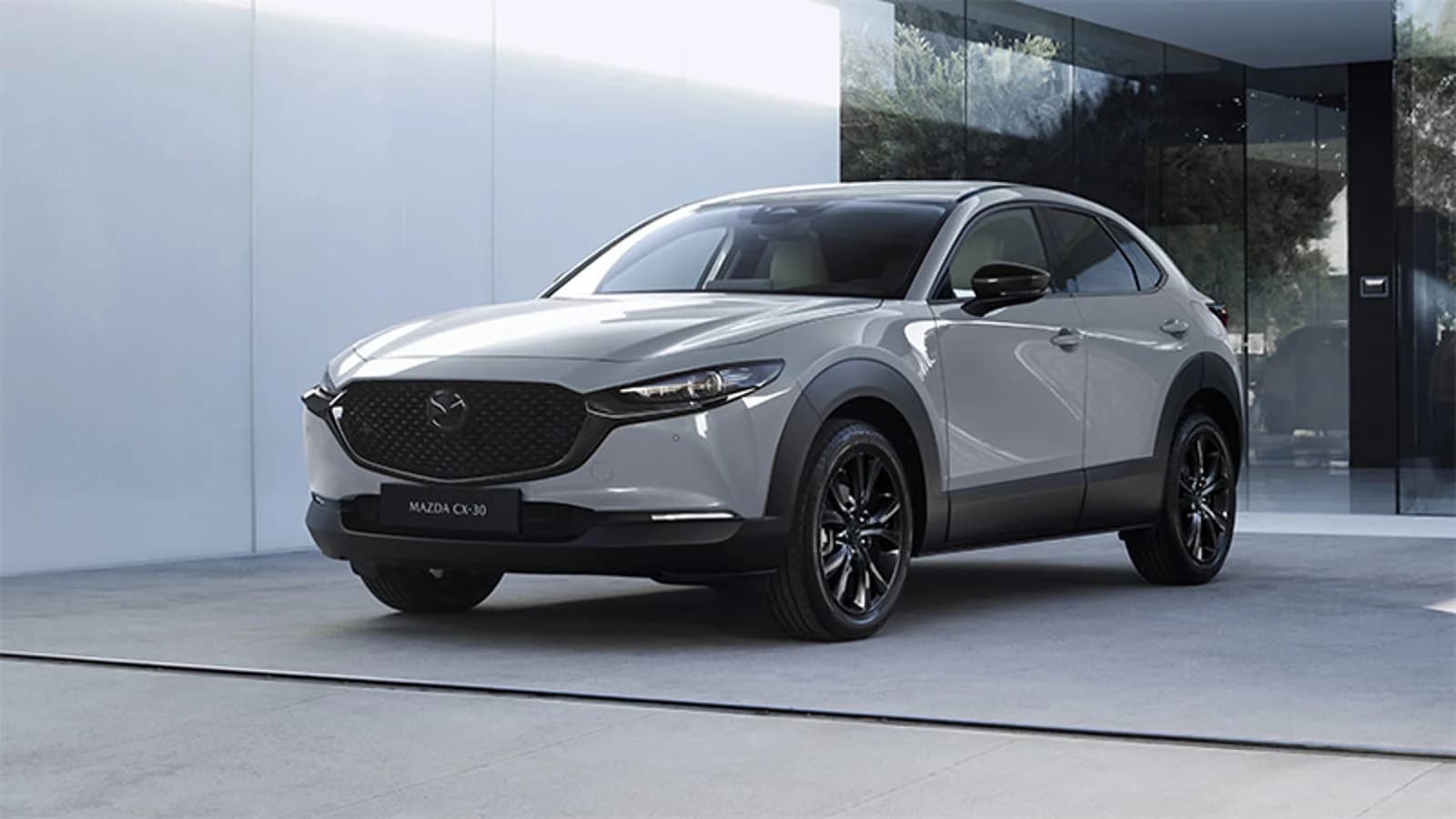
Official Mazda CX-30 2027 press image. Source: Mazda Deutschland / Mazda Media, supplied for editorial press use.
2027 Mazda CX-30 update adds Homura Plus and Makoto editions
Mazda is carrying the CX-30 into the 2027 model year with new equipment lines, revised i-Activsense driver assistance and a series of small exterior and interior changes. The compact crossover keeps its existing basic format and Skyactiv engines. The update is aimed at making the CX-30 easier to specify against compact SUVs such as the Ford Puma, Volkswagen T-Roc and Skoda Kamiq, rather than turning it into an all-new vehicle.
The main additions are the Homura Plus equipment line and the special Makoto edition. Mazda is also introducing Aero Grey and Zinc Green exterior colours in European markets. The safety package gains changes to Smart Brake Support, motorcycle detection, intersection support and the way adaptive cruise control can work with traffic-sign recognition.
What is new for 2027
Homura Plus sits above the existing Homura version and adds equipment intended to make the CX-30 feel more complete at the upper end of the range. Makoto is a separate special edition with a lighter cabin theme and its own exterior details. The exact combination of engines, transmissions and equipment remains market-dependent.
Mazda’s regional press material also describes black exterior details for selected versions, including the Signature Wing, Mazda emblem, rear badges and mirror caps. These are trim-level changes rather than structural revisions. The 2027 CX-30 remains the compact crossover positioned between the smaller CX-3 and the larger CX-5 in Mazda’s European line-up.
The model’s published dimensions remain compact: Mazda press material gives a length of 4,395mm, a width of 1,795mm, a height of 1,540mm and a 2,655mm wheelbase. Those measurements help explain the CX-30’s intended role. It offers a raised driving position and crossover styling without moving into the footprint of a larger family SUV.
Homura Plus equipment
One of the most substantial changes is the revised Matrix LED lighting system. Mazda says the system can provide a pedestrian marking function and reduce light intensity when it recognises highly reflective traffic signs, helping to limit glare. Such features operate within defined conditions and do not remove the need for the driver to manage speed and visibility.
The Homura Plus specification also includes a 360-degree camera and a reversing assistance function with braking support for rear cross traffic. Mazda lists black leather seat upholstery on specified surfaces, electric adjustment for the driver’s seat, front-seat heating, black roof rails and Gunmetal interior accents. A 12-speaker Bose surround system is also listed in the German press information.
Equipment descriptions published by Mazda’s national organisations are not identical in every market. A buyer should therefore check the local price list instead of assuming that every item in the German or French release is standard on a Romanian car. The same name can be used with a different engine, transmission or option structure.
The Makoto special edition
Makoto takes a different approach to the cabin. Mazda describes a lighter interior with white and light-grey surfaces, a suede-like dashboard finish on specified areas, a brushed-silver key cover and floor mats carrying Makoto branding. The aim is to create a brighter cabin atmosphere than the darker Homura theme.
The special edition is also listed with a 360-degree camera and a 12-speaker Bose system. Black 18-inch alloy wheels and black exterior trim complete the visual treatment. Makoto is not a separate powertrain. It is an equipment and design version built around the existing CX-30 mechanical package.
The distinction matters for buyers comparing prices. A special edition can add equipment and a different interior without changing acceleration, battery technology or the vehicle’s underlying platform. Mazda has not presented Makoto as a new generation or a new drivetrain.
Changes to i-Activsense
The 2027 CX-30 links Mazda Radar Cruise Control, known as MRCC, with Traffic Sign Recognition, or TSR. The driver can accept a detected speed through a steering-wheel control. This can reduce the number of manual inputs on a changing road, but the driver still needs to check whether the camera has read the correct sign and whether the detected limit applies to the current lane.
Smart Brake Support receives improved detection, including motorcycle recognition and stronger support at intersections. Mazda also says motorcycle detection is integrated into Blind Spot Monitoring. The systems can warn or intervene in certain situations, but the manufacturer does not claim that they prevent every collision. Weather, speed, road layout, visibility and the position of another road user all affect the response.
The Prime-Line version gains secondary-collision mitigation and a driver-monitoring function in the German specification. Mazda also lists a matt-black centre console, black window trim and revised LED daytime running lights for the entry version. These changes make the safety update relevant beyond the most expensive trim.
Engines and efficiency
The model-year change does not introduce a new CX-30 platform or a battery-electric version. European Mazda material continues to list the Skyactiv-G 140 and Skyactiv-X 186 engines, with Mazda M Hybrid technology. The mild-hybrid system recovers energy during deceleration and can support the vehicle’s electrical system and engine operation. It is not the same as a plug-in hybrid and does not give the CX-30 an electric-only driving range.
All-wheel drive is available with selected Skyactiv-X configurations, depending on market and trim. Mazda publishes different fuel-consumption and CO2 ranges according to engine, gearbox and wheel specification. Official WLTP figures should be treated as a comparison method, not as a guarantee of real-world fuel use in every traffic and weather condition.
This mechanical continuity is important in the context of the Ford Puma comparison. The CX-30’s 2027 changes focus on equipment, cabin presentation and driver assistance. Mazda has not announced a claim that it will outsell the Puma or a technical transformation that would put the two cars in different categories. The goal is to keep the CX-30 competitive as buyers pay more attention to standard equipment and safety functions.
What European buyers should check
The first question is which national specification is available. Homura Plus and Makoto may have different standard features or prices from one country to another. A German press release is useful for describing the programme, but it is not a Romanian price list. Buyers should check the local combination of engine, gearbox, all-wheel drive, wheels, lighting and assistance systems.
Colour availability also needs confirmation. Mazda’s regional information indicates that some colours can depend on production timing. An in-stock car and a factory order may therefore have different exterior colour choices and delivery dates.
The 2027 CX-30 is an update, not a full model replacement. It keeps the compact dimensions and current powertrain family while adding two versions, improved assistance and refreshed design details. That may matter to drivers who already like the CX-30’s size and petrol engines. It will not answer the needs of someone looking specifically for a fully electric crossover, because Mazda has not announced such a change in this update.