The short answer
A used Skoda Fabia is worth considering in 2026 if you want a small, practical car that is easy to maintain and roomy enough for town, commuting and occasional trips out of town. Do not treat it as an automatically simple choice. On the market you find different generations, MPI and TSI engines, older diesels, manuals, DSG, high urban mileage, fleet cars and imported examples.
Short checklist:
- identify the exact generation, engine, gearbox and equipment from the VIN;
- on MPI, check cold starting, oil consumption, timing and services;
- on TSI, watch the turbo, chain or belt, cooling, oil and change history;
- on DSG, test pull-away, slow driving, a ramp, reverse and shifts after warm-up;
- on older diesels, check DPF, EGR, injectors and real long-distance use;
- inspect the suspension, brakes, tyres and wheels, because Fabia is often used in town;
- do not assume the boot solves everything: test the rear seat, a child seat and your luggage;
- compare the price with similar listings by year, mileage, history, gearbox and equipment.
The practical rule: Fabia is a good buy when the example has a clear history and predictable costs. It becomes a trap when a low price hides postponed services, city wear, a neglected gearbox or kilometres that are hard to verify.
Why Skoda Fabia deserves a separate guide
The Carboratory archive already has material on many small models and urban crossovers: Sandero, Clio, T-Cross, Juke, Stonic, Captur, Vitara and other cars sought in Romania. Fabia appeared in comparisons and in an old article about 2016, but it did not have a current guide built for the buyer searching directly for a “used Skoda Fabia”.
Interest is high enough for a dedicated article. When this guide was researched, the CautiMasina page for Skoda Fabia showed 2,287 listings. The supply includes very cheap cars, fleet examples, Fabia Combi, recent generations with 1.0 TSI, nearly new cars and many intermediate configurations.
This variety helps negotiation, but it demands discipline. A Fabia at €5,000, one at €8,000 and one at €14,000 are not checked in the same way.
Which Fabia generation you are looking for
Fabia has been on the market for a long time, and the differences between generations matter. Old models are attractive on a small budget, but they can need money immediately for brakes, suspension, timing, tyres, air conditioning and rust. The third generation, launched in 2014, is common in Romania and can be a balanced choice if the history is clear. The fourth generation, introduced in 2021, is more spacious, safer and more modern, but it costs more.
Skoda communicated for the fourth generation a length of 4,108 mm and a boot of 380 l, 50 l more than the previous generation. For a small car, these figures matter. Fabia can be more practical than it looks, but it does not replace a compact if you often have three adults in the back or large luggage.
Before you go to a viewing, establish the exact generation and check whether the listing uses correct photos, engine and equipment. On small cars, the difference between a simple spec and a well-equipped one can change daily comfort a lot.
MPI or TSI: choosing the engine
MPI engines are generally simpler and suited to town. They do not offer the same pick-up as a TSI, but they can be easier to accept for a buyer who wants predictable costs. On an MPI, check cold starting, idle, oil consumption, coolant losses, timing and the service history.
TSI engines are more pleasant on open roads and overtaking, especially on recent generations. They need more attention to maintenance, however. On the test, watch:
- noises on cold start;
- idle oscillation;
- smoke on acceleration;
- oil or coolant losses;
- turbo response;
- services done on time;
- the type and interval of the timing drive for the specific engine;
- diagnosis before and after the test drive.
Do not buy a TSI only because it has more power. If you drive almost exclusively in town, a simple engine can be more logical. If you commute extra-urban, the TSI can be the more pleasant choice, but only with a good history.
Older diesels: low consumption, clear conditions
On the market, diesel Fabias appear with attractive prices and low consumption. For someone who constantly does long journeys, a maintained diesel can make sense. For short town trips, school runs, shopping and distances of a few kilometres, the risk rises.
On diesel, check:
- DPF and regenerations;
- EGR;
- injectors;
- cold starting;
- smoke;
- flywheel and clutch;
- oil and leaks;
- the real history of long journeys;
- ITP, emissions and dashboard warning lights.
A cheap diesel can become expensive if it was used as a city car. Do not look only at the consumption on the dashboard.
Manual gearbox or DSG
The manual gearbox is the most common and can suit a controlled budget. Even so, a city Fabia can have a tired clutch even at apparently reasonable kilometres. Test pull-away, first gear, reverse, vibration, the bite point and noises when the pedal is pressed.
DSG is convenient, but it must be checked carefully. Do not test it only on an open boulevard. Drive slowly, stop, restart, climb a ramp, reverse-park and repeat after the gearbox has warmed up. Jerks, long delays, vibration and faults need serious diagnosis, not quick explanations.
Ask whether there are invoices for gearbox service, whether adaptations or interventions were done, and whether the seller accepts an independent check.
City wear shows under the car
Fabia is often bought for town, deliveries, a short commute or as the family's second car. That means kerbs, potholes, frequent braking, tight parking and many starts.
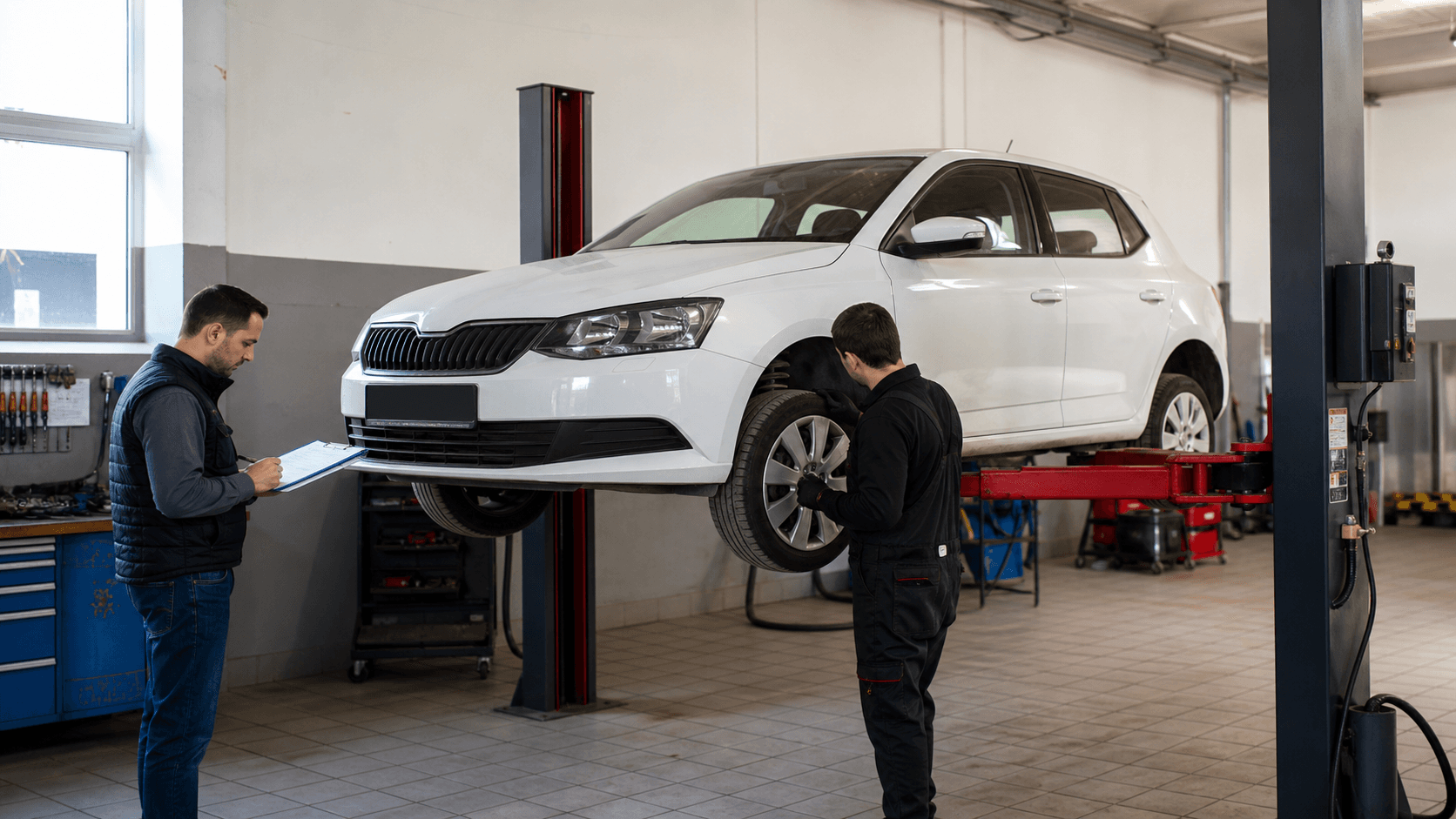
On a lift, check:
- bushes, drop links, dampers and wheel bearings;
- discs, pads and calipers;
- wheels hit on the inside;
- unevenly worn tyres;
- scuffed undertrays and sills;
- leaks at the engine or gearbox;
- rust on sills, wings, floor and tailgate;
- play in the steering;
- exhaust and mounts.
A small car can look cheap until you add four tyres, brakes, suspension and a full service.
Space, boot and equipment
Fabia is practical for its class, especially the new generation, but it must be tried with your things. If you have a child, fit the seat. If you often travel with luggage, put a trolley or a pushchair in the boot. If you are tall, adjust the driver's seat and check the rear space.
On equipment, watch what you use daily:
- working air conditioning or Climatronic;
- parking sensors;
- a camera, if fitted;
- heated seats;
- LED headlights;
- cruise control;
- Android Auto or Apple CarPlay;
- electric windows and mirrors;
- two keys.
A poorly equipped Fabia can be acceptable at a low price. At a price close to newer or larger cars, the gaps become important.
Safety and assistance systems
Euro NCAP published for the Skoda Fabia tested in 2021 scores of 85% for adult protection, 81% for child protection, 70% for vulnerable road users and 71% for Safety Assist. The assessment is useful especially for the new generation, but it does not mean that every Fabia in a listing has the same equipment or the same condition.
Check in practice:
- airbags and dashboard warning lights;
- seat belts;
- automatic emergency braking, if fitted;
- Lane Assist, if fitted;
- sensors and camera;
- a replaced windscreen;
- frontal damage;
- calibration after repairs;
- headlight operation.
On a used car, safety depends on the actual equipment, repairs, tyres, brakes and geometry, not only on the model's rating.
Questions for the seller
Before the viewing, ask for clear answers:
- What is the VIN?
- What exact engine and gearbox does it have?
- Is the car from Romania or an import?
- Are there a service book and invoices?
- When was the last service?
- Has the timing been changed, if applicable?
- Has it had damage?
- Does the air conditioning work?
- Are there two keys?
- What tyres does it have and what DOT?
- Does the seller accept a check in a workshop chosen by the buyer?
If the answers are incomplete, do not compensate with enthusiasm. Supply is large and it is worth looking for a more transparent example.
Verdict
A used Skoda Fabia is one of the more logical small cars for Romania, especially if you want reasonable costs, dimensions that are easy to use in town and enough space for daily use. The best examples are not necessarily the cheapest, but those with a clear history, an engine suited to your route and predictable first-year expenses.
Choose MPI if you want simplicity and drive a lot in town. Choose TSI if you commute and want better pick-up. Choose DSG only after a slow test and diagnosis. And if you see a very cheap Fabia, calculate the service, tyres, brakes, timing, paperwork and inspection before you decide you have found a bargain.