The short answer
A used car with air suspension is worth considering only if the system rises and drops evenly, does not sag on one corner after standing, has no dashboard faults, the compressor does not run obsessively, the bags are not cracked, the lines do not leak air, and a workshop can check the system with suitable diagnosis. The comfort is real, but the costs can be real too.
Short checklist:
- check by VIN whether the car has original air suspension or an aftermarket conversion;
- leave it parked for a few hours, ideally overnight, and compare height at all corners;
- test every height and comfort mode;
- listen to the compressor at start-up and after a level change;
- ask for diagnosis of level, sensor, valve and compressor faults;
- inspect bags, lines, dampers and sensors on a lift;
- check whether the car was towed or used often fully loaded;
- ask for invoices for bags, compressor, valve block, dampers or calibration;
- calculate the costs before you negotiate.
The practical rule: sound air suspension makes the car more comfortable and more versatile. Tired air suspension can turn a cheap premium SUV into an expensive project.
Why this is a useful subject for Carboratory
The Carboratory archive mentions air suspension in articles about BMW X5, Mercedes GLE, Audi Q5, Volvo XC60, Touareg, Cayenne or premium cars, but a dedicated guide was missing for the buyer who compares used examples by equipment. On the used market, air suspension appears mainly on premium SUVs, limousines, large estates and some electric models.
Official sources explain why the option attracts buyers: Volvo describes height adjustment, lowering for loading and warnings for faults; Volkswagen explains on the Touareg the ground-clearance levels, lowering with speed and the loading mode; Mercedes-Benz describes AIRMATIC as a system with air springs that adjusts height when the load changes. See the Volvo suspension documentation, Volkswagen Newsroom on the Touareg and Mercedes-Benz on AIRMATIC.
What air suspension is
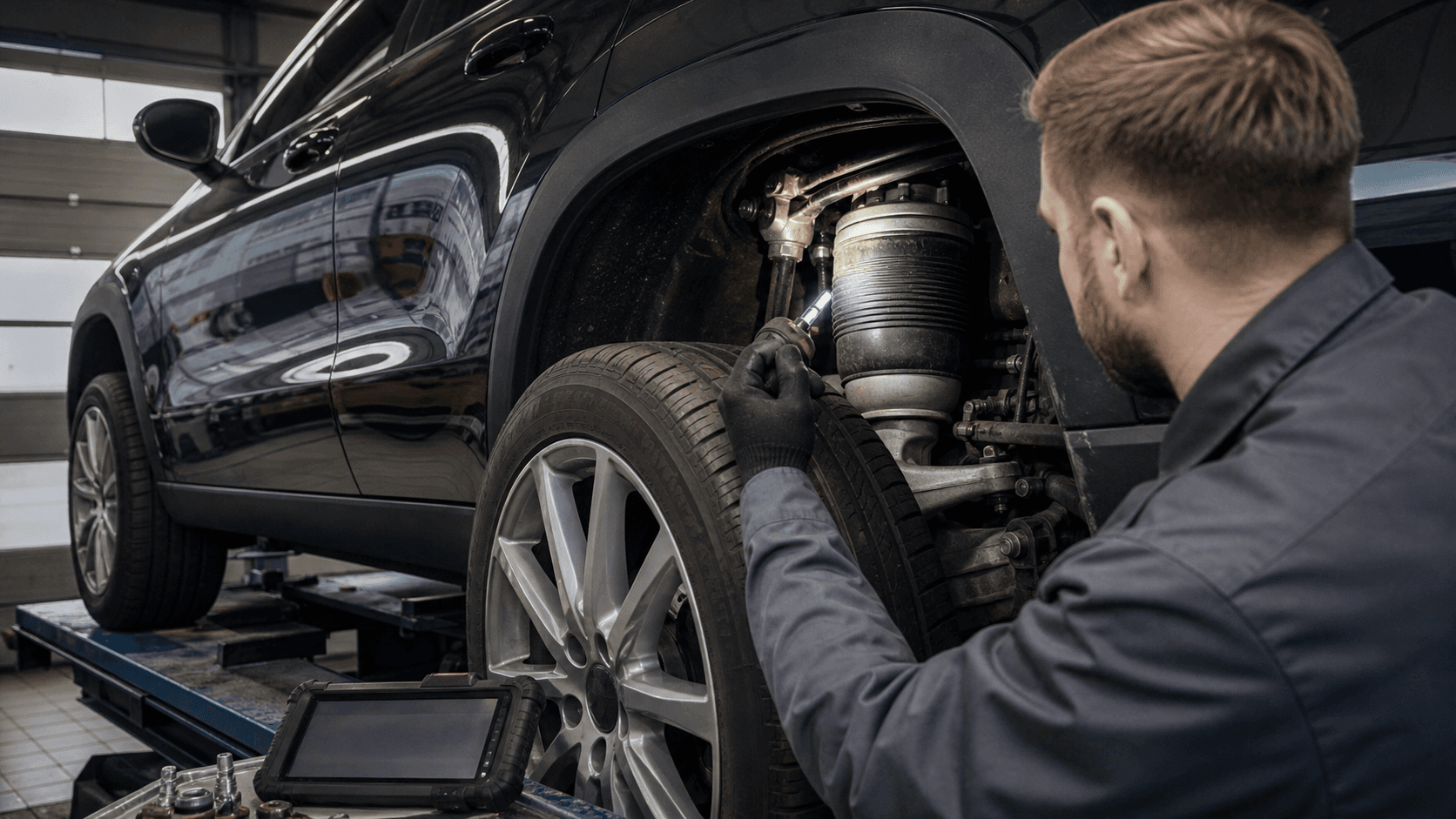
On a conventional suspension, the car’s weight is supported by metal springs and dampers. On air suspension, the spring is replaced or supplemented by air bags. The system uses a compressor, a reservoir or pressure circuit, lines, valves, level sensors, a control unit and matching dampers.
The advantages can be clear:
- better comfort on a long journey;
- adjustable ground clearance;
- lowering for access or loading;
- levelling when the car is loaded;
- different modes for tarmac, motorway or a poor road;
- a premium image.
The drawback is complexity. Each extra component can become a cost after 8-12 years, especially on roads with potholes, salt, mud, extreme temperatures and incomplete maintenance.
Original or aftermarket?
The first step is to find out whether the air suspension was fitted at the factory. The check is done by VIN, the options sheet and the real components on the car. Some models have air suspension as standard on certain versions, optional on others, or not at all.
Original air suspension has the advantage of integration with the car’s software, drive modes, sensors and safety systems. It can still be expensive for parts.
An aftermarket kit may be fitted for appearance, height adjustment or a specific use. Here you must check:
- installation documents;
- compatibility with the model;
- parts quality;
- legality of the modification;
- compressor and reservoir location;
- the lines;
- calibration;
- wheel geometry;
- acceptance at MOT (ITP) and by insurance.
If the seller says “it is on air” but cannot explain who fitted the system, what parts it has and what paperwork exists, treat the car as high risk.
The overnight test
The simplest test is standing. A car with a healthy system should keep a reasonable level. Some systems may adjust position slightly, but a visibly dropped corner after a few hours points to a possible air leak.
Do this:
- park the car on a level surface;
- set the normal level;
- measure the distance from wheel centre to wing at each corner;
- leave the car for at least a few hours, ideally overnight;
- measure again.
If one corner drops more than the others, it may be a cracked bag, a line, a fitting, a valve block or a sensor. Do not accept the explanation “they all do that”. Ask for a check.
How the car should rise and drop
At the viewing, test every available mode: normal, comfort, sport, off-road, access, loading, or whatever that car offers. Not all models have the same functions.
Watch for:
- even rise;
- even drop;
- a reasonable reaction time;
- no error messages;
- a compressor that does not run constantly;
- equal height left to right;
- clear differences between modes.
A very slow rise, a corner that stays low or a compressor that starts often can indicate leaks or wear. The compressor must not permanently compensate for a leak.
What to check on a lift
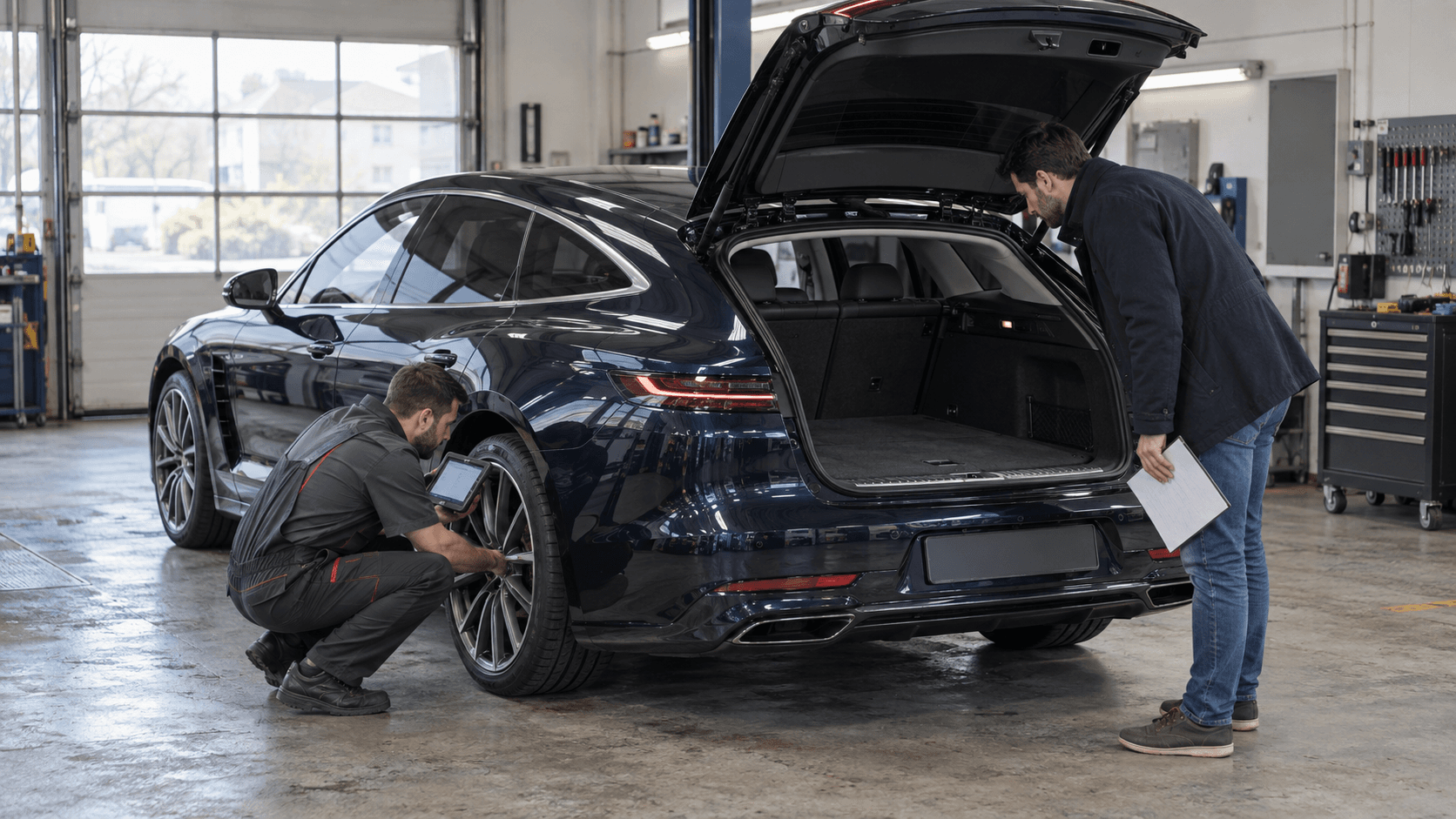
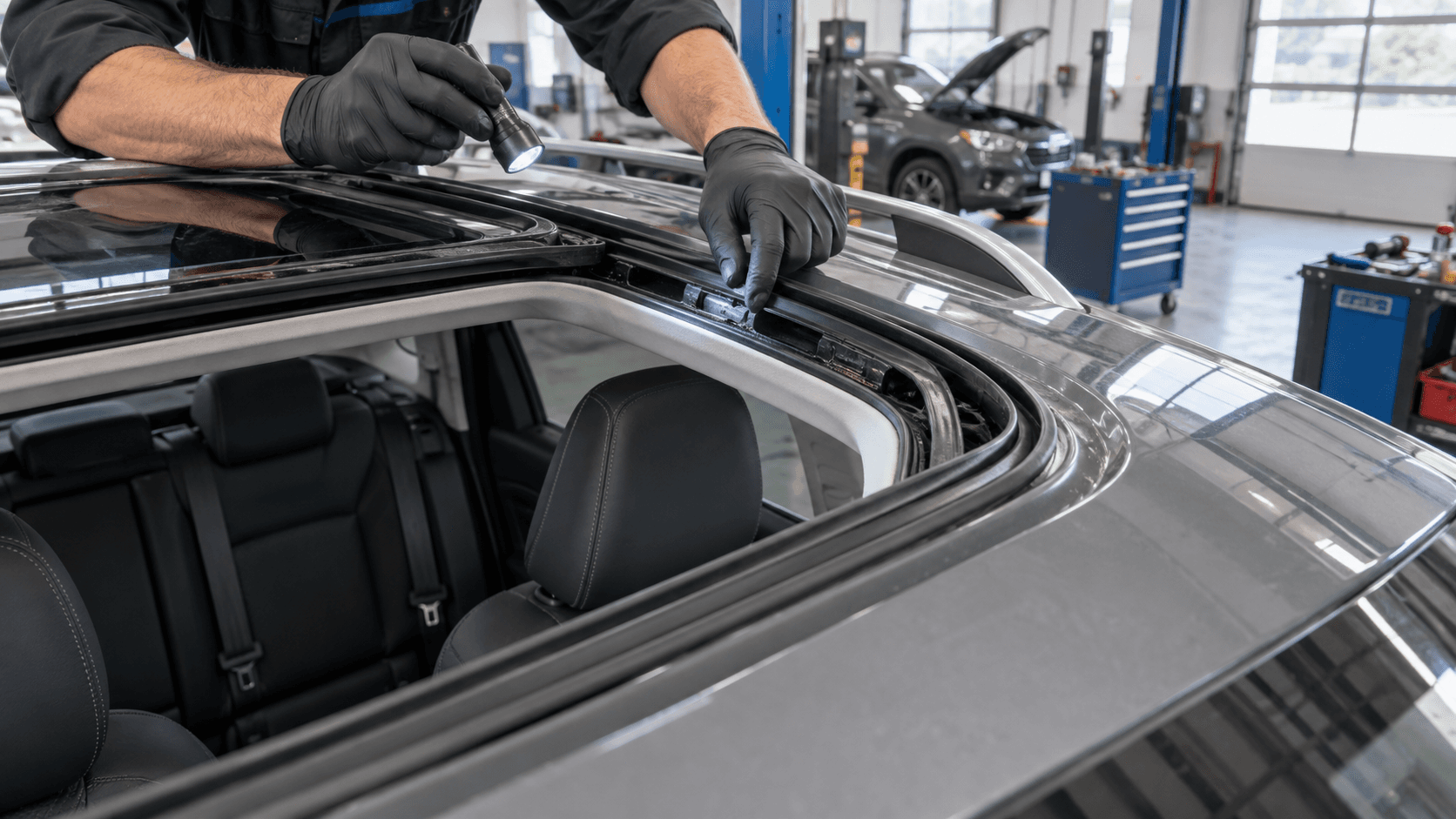
On a lift, a mechanic can see more than you see in a car park. Air suspension must be inspected together with the rest of the running gear.
The check includes:
- cracked or aged bags;
- rubbing traces;
- cracked lines;
- fittings;
- leaking dampers;
- compressor and mounts;
- valve block;
- level sensors;
- arms, bushes and drop links;
- geometry;
- unevenly worn tyres.
Not every problem is visible. Some leaks appear only at certain temperatures or body positions. That is why diagnosis and the standing test matter.
Diagnosis is not limited to the engine
Many buyers ask for diagnosis only on the engine and gearbox. On a car with air suspension, chassis, suspension, body and comfort modules must be read, depending on the brand.
Ask for checks of:
- stored fault codes;
- intermittent faults;
- system pressure, where available;
- level-sensor values;
- height calibration;
- compressor start count or running time, if it can be read;
- the history of cleared faults, where the tool allows it.
If the seller clears faults before the viewing, the test becomes weaker. A good workshop can sometimes see suspect values even without a warning light.
Poor roads and large wheels change the calculation
Air suspension does not cancel physics. On roads with potholes, large wheels and low-profile tyres, the bags, dampers, arms and bushes are still loaded. A premium car on 20-22 inch wheels can be comfortable on good tarmac, but expensive on broken roads.
On the test drive, watch for:
- knocks at low speed;
- cracks when the level changes;
- excessive roll;
- a car that sits crooked;
- a crooked steering wheel;
- vibration under braking;
- comfort differences between modes;
- noises after bumps.
Combine this check with the guide on suspension and steering on a used car.
When costs can become too high
There is no single price for repairs. Cost depends on brand, model, axle, original or aftermarket part, labour, calibration and workshop access. Before purchase you must still ask for an indicative quote for the likely scenarios.
Ask the workshop how much it would cost:
- one air bag;
- two bags on the same axle;
- a compressor;
- a valve block;
- an air damper;
- a level sensor;
- lines;
- calibration;
- geometry after the work.
If the car is cheap precisely because the suspension is tired, include the repair in the real price. The advert price is not the final price.
Is it worth it or not?
It is worth it if:
- you do long journeys;
- you want comfort;
- you need adjustable ground clearance;
- you tow or load occasionally, within the car’s limits;
- you have a competent workshop nearby;
- the budget includes maintenance.
It is not worth it if:
- you are buying at the limit of the budget;
- you want simple costs;
- the car has faults;
- it sags on one corner;
- there are no invoices;
- the seller refuses the overnight test;
- the workshop cannot diagnose the model.
Air suspension is not a reason to reject a car automatically, but it is a reason to check more seriously than with a simple suspension.
Frequently asked questions
Is it normal for the car to drop after I stop?
Some models drop in a controlled way for access, aerodynamics or parking. It is not normal for a single corner to sit visibly lower, or for the car to sag unevenly without explanation.
Should the compressor be audible?
It can be normal to hear it briefly when the system changes level. It is not normal for it to run very often or for a long time to hold the height.
Can I check air suspension at home?
You can observe height, noises and faults. Do not dismantle the system at home. Volvo warns in its documentation that the physical suspension system must be handled by trained technicians.
Is it better than conventional suspension?
It is more comfortable and more versatile in many situations, but it is not automatically more suitable for every buyer. If you want predictable costs, conventional suspension can be more logical.
What if the car has a suspension fault but still drives well?
Ask for diagnosis and a quote before a deposit. A suspension fault can be a sensor, calibration, compressor or an air leak. Without diagnosis, you negotiate blind.