The short answer
A used Suzuki Vitara is worth considering in 2026 if you want a small SUV that is relatively light, simple to use in town and available with AllGrip all-wheel drive. Do not buy it only for a reputation as a robust model. You must identify the exact generation, engine, gearbox, hybrid system, service history and whether the example is 2WD or 4WD.
Short checklist:
- ask for the VIN and check year, engine, gearbox, equipment and country of origin;
- clearly separate the 1.6 petrol/diesel, 1.4 Boosterjet, 48V mild hybrid and strong hybrid versions;
- on 1.4 Boosterjet, check oil, turbocharger, cooling, ignition and any cleared faults;
- on 48V mild hybrid, inspect the battery, starter-generator, wiring and start-stop system;
- on strong hybrid, test the transitions, the AGS gearbox and network service history;
- on AllGrip, confirm the system by VIN and test Auto, Sport, Snow and Lock modes where they exist;
- check the floor, sills, wheel arches, brakes, suspension, wheels and tyres;
- test the camera, sensors, automatic braking and lane assist if the equipment includes them;
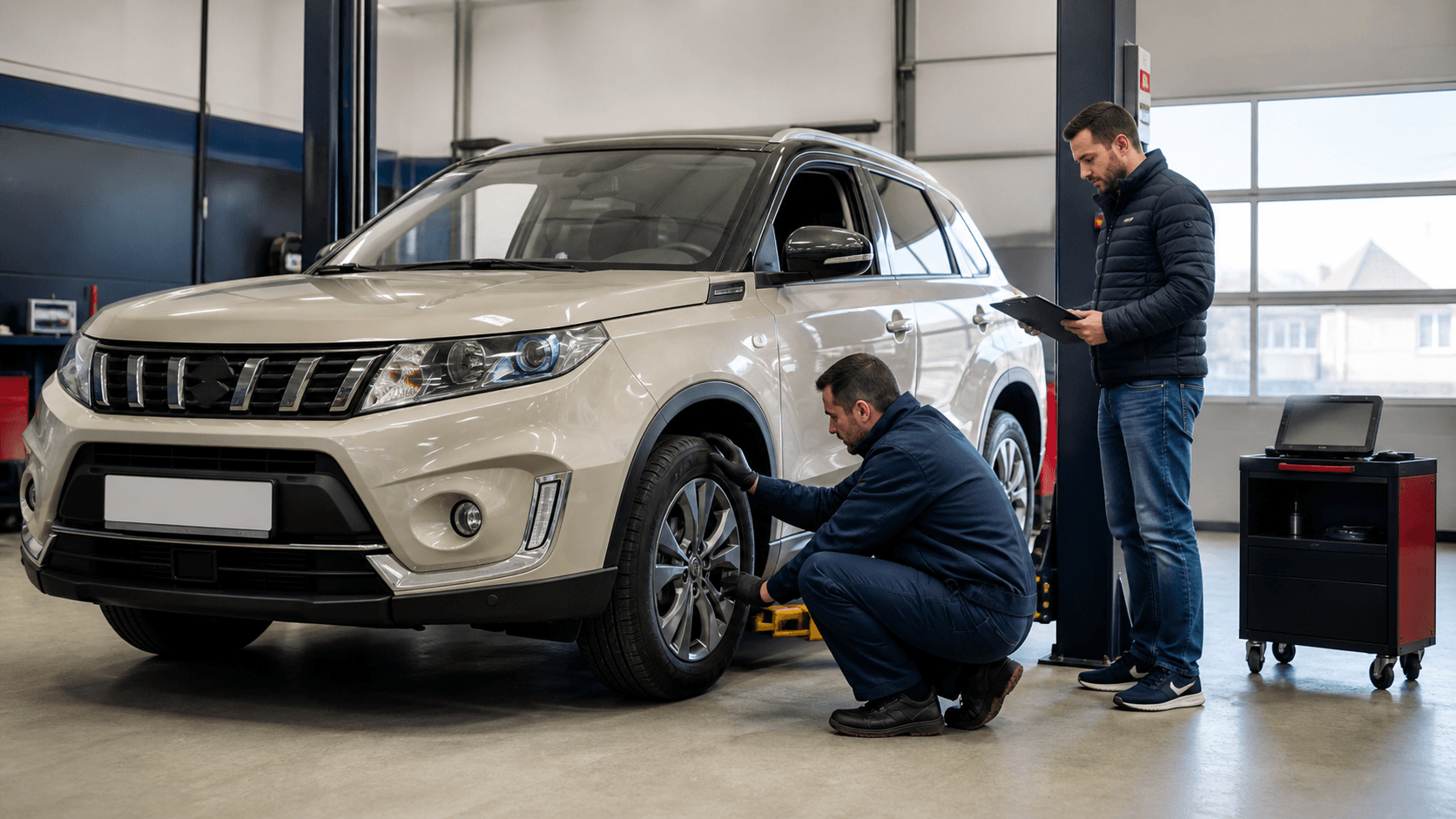
- do not pay a deposit without diagnosis, a lift inspection and a check of mileage/accident history.
The practical rule: Vitara is attractive when you buy a car with a clear history and a specification that matches your routes. A neglected AllGrip or a hybrid without documents can cost more than the difference versus a simpler 2WD crossover.
Why Vitara needs a separate guide
The Carboratory archive includes Suzuki Vitara in rankings about small SUVs, Japanese SUVs, 4x4 cars and alternatives to Dacia Duster. What was missing was a dedicated article for the buyer searching specifically for “used Suzuki Vitara” and wanting to know the differences between 1.6, Boosterjet, Hybrid, AllGrip and the available gearboxes.
The subject also has practical demand. The CautiMasina page for Suzuki Vitara showed 840 cars available when this article was researched, mixing used examples, nearly new cars, petrol, hybrid and electric versions arriving through European listings. A wide supply helps negotiation, but it can create confusion if the advert uses “Hybrid” generically.
Suzuki Romania presents the current Vitara with two powertrain directions: SHVS Mild Hybrid 48V and Strong Hybrid, and AllGrip Select has Auto, Sport, Snow and Lock modes on versions equipped with all-wheel drive. On a used car, those names must be verified on the actual example, not taken from a brochure.
Which Vitara are you actually looking for?
On the Romanian market you will meet several types of Vitara:
- 1.6 naturally aspirated petrol, usually simpler and older;
- 1.6 diesel, suitable only if it has history and a genuine long-distance use pattern;
- 1.4 Boosterjet, a turbo petrol engine that is more enjoyable but dependent on maintenance;
- 1.4 Boosterjet 48V mild hybrid, with electric assistance and a more complex start-stop system;
- 1.5 strong hybrid, with a motor-generator, 140V battery and AGS automatic gearbox;
- 2WD versions and AllGrip 4WD versions.
Do not compare two cars only by year, kilometres and price. A naturally aspirated 1.6 2WD Vitara can be simpler to maintain than a hybrid AllGrip, but it will not offer the same grip on difficult roads. A Boosterjet can be more pleasant on a long trip, but it needs oil and cooling history. A strong hybrid can be convenient in town, but the gearbox and hybrid side must be tested.
1.6 petrol: simple, but check the age
The 1.6 petrol engine is sought for simplicity. It can be a good choice if you want a small family car with predictable costs and no turbocharger. Many examples, however, already have years behind them, urban miles, tired brakes, worn suspension and cheap repairs.
At the viewing check:
- a cold start;
- idle;
- oil consumption;
- coolant losses;
- the clutch;
- the manual or automatic gearbox;
- leaks under the engine;
- the catalytic converter and lambda sensors;
- service history.
A simple engine does not mean a problem-free car. If the owner has no invoices, if the engine has been washed recently or if dashboard warning lights appear intermittently, ask for diagnosis before you negotiate.
1.4 Boosterjet: check turbo, oil and cooling
Boosterjet changes the car’s character. Vitara becomes livelier, more suitable for national roads and motorways, and with AllGrip it can be a good choice for areas with hard winters. The sensitive part is the maintenance history.
Ask clearly:
- at what interval the oil was changed;
- what oil specification was used;
- whether there are invoices;
- whether the engine has had antifreeze losses;
- whether the turbocharger whistles, leaks oil or has play;
- whether spark plugs and coils have been replaced;
- whether there is modified software.
On the test drive, accelerate progressively and watch for hesitation, smoke, the smell of burnt oil, temperature and behaviour after warm-up. A Boosterjet that only behaves well in a short test can hide infrequent services or faults cleared before the viewing.
Mild Hybrid 48V: do not confuse it with a full hybrid
The SHVS Mild Hybrid 48V system uses an integrated starter-generator and a 48V lithium-ion battery. It assists the petrol engine, recovers energy on deceleration and can make start-stop smoother, but it does not turn the car into a hybrid that runs electrically like a full hybrid.
Check:
- the 48V battery and any fault codes;
- the 12V battery;
- wiring and connectors;
- start-stop operation;
- dashboard messages;
- diagnosis of the hybrid modules;
- service history.
Do not accept the explanation “all hybrids do that” for warning lights, sluggish starts or messages about the electrical system. Sometimes the problem is the 12V battery, sometimes a 48V-system component. The difference must be established by diagnosis, not by assumptions.
Strong Hybrid and AGS: test it in town, not only on a boulevard
Vitara Strong Hybrid uses the 1.5 Dualjet engine, a motor-generator, a 140V battery and a six-speed AGS automatic gearbox. Suzuki describes the system as a hybrid that can run electrically in certain conditions and that uses the electric motor to help with gear changes.
On a used car, the test must be done in real traffic:
- pulling away from rest;
- bumper-to-bumper driving;
- light acceleration;
- regenerative braking;
- forward-and-reverse manoeuvres;
- a slow climb on a slope;
- shifts after warm-up;
- a cold start;
- a full diagnosis.
The AGS gearbox does not feel identical to a conventional automatic. Strong jolts, long delays, transmission messages or hybrid faults must not be ignored. Ask for a test in a workshop that knows Suzuki systems.
AllGrip: useful, but not free to maintain
AllGrip is one of the reasons Vitara remains interesting in Romania. If you live in an area with hills, unploughed roads, access to a cabin or hard winters, it can be very useful. If you drive almost exclusively in town, a 2WD version can be simpler and cheaper.
On AllGrip check:
- confirmation by VIN;
- the selector and available modes;
- the driveshafts;
- the propshaft, if that configuration has one;
- differentials and couplings;
- leaks;
- noises in tight turns;
- vibration under acceleration;
- identical tyres on both axles;
- impact marks under the car.
A 4WD system with mismatched tyres, underside impacts or neglected oils can become expensive. Do not pay the extra for AllGrip if you do not check it on a lift.
Body, rust and interior
Vitara is often used as a city car, but also for poor roads, mountains, fishing, a cabin or winter commuting. That is why the body and interior say a lot about use.
Inspect:
- the sills;
- the wheel arches;
- the floor;
- the chassis rails;
- the underbody shields;
- the lower parts of the bumpers;
- the boot carpet;
- the tailgate;
- the upholstery;
- the steering wheel, pedals and gear lever;
- traces of old mud under the car.
A car with normal use marks can be a good purchase. A car cleaned aggressively, with a recently painted underside or broken plastics in the boot needs more attention.
Safety, ADAS and Euro NCAP
Vitara scored five Euro NCAP stars in 2015 for the European generation tested then. The scores published by Suzuki and Euro NCAP included 89% for adult protection, 85% for children, 76% for pedestrians and 75% for Safety Assist. Those figures are useful as a historical reference, but they do not mean that every used Vitara has the same equipment or the same condition.
On the actual car test:
- automatic braking, without dangerous trials;
- lane warning;
- the camera;
- parking sensors;
- cruise control;
- the headlights;
- automatic wipers;
- all reported airbags;
- the seatbelts;
- ISOFIX.
If the windscreen or front bumper has been replaced, ask about sensor calibration. ADAS systems can exist in the brochure and still not work correctly on a car repaired superficially.
What to ask the seller
Send the questions before the viewing:
- What is the VIN?
- Is it 2WD or AllGrip?
- What engine does it have exactly?
- Is it 48V mild hybrid, strong hybrid or plain petrol?
- What gearbox does it have?
- Are there service invoices?
- Has it had accident damage or resprayed panels?
- Has it been used for towing, forest roads or off-road?
- Does it have two keys?
- Does the seller accept diagnosis and a lift inspection?
- Is there remaining warranty or dealer-offered warranty?
A vague answer to questions about engine, gearbox and AllGrip is a signal to check the documents before you waste time on the road.
What to compare it with in Romania
Vitara should be compared with Dacia Duster, Hyundai Kona, Renault Captur, Ford Puma, Nissan Juke, Skoda Kamiq, Volkswagen T-Cross, Peugeot 2008 and Suzuki S-Cross. If you want genuine 4x4 in a reasonable budget, the list narrows. If you do not need 4x4, some rivals can offer a more modern interior or a more suitable boot.
Compare:
- purchase price;
- history;
- the cost of the first service;
- tyres;
- real consumption;
- insurance;
- parts availability;
- resale value;
- safety equipment;
- the cost of a repair to the 4WD or hybrid system.
Do not buy a Vitara only because “it is Japanese”. Buy the example that can prove its maintenance.
Frequently asked questions
Is a used Suzuki Vitara a good choice in 2026?
Yes, if you want a small SUV that is easy to use daily and you find an example with a clear history. It is especially worthwhile when you choose correctly between 2WD, AllGrip, plain petrol and hybrid.
Which Suzuki Vitara engine is simpler?
The 1.6 petrol versions are generally the simplest, but many already have age. 1.4 Boosterjet is more enjoyable, but it needs a good history of oil, cooling and turbocharger care.
Can Vitara Mild Hybrid run electrically?
Not like a full hybrid. The SHVS Mild Hybrid 48V system assists the petrol engine and recovers energy, but it is not equivalent to a hybrid that runs electrically for consistent periods.
Is AllGrip worth it on Suzuki Vitara?
It is worth it if you have hard winters, hill roads, access to a cabin or routes with poor grip. For town and clean national roads, a 2WD version can be cheaper and simpler.
What do I check first on a used Vitara?
The VIN, the exact engine, the gearbox, service history, 2WD/AllGrip status, diagnosis and the lift inspection. Only then compare the price.
Sources consulted: CautiMasina - Suzuki Vitara page and listings indexed in August 2026; Suzuki Romania - Vitara Hybrid pages and the description of SHVS Mild Hybrid 48V, Strong Hybrid and AllGrip Select; Global Suzuki - data on Vitara, strong hybrid and 48V SHVS; Euro NCAP and Suzuki Global News - the 2015 Vitara result.