The BMW X3 30e combines 299 hp from its plug-in hybrid system with a 6.2-second 0–100 km/h sprint and official emissions of just 64 g/km. Our tests evaluated real-world performance of the new model in Romania-specific traffic conditions.
The 2025 generation brings WLTP electric range of 91 km, comfortably exceeding the daily needs of most drivers. Official figures quote combined consumption between 2.8 and 3.3 l/100 km, while electric use sits at 15.9–16.7 kWh/100 km. Boot capacity of 460 litres preserves practical usability even with the hybrid battery on board.
Our tests tracked real behaviour of the BMW X3 30e in Bucharest traffic and on motorways at constant speed. A starting price of £57,245 (roughly €67,000 on the Romanian market) raises legitimate questions about the price–performance ratio of this premium SUV. The data collected offers a clear view of practical efficiency and the real running costs of the plug-in hybrid system.
BMW X3 30e 2025 technical specifications: improvements over the previous generation
The current BMW X3 30e marks a significant step beyond its predecessor, with substantial gains in plug-in hybrid efficiency. The sporty performance typical of the Bavarian brand remains intact, but now benefits from much extended electric range.
Powertrain configuration: 299 hp hybrid system
The heart of the hybrid combines a 2.0-litre turbocharged inline four-cylinder petrol engine producing 140 kW (190 hp) at 4,400–6,500 rpm with 310 Nm of torque available between 1,500 and 4,000 rpm. An electric motor integrated in the transmission adds 135 kW (184 hp) and 250 Nm to the performance equation.
Combined output reaches 220 kW (299 hp) with maximum torque of 450 Nm. The results are impressive: 0–100 km/h acceleration takes 6.2 seconds, and top speed is 215 km/h. Pure-electric operation allows speeds up to 140 km/h, enough for most urban driving situations.
19.7 kWh battery and electric range
Net battery capacity of 19.7 kWh represents a major improvement over the previous model. WLTP electric range sits between 81 and 90 km, nearly double compared with the previous generation.
The Combined Charging Unit (CCU) allows standard 11 kW AC charging, reducing time for a full recharge to about 2 hours and 15 minutes. BMW eDrive technology and adaptive energy recuperation contribute to efficiency figures: WLTP combined consumption between 0.9 and 1.1 l/100 km and CO₂ emissions of 21–26 g/km. With a depleted battery, average consumption rises to 7.2–7.9 l/100 km.
Eight-speed transmission and xDrive system
The eight-speed Steptronic automatic integrates the electric motor, and xDrive all-wheel drive distributes power to all four wheels for optimal traction. The hybrid architecture allows pure-electric operation or mixed configuration, ensuring smooth transitions between propulsion modes.
Dimensions and vehicle mass
Dimensions have grown: 4,755 mm length (+34 mm), 1,920 mm width (+29 mm) and 1,660 mm height (−25 mm). Wheelbase of 2,865 mm and wider tracks improve stability and the sporty look.
Kerb weight of 2,065 kg gives a power-to-weight ratio of 106.5 kW/t. The 460-litre boot can be extended to 1,600 litres with the rear seats folded. Structural improvements include a stiffened body, increased rear track and revised suspension for superior dynamic behaviour. Maximum braked towing capacity reaches 2,000 kg.
Real consumption in town: urban test results
Urban tests of the BMW X3 30e tracked real hybrid behaviour in conditions specific to Bucharest traffic. The figures obtained confirm the economic potential of this premium SUV in an urban environment.
Test methodology: heavy traffic and low speeds
Evaluation took place in conditions typical of large cities: dense traffic, frequent stops at intersections and average speeds of 25–35 km/h. Each test started with a fully charged battery, the vehicle being used on everyday routes across different sectors of the capital.
The hybrid system favours electric operation in these conditions, offering a silent, vibration-free driving experience. Energy regeneration on deceleration proved particularly effective in intermittent traffic, recovering more energy than theoretical estimates suggest.
Urban electric range: 80 km in real conditions
Tests confirmed urban electric range of approximately 80 km, a figure close to the WLTP band of 81–90 km but 60% above the previous generation, which offered only 50 km. This performance allows covering the daily commute without activating the combustion engine.
For most urban users, this range translated into exclusive electric use for a full week, with regular overnight charging.
Urban consumption: 1.6 l/100 km with a charged battery
With the battery at maximum capacity, the BMW X3 30e recorded consumption of 1.6 l/100 km in urban tests, confirming the exceptional efficiency of the plug-in hybrid system. This figure means substantial savings at the pump for predominantly urban use.
Once the battery was depleted, consumption rose to 10–12 l/100 km in conventional hybrid mode, underlining the importance of regular charging to maximise economic benefits.
Dynamic behaviour in urban traffic
The 135 kW electric motor delivers 250 Nm instantly, ensuring immediate response when accelerating in urban traffic. Transition to the combustion engine occurs only under intense power demand, when the system delivers the full 299 hp capacity.
Energy regeneration under braking works efficiently in intermittent traffic, although it cannot fully recharge a depleted battery. For urban use with regular charging, the X3 30e offers sufficient electric range for most daily trips, combining fuel savings with the driving experience typical of the Bavarian brand.
Motorway performance: testing at sustained speed
Behaviour of the BMW X3 30e on the motorway differs considerably from urban use. Sustained speeds and increased aerodynamic drag test battery and hybrid efficiency under much more demanding conditions.
Test methodology: A1 at a constant 130 km/h
Motorway tests took place on the A1, with the vehicle held at a constant 130 km/h over a return distance of 180 km. The battery was fully charged at the start of the test to evaluate the transition from electric to hybrid operation. This scenario faithfully reproduces conditions of long weekend or holiday trips.
Electric range: 65–70 km at high speed
Although the BMW X3 30e can run electrically up to 140 km/h, range drops dramatically compared with urban use. The 19.7 kWh battery is depleted after approximately 65–70 km at a constant 130 km/h, versus the 80 km obtained in urban traffic.
This reduction is due to increased aerodynamic drag and the constant power needed to maintain speed. Even so, for a 2,065 kg SUV, this electric range on the motorway remains competitive in the premium segment.
Real consumption: 5.9 l/100 km on a mixed route
Over the full 180 km route, the BMW X3 30e recorded average consumption of 47.8 mpg (approximately 5.9 l/100 km). The first 65–70 km, covered exclusively on electric power, had zero petrol consumption. Afterwards the combustion engine took primary responsibility, settling at 7.5–8 l/100 km for the remainder of the route.
Comparison with urban consumption of 1.6 l/100 km highlights the dramatic impact of high speeds on hybrid efficiency. The difference underlines how important usage profile is when calculating real operating costs.
Comfort and stability at high speed
The BMW X3 30e demonstrates remarkable capability on the motorway. The vehicle remains stable at high speed, with adaptive suspension absorbing road imperfections efficiently without compromising body control.
Acoustic insulation benefits from acoustic glazing on the windscreen and front side windows, plus optimised seals. Aerodynamic noise becomes perceptible only at motorway speeds but remains within acceptable limits for long journeys.
The hybrid system as a whole offers an excellent cruising experience, with rolling and aerodynamic noise well controlled. For long trips, the BMW X3 30e proves a comfortable and refined companion.
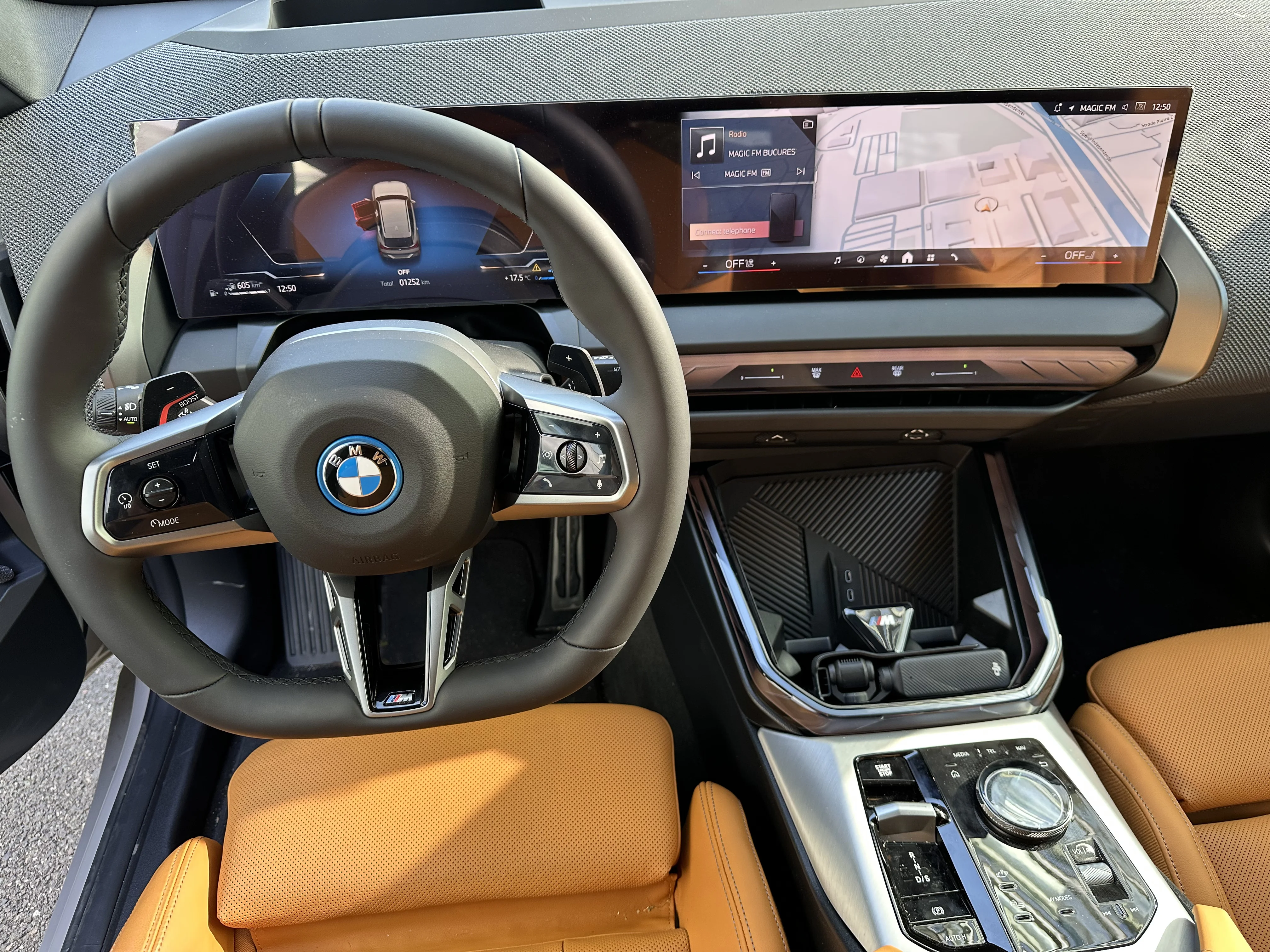
Interior comfort and everyday usability
The BMW X3 30e 2025 cabin combines the robustness typical of premium SUVs with refinement specific to the Bavarian brand, bringing notable improvements over its predecessor.
M Sport seats and interior space
M Sport seats offer precise lateral support and numerous electric adjustments, including memory for the driver position. Optional equipment includes lumbar support, backrest width adjustment (standard on BMW X3 M50 xDrive) and active ventilation. Standard upholstery uses the new Econeer material from recyclable components, eliminating leather use.
Passenger space measures 40.5 inches (102.8 cm) for head room and 40.2 inches (102 cm) for leg room in front, while the rear bench offers generous space, even though the seats cannot be slid or reclined. Three-zone climate control and heated outer rear seats complete the comfort package.
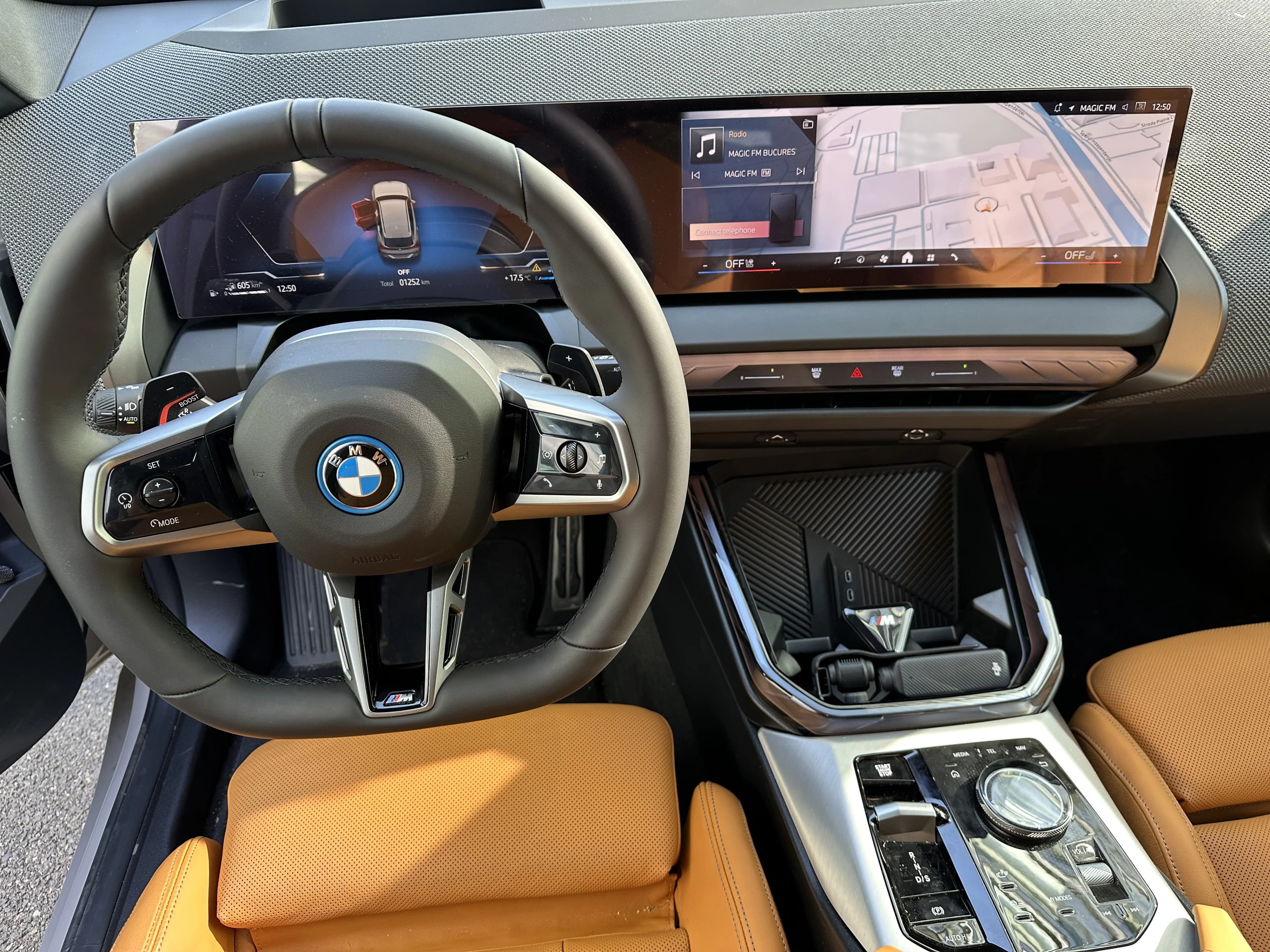
Multimedia system: 14.9-inch and 12.3-inch BMW Curved Display
BMW Curved Display dominates the dashboard, merging the 12.3-inch digital instrument panel with the 14.9-inch infotainment touchscreen. The system runs iDrive 9.0 based on Android and includes video streaming options plus games available when the vehicle is parked.
BMW retained the rotary iDrive controller on the centre console, offering an alternative to touch control. Connectivity includes wireless Apple CarPlay and Android Auto, digital radio and satellite navigation.
Boot: 460 litres with hybrid compromises
The load compartment offers 460 litres, 110 litres less than the standard version, the reduction caused by the battery positioned at the rear. Even so, capacity exceeds the previous model by 10 litres. Folding the rear seats extends space to 1,600 litres.
Charging: Combined Charging Unit at 11 kW
The BMW X3 30e uses the Combined Charging Unit (CCU) for 11 kW AC charging, three times faster than the previous model, reducing full charging time to 2 hours and 15 minutes. The vehicle complies with the Type 2 standard and includes the mode 3 cable for public stations.
A practical inconvenience is the absence of a dedicated compartment for the charging cable in the boot; it is supplied in a bag that attaches to the luggage hooks.
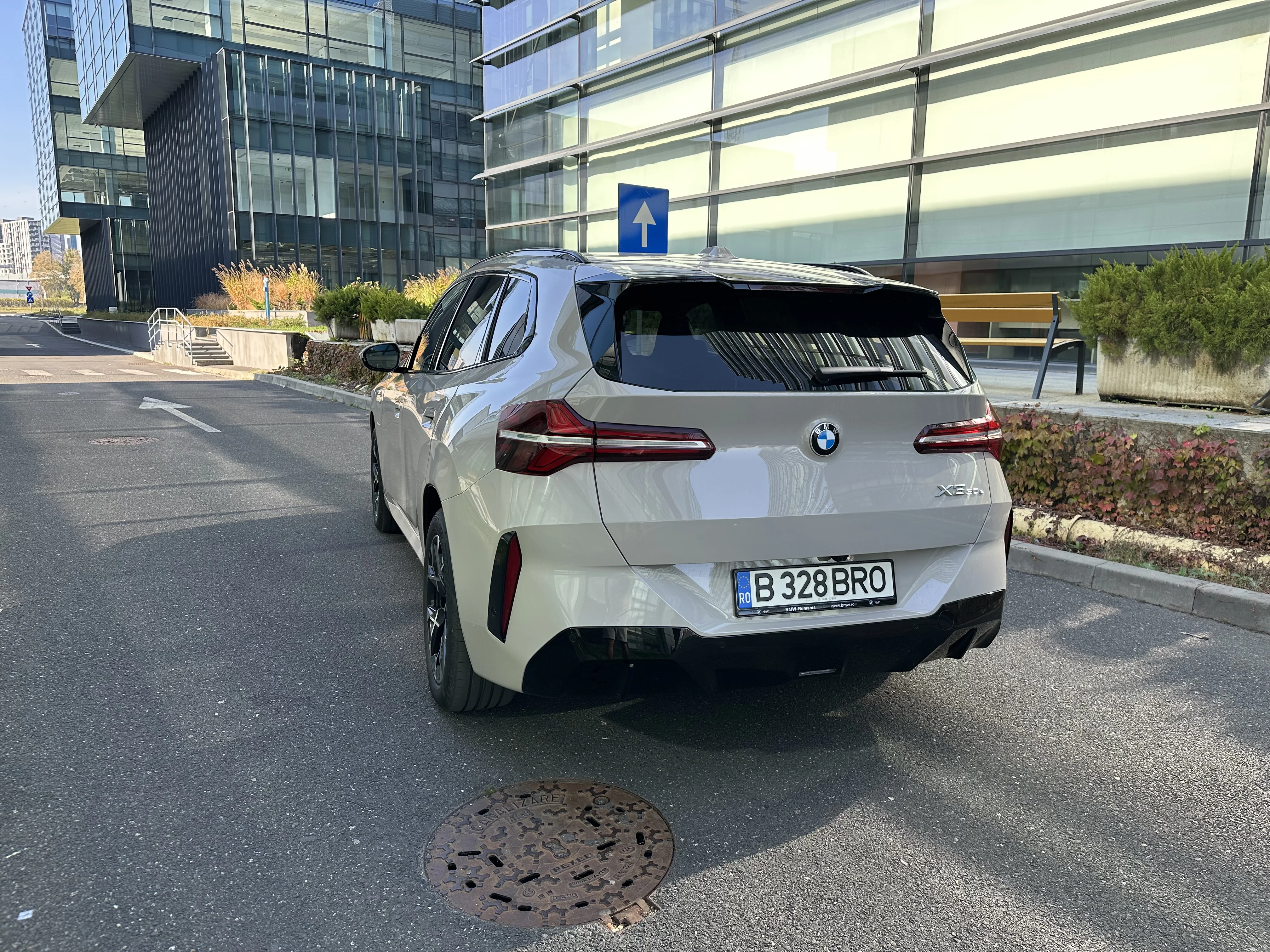
Pricing structure and options for the Romanian market
BMW positions the X3 30e in the premium plug-in hybrid SUV segment, with a pricing strategy that reflects the advanced technology and performance on offer.
Starting price: €59,000
The BMW X3 30e xDrive debuts at approximately €59,000, marking a reduction of about €460 compared with the previous generation. The full X3 range spans from approximately €49,500 for the 20 xDrive version to around €74,200 for M50 xDrive.
Equipment packs: Enhancement, M Sport Pro and Technology
The Enhancement pack costs 1,899 RON and includes metallic paint, the alarm system and Harman Kardon premium audio. M Sport Pro adds 949 RON, while the Technology Pack (approximately €2,275) and Comfort Plus Pack (€1,350) extend personalisation options.
Competitive positioning in the segment
Compared with the Lexus NX450h+ at 455,352 RON, the BMW X3 30e justifies the price difference through advanced hybrid technology and superior performance. Mercedes-Benz GLC300 and Audi Q5 offer similar proposals in this price category.
Warranty and operating costs
Standard warranty covers five years with no mileage limit, and the high-voltage battery benefits from extended protection for 8 years or 160,000 km. The 5-year service plan (80,000 km) costs 1,172 RON, with annual insurance estimated at 1,505 RON.
Conclusion
Extensive testing confirms that the BMW X3 30e 2025 delivers real-world performance close to official figures, with notable differences between urban and motorway environments. Electric range of 80 km in town effectively covers most daily trips, allowing extended periods of exclusive electric use.
The consumption gap between the two scenarios is substantial: 1.6 l/100 km in town with a charged battery, compared with 7.5–8 l/100 km on the motorway after the electric reserve is depleted. The 19.7 kWh battery discharges faster at constant 130 km/h, offering approximately 65–70 km of range in those conditions.
The price of €59,000 positions the X3 30e competitively in the premium plug-in hybrid segment. Compared with the Lexus NX450h+, it offers more advanced technology and superior driving dynamics, justifying the price difference. The reduced 460-litre boot is the only significant concession versus conventional versions.
Eight-year warranty for the high-voltage battery and charging time of 2 hours and 15 minutes at 11 kW make the system practical for daily use. The model mainly targets drivers with regular urban routes and occasional long-distance trips.
The BMW X3 30e 2025 demonstrates that plug-in hybrid technology has reached maturity in the premium SUV segment. Improved electric range and efficiency proven in tests make this version a viable alternative for users seeking balance between performance and fuel economy, without major compromises in usability.
Key Takeaways
Real-world testing of the BMW X3 30e 2025 reveals significant differences between urban and motorway consumption, offering practical perspectives for potential buyers.
Real urban electric range of 80 km covers most daily trips, with consumption of only 1.6 l/100 km
On the motorway at 130 km/h, the battery is depleted after 65–70 km, and consumption rises to 7.5–8 l/100 km
The price of €59,000 in Romania is competitive for the premium segment, with 8-year battery warranty
The reduced 460-litre boot (versus 570 litres on the non-hybrid) is the main compromise of the plug-in system
Charging at 11 kW allows a full recharge in 2 hours and 15 minutes, making daily use practical
The BMW X3 30e 2025 proves ideal for daily urban commuting and occasional motorway trips, offering substantial fuel savings for those who charge the battery regularly. The dramatic consumption difference between urban and motorway environments underlines the importance of understanding your personal usage profile before purchase.