The short answer
Automatic high beams use a forward-facing camera, and sometimes additional sensors, to decide whether the road is dark enough for main beam and whether another road user could be dazzled. The system normally switches between dipped beam and main beam. It does not turn a conventional headlamp into a matrix system that keeps the full beam on while cutting a hole around another vehicle. That is a separate adaptive-driving-beam concept.
The basic task is easy to describe but demanding to perform consistently. The car has to interpret points of light, estimate whether they belong to headlights or tail lamps, account for street lighting, and react to a changing scene. It also has to obey the conditions programmed by its manufacturer. This is why “automatic high beam” is a family of systems rather than one identical feature across every brand.
What the camera is looking for
The camera is commonly mounted high on the windscreen, near the interior mirror. It observes the road ahead rather than measuring only the light level directly in front of the bonnet. Oncoming headlamps are an obvious signal. Tail lamps matter too, because a driver following another vehicle can still dazzle it with main beam. Streetlights and other bright, fixed sources may also influence the decision.
The software does not simply react to the brightest pixel. It considers the position of a light, its apparent movement, its colour and its relationship to the road. A billboard, a house window or a lamp on a bend can look bright without representing a vehicle. The system therefore needs rules that distinguish a relevant road user from background illumination. Different manufacturers use different thresholds and processing strategies.
Honda’s public explanation offers a clear example. Its Auto High-Beam system uses a camera to detect oncoming headlamps, the tail lamps of vehicles ahead and streetlights. Honda says that, in the described application, the function can switch at speeds above roughly 30 km/h when the light switch is in AUTO and the other activation conditions are met. The figure is a manufacturer-specific example, not a universal speed for every car.
When the beam changes
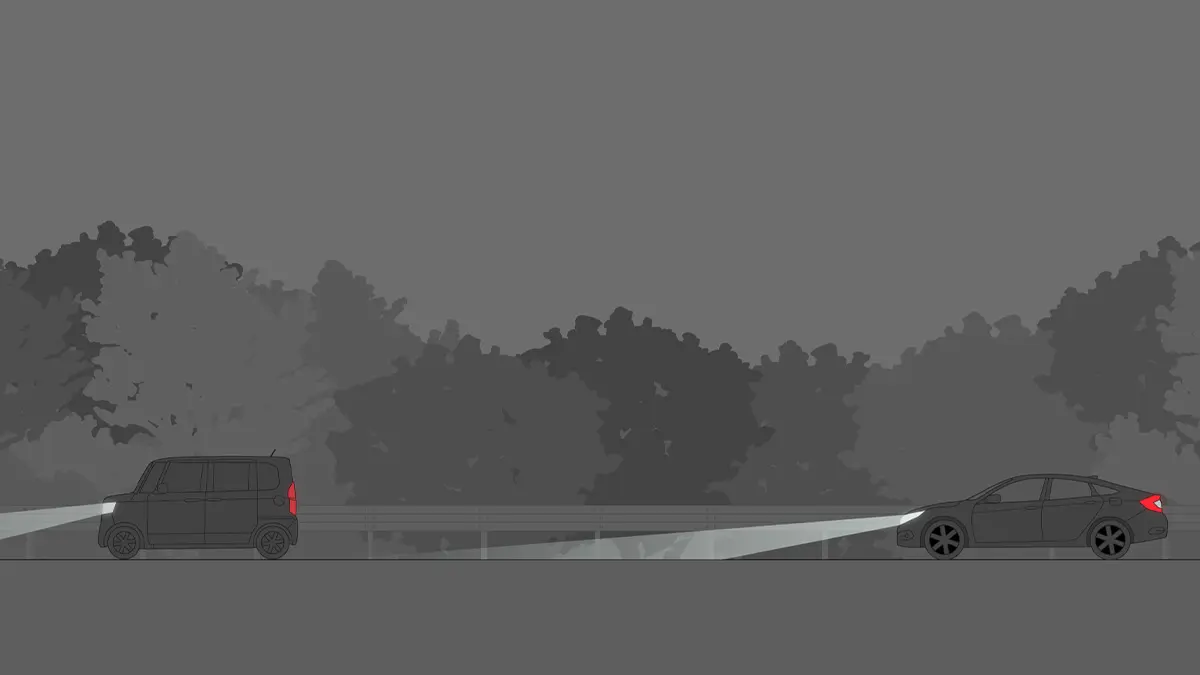
The usual sequence begins with darkness. If ambient light is sufficient, the system may keep dipped beam on because additional distance illumination is unnecessary. If the road is dark and the scene ahead appears clear, main beam can be selected. When an approaching vehicle is detected, the system returns to dipped beam. The same can happen when the camera sees the tail lamps of a vehicle travelling in the same direction.
When the vehicle disappears, the system may restore main beam. It does not have to do so immediately. A short confirmation period helps avoid constant switching in traffic, on undulating roads or around bends. The exact timing, speed threshold and distance window are determined by the vehicle software and the relevant approval requirements.
The driver normally has to enable the function in a defined way. Depending on the model, that can mean leaving the headlamp switch in AUTO, selecting the low-beam position on the stalk, pressing a dedicated button or accepting a setting in a vehicle menu. An illuminated symbol does not mean that main beam is currently on; on some cars it means the assistant is ready to operate. The owner’s manual is the only reliable guide to that distinction.
Automatic switching is not adaptive lighting
Transport Canada separates automatic high beams from adaptive driving beams. Automatic switching changes the whole headlamp from high to low beam. An adaptive driving beam can selectively dim or extinguish sections of the light pattern, retaining illumination in empty areas while reducing glare around detected vehicles. Marketing names such as matrix LED, anti-dazzle high beam and adaptive headlights can describe related hardware, but they should not be treated as synonyms without checking the specification.
This difference matters when comparing used cars. A windscreen camera may support lane or sign recognition without the car having an automatic main-beam assistant. Conversely, a vehicle may have an assistant that switches the whole beam even though the headlamp looks sophisticated. A dealer listing that says “intelligent lights” is not precise enough evidence. The original equipment list, the manual and a nighttime functional test are better references.
Where the feature can struggle
The camera needs a clean and correctly calibrated view. Dirt, condensation, ice, heavy rain, fog and snow can reduce recognition quality. A windscreen replacement can also matter when the camera is mounted behind the glass; many vehicles require a calibration procedure after that work. A temporary limitation may appear without a permanent hardware failure, while a warning message or stored fault can point to a more serious issue.
Road geometry creates another limitation. A vehicle hidden behind a crest or bend may be detected late. A motorcycle, bicycle or poorly illuminated vehicle does not present the same light pattern as a modern passenger car. Reflections from wet roads, signs and buildings can also confuse the scene. None of these cases removes the driver’s responsibility to dip the headlights manually.
NHTSA describes automatic high beams as a driver-assistance technology and tells drivers to remain engaged. Transport Canada gives the same practical warning: the function helps, but it does not replace attention and judgement. The useful mental model is an assistant watching the road with limited perception, not an independent lighting decision-maker.
What to check on a used car
A safe inspection should verify the feature on a suitable dark road, without creating glare or breaking local rules. Check that the system can identify both oncoming headlamps and the tail lamps of a vehicle ahead. Confirm that manual override still works, that the instrument-cluster indication is understood and that the assistant can be disabled. If the windscreen has been replaced, ask whether the forward camera was calibrated.
Also check whether the car has automatic high-beam switching or adaptive headlamps. The two may be listed separately in the equipment sheet. On some vehicles the camera is standard but the software function belongs to a higher trim or an optional package. The presence of a camera behind the mirror proves only that the vehicle has a camera, not which functions are active.
Automatic high beams can make dark-road driving less repetitive and can reduce the chance of leaving main beam on when traffic appears. Their benefit depends on a clear camera view, suitable conditions and a driver willing to take over. If the road scene looks ambiguous or another driver appears uncomfortable, dipping the beam manually is still the correct response.