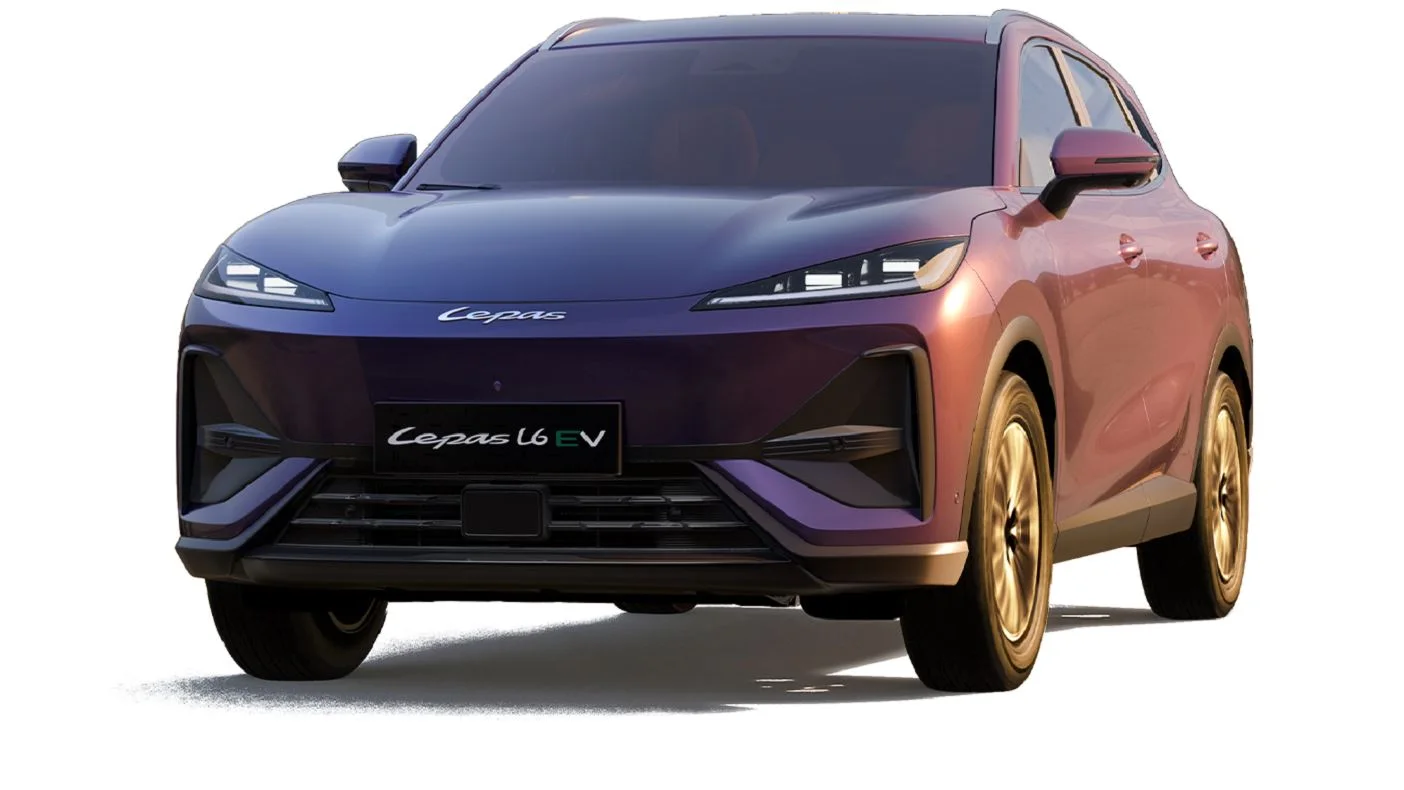
The Lepas L6 has earned five stars in Euro NCAP's 2026 assessment. That headline is supported by strong crash and post-crash results, but it is not a perfect report. The electric SUV scored 62% for Safe Driving, 78% for Crash Avoidance, 87% for Crash Protection and 95% for Post Crash Safety.
Euro NCAP tested a left-hand-drive L6 BEV Premium with front-wheel drive and a kerb weight of 1,830 kg. Its applicability table also lists BEV Comfort and several PHEV variants in both left- and right-hand-drive form. Buyers should still match the precise trim and type-approval documentation, because market names can differ from those used by the safety organisation.
Strong occupant protection, not flawless protection
The passenger compartment remained stable in the frontal offset test. Protection was good or adequate for most critical body areas, although chest protection was rated marginal in the full-width frontal test and in the side pole impact. The side barrier test produced good protection for critical body regions.
A centre airbag is standard and worked well, limiting contact between the front occupants. Head protection was good, while control of far-side body excursion was rated marginal. Euro NCAP's detailed results show 92% for frontal impact, 94% for side impact and 98% for rear impact. Those numbers explain the strong 87% Crash Protection pillar without erasing the weaker individual readings.
For pedestrians and cyclists, head, knee and tibia protection was mostly good or adequate. Protection around the femur was predominantly poor. The vulnerable-road-user impact subscore was 64%, so the five-star badge should not be read as uniform excellence across every contact zone.
Crash avoidance worked in demanding scenarios
The latest autonomous emergency braking system performed well in many scenarios, including turning and crossing paths. The car also warns occupants if they are about to open a door into a cyclist's path. Its lane-support system can intervene in critical situations, although Euro NCAP did not award a high driver-acceptance score. The system's sensitivity is not linked to the driver's detected alertness.
Driver monitoring recognises fatigue, distraction and phone use. The speed-limit assistant was tested over roughly 2,000 km in France, Italy and Spain. It identified the correct limit in 77% of situations, representing 88% of the distance covered. Adaptive cruise control generally responded well to changing traffic conditions.
Physical access to driving controls was a relative strength. Some comfort and infotainment functions scored less well for ease of use. The L6 does not recognise seat-belt misuse such as routing the belt behind the body, nor does it identify an occupant's out-of-position posture or stature. A Child Presence Detection system is fitted, but it failed to meet the protocol requirements and received no credit.
Post-crash response is the standout result
The 95% Post Crash Safety score is the L6's best result. It was the joint-highest figure in Euro NCAP's 18 November batch, shared with the Lepas L8 PHEV. The equipment includes multi-collision braking, an advanced eCall function that can transmit crash and occupant information, automatic high-voltage isolation and automatic door unlocking.
Rescue information and provisions for extracting occupants also contributed. These measures cannot prevent the first collision, but they can reduce the chance of a secondary impact and help emergency services work more quickly.
What the specifications say — and what they do not
Lepas UK has announced a 65 kWh LFP battery, a 160 kW front motor and 275 Nm for its L6 EV. The claimed WLTP range is 449 km, while peak DC charging power is 120 kW. A 30–80% charge is quoted at about 22 minutes. The vehicle measures 4,570 mm long, 1,852 mm wide and 1,676 mm tall, with a 2,700 mm wheelbase. Boot capacity is 410 litres, expanding to 1,334 litres with the rear seats folded, plus a 99-litre underfloor compartment.
These are official UK-market figures, not a universal European specification. Equipment, tyres, software and homologated range can vary by market and trim. Five-star safety coverage and a country's sales specification are related only when the listed variant and its safety equipment match.
Romania provides a useful example. The official Romanian site presents both PHEV and BEV concepts, but its current commercial offer is for the plug-in hybrid, starting at €35,990 including VAT during a launch promotion. It declares 92 km of electric WLTP range for the PHEV, while local BEV figures and pricing are still to be published. Romanian trims are called Essence and Elegance, whereas the Euro NCAP applicability table uses Premium, Comfort and Luxury. Without a published cross-reference, buyers should confirm the homologated variant with the importer rather than assuming every local name maps automatically to the tested car.
What five stars mean in 2026
Euro NCAP reorganised its 2026 assessment around four phases: safe driving, crash avoidance, crash protection and post-crash safety. Nine SUVs earned five stars in this particular release, while the Nissan Leaf received four. The rating therefore remains a demanding comparative result, but the stars alone do not show where one model is stronger than another.
For the L6, the useful reading is specific. Structure, restraint systems and rescue provisions are convincing. Active safety handled many difficult scenarios well. Occupant-state recognition, child-presence detection and some vulnerable-road-user protection leave measurable room for improvement. The five stars are deserved under the published protocol; the detailed scores are what prospective owners should use to understand the limits behind the badge.