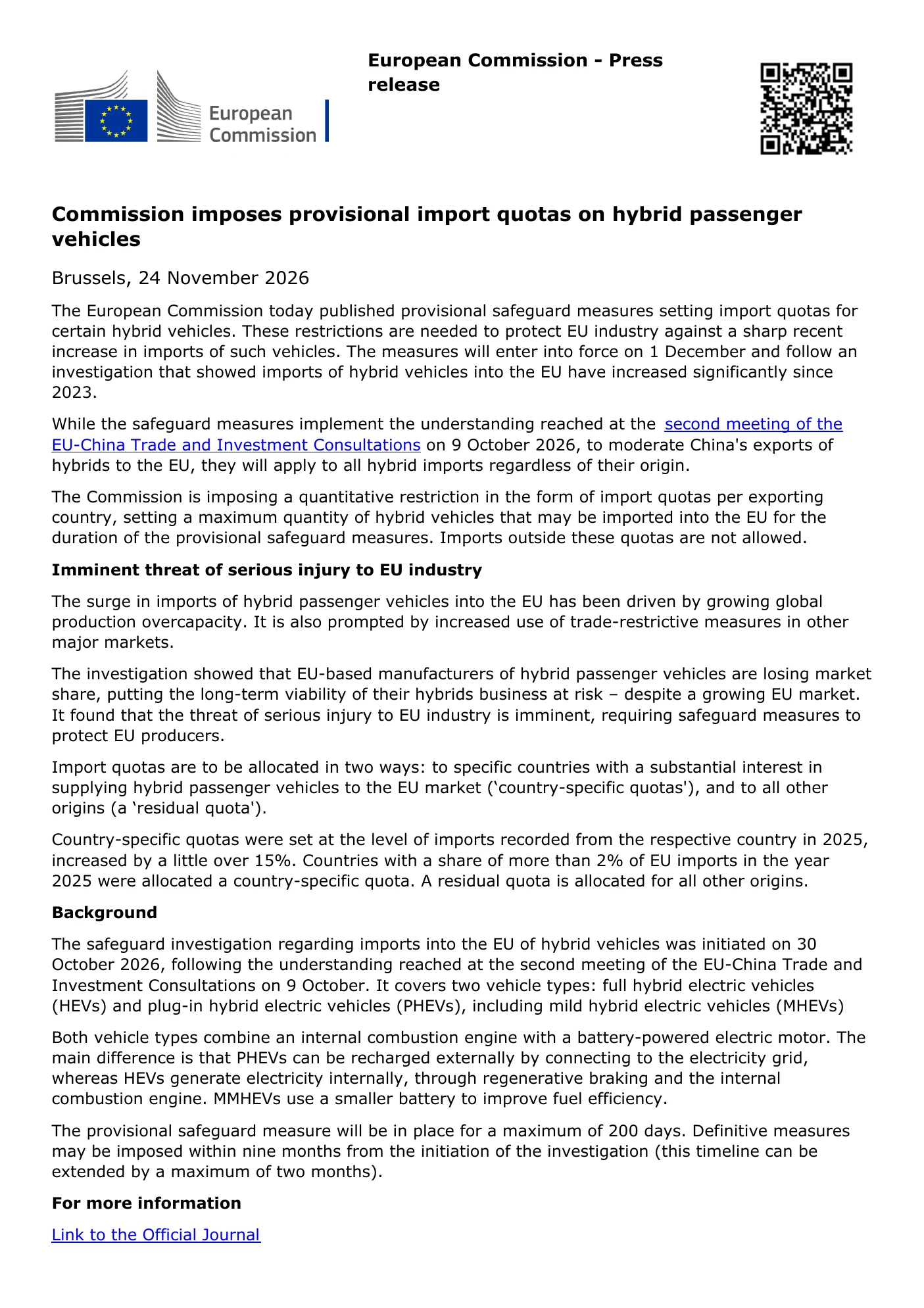
The European Union will cap imports of certain new hybrid passenger cars for 200 days from 1 December 2026. Commission Implementing Regulation (EU) 2026/2614 creates country quotas for vehicles that use both a combustion engine and an electric motor for propulsion. China receives a total allowance of 191,780 cars until 18 June 2027, but the measure also covers major suppliers including Japan, Türkiye, the United Kingdom and South Korea.
This is a quantitative restriction, not an extra tariff that can simply be paid after the allowance runs out. Article 1 states that imports of the covered product cannot enter the Union once the relevant origin's quota is exhausted. Cars admitted within a quota remain subject to the customs duty that would otherwise apply, including any preferential treatment under a trade agreement.
Which cars fall within the measure
The regulation covers new passenger vehicles principally designed for no more than nine people, including the driver. Both a piston combustion engine and one or more electric motors must propel the vehicle. That definition includes conventional full hybrids, plug-in hybrids and mild hybrids in which the electric system helps drive the car.
Pure battery-electric cars are outside this regulation. They are addressed by separate customs and countervailing-duty rules. Used hybrids are also outside the new quota, although the Commission has placed used hybrids, used battery-electric cars and several other vehicle groups under retrospective surveillance.
Marketing terminology is not enough to decide whether a car counts. Customs classification uses the CN and TARIC codes listed in the regulation. A 48-volt system that contributes torque to the wheels can meet the product definition, while a micro-hybrid whose electrical source only supports non-propulsion functions is excluded. Importers will need the actual technical and origin documentation for each version.
Origin means the vehicle's non-preferential customs origin, not the headquarters of the brand. A European badge on a car built in China can consume China's quota. A Chinese-owned model manufactured in the EU is not an import from a third country. The same model family can therefore receive different treatment when it comes from different factories.
The quotas are divided into three periods
China's allowance is 86,301 cars from 1 December 2026 to 28 February 2027, 88,219 from 1 March to 31 May and 17,260 from 1 to 18 June. Those three amounts total 191,780 units. Japan receives 170,889 over the full period, Türkiye 126,320, the United Kingdom 105,402 and South Korea 67,924.
Mexico's total is 34,755, Morocco's 23,954, Serbia's 19,353 and the United States' 18,482. All other covered origins share a residual allowance of only 822 cars. South Africa is shown as exempt, while Iceland, Liechtenstein, Norway, Ukraine and Kenya are also excluded under provisions identified in the regulation.
Unused volume can move from one quota period to the next within the 200-day measure. It does not create an unlimited annual pool. If requests exceed the available balance, allocation is made proportionally and rounded down to whole vehicles. Once the balance is gone, the quota closes.
China-made vehicles require an additional signed and stamped export-quota certificate issued by the China Chamber of Commerce for Import and Export of Machinery and Electronic Products. The prescribed form identifies the seller, importer, invoice, brand, model and quantity. Shipping a car before 1 December does not by itself prove that it has been released for free circulation before the restriction starts.
Why the Commission acted
The Commission opened its safeguard investigation on 30 October 2026. Its preliminary data show covered imports rising from 957,965 cars in 2023 to 1,225,813 in 2025. For the most recent 12-month period examined, covering the second half of 2025 and first half of 2026, the volume reached 1,423,691.
China supplied 46,001 covered cars in 2023, 106,542 in 2024 and 302,403 in 2025. The latest 12-month period reached 486,582, an index increase of almost 1,000% from the 2023 base. The regulation says the rise continued quarter by quarter: Chinese volumes moved from 92,999 in the third quarter of 2025 to 170,748 in the second quarter of 2026.
The Commission's model comparison covered 25 imported models and 29 EU-built models in four vehicle categories. It calculated imported offer prices around 18.3% below those of Union producers. These are Commission findings used for a preliminary safeguard decision, not Carboratory price tests and not proof that every imported hybrid undercuts an equivalent EU model by the same percentage.
The institution says EU producers face an imminent threat of serious injury rather than a final finding that serious injury has already occurred. The accelerated procedure used information available at this stage. Importers, dealers, producers and other interested parties can still submit evidence during the continuing investigation.
What a buyer can and cannot infer
The regulation does not order a price increase. An importer may have stock already released into free circulation, may receive enough quota for its planned deliveries or may source a version from another plant. It could also delay customs clearance, adjust allocations between markets or prioritise higher-margin versions if a quota becomes tight. These are commercial responses, not requirements written into the law.
For an order due after 1 December, buyers should ask where the specific car was built, whether it is already in EU free circulation and whether the delivery date depends on a quota allocation. A VIN can indicate a factory, but the certificate of conformity and import documentation are stronger evidence. The date on an order form is not the same as the customs release date.
The provisional measure ends on 18 June 2027 unless it is replaced or amended. Definitive measures can be imposed within nine months of the investigation's opening, with a possible extension of up to two months. Until then, the relevant practical indicator is the remaining quota for the car's manufacturing origin, not the nationality of its badge or the total number of hybrids registered in one EU country.