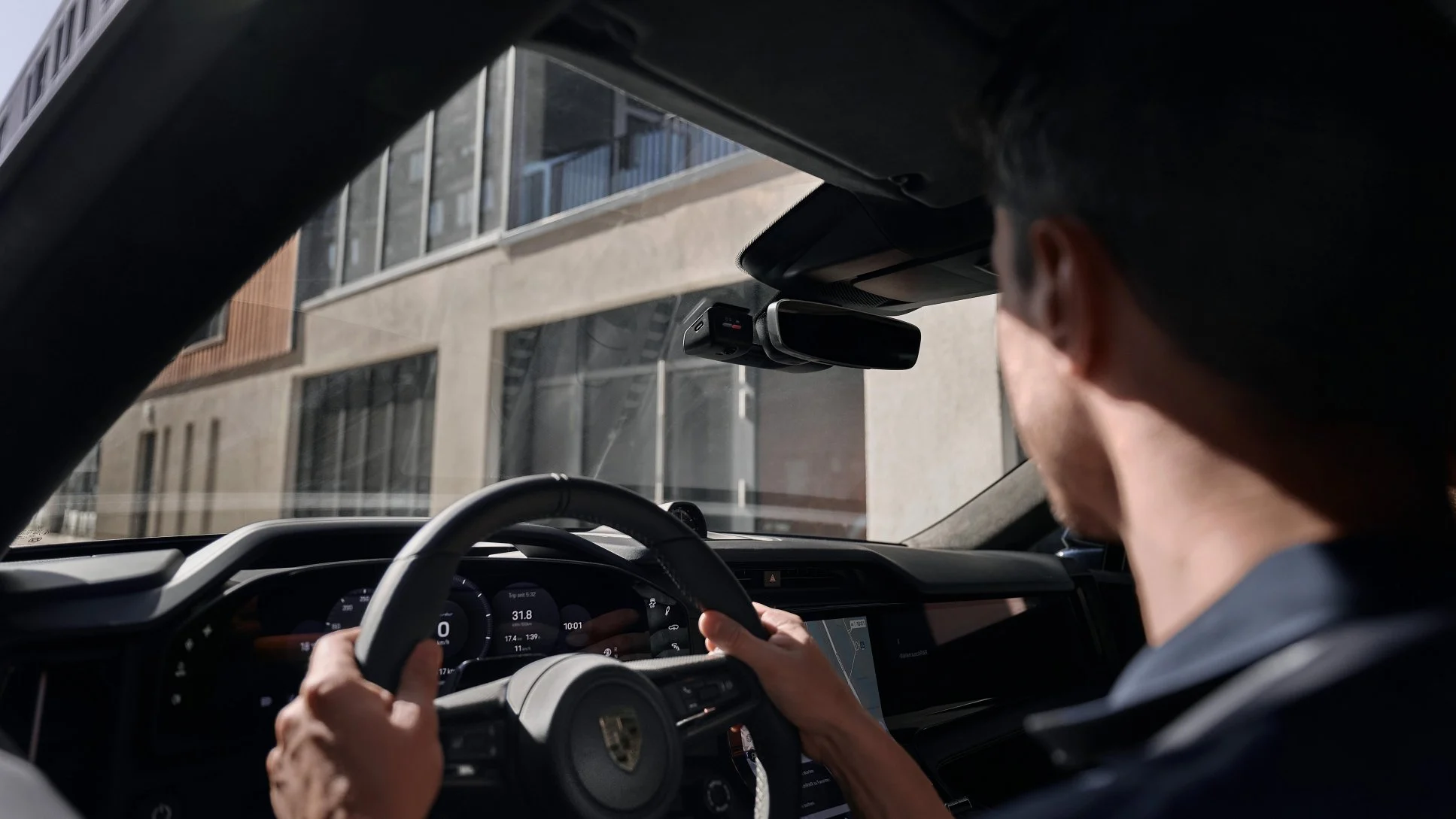
Porsche Dashcam Gen. 2 adds an interior camera to the manufacturer's accessory system for the first time. Mounted centrally below the rear-view mirror, the main unit records the road and the cabin, while compatible fixed-roof cars can also use a rear camera. QHD recording, HDR, a polarising filter, GPS, radar and a G-sensor are combined with local microSD storage and controls in the My Porsche app.
Porsche says the accessory can now be ordered through its Vehicle Accessories Finder or from Porsche Centres. That is not a universal compatibility promise or a confirmed price in every market. The car needs the QK3 dashcam pre-wiring option, and the installation instructions specify that the hardware should be fitted by a Porsche Centre.
Three cameras do not all use the same specification
The front camera records at 2,560 × 1,440 pixels. It can run at 60 frames per second when used as a single channel, or 30 fps in a two- or three-channel arrangement. Porsche lists a 137-degree diagonal field of view, with 114 degrees horizontally and 61 degrees vertically.
The cabin camera uses a square 1,440 × 1,440-pixel format at 30 fps. Its quoted 210-degree horizontal and vertical view is intended to cover the occupants rather than provide a conventional forward-facing frame. The separate rear camera records QHD at 30 fps and uses the same 137-degree diagonal angle as the front unit.
Porsche describes the product as a two- to three-channel camera system, depending on vehicle and equipment. Cabriolet and Targa models are offered with a front camera, while other body styles can use front and rear cameras. Buyers should have the exact configuration checked against the vehicle identification number, model year and installed preparation rather than assuming that every camera shown in the publicity material will fit every Porsche.
HDR is intended to retain detail across bright and dark parts of an image, while the polarising filter reduces reflections from glass. Those features do not guarantee readable registration plates in every recording. Porsche's own support material says low light, fog, dust and a large relative speed can prevent a plate from being captured clearly.
Radar and impact detection manage parking clips
The G-sensor responds to impacts or vibration above the selected threshold. Radar can monitor movement near a parked car, depending on its model and equipment. Parking mode begins roughly one minute after the ignition is switched off. A detected shock or movement can create a 20-second sequence, filed separately as an impact or parking recording.
The G-sensor has five sensitivity levels. Radar can be set to a near range of up to 2 metres or a far range of up to 7 metres under optimum conditions. Porsche cautions that temperature and the surrounding environment affect the real range. Objects passing horizontally at more than approximately 15 km/h do not trigger an event, which should reduce recordings caused by ordinary passing traffic.
A 64 GB microSD card is supplied, and the camera supports capacities up to 512 GB. Porsche specifies Class 10 or better and MLC memory for replacements, while noting that it cannot guarantee every third-party card. Driving, parking and event files occupy separate storage areas. The oldest material in each area is overwritten, so an owner who needs evidence should download it promptly or remove the card after switching the camera off.
The system records GPS information including position and speed. Date and time are based on GPS and synchronised with the connected phone for the local time zone. On a computer, one file can contain separate video tracks for the available views; Porsche recommends a player such as VLC when a standard player shows only the front track.
App control is local, not remote surveillance
My Porsche provides the gallery, live view and settings for cameras, audio, illumination and sensor sensitivity. The phone connects through the car's hotspot, with Porsche recommending the 5 GHz network where available. Communication between the phone and dashcam uses WPA/WPA2 encryption.
Live view is not available remotely from a house or office. The phone has to be connected to the vehicle hotspot. The dashcam can operate with its default settings without a permanent smartphone connection after setup, but Porsche requires initial configuration through My Porsche so the country and the relevant regulatory settings can be selected.
Porsche says it cannot access footage recorded by the dashcam, footage downloaded to the app or data held on the owner's phone. Recordings are stored locally on the microSD card and on the phone only when the user downloads them. That design reduces cloud dependence, but it also leaves the owner responsible for preserving, securing and lawfully using the files.
Battery management monitors the car while parking mode is active and shuts the camera down before charge falls to a level that could impair starting. Available standby time therefore depends on the model, battery and equipment. Thermal protection switches the unit off above 85 °C and restarts it below 65 °C.
Compatibility begins with recent model years
Porsche's international guide lists the 718, 911, Taycan, Panamera, combustion-engined Macan and Cayenne from model year 2023. Macan Electric is listed from model year 2024 and Cayenne Electric from model year 2026. It also states that the camera is currently incompatible with vehicles fitted with the Mobileye Level 2++ assistance system.
Availability of continuous recording, audio and parking functions can vary by country. Porsche tells users to check local recording laws and obtain the consent of all occupants when audio is enabled. An illuminated wordmark may indicate camera status, but a visible light does not replace the owner's legal obligations toward passengers or people captured outside the car.
No single global retail price was included in the announcement. Installation cost, camera combination and availability need a market-specific quotation. For an existing car, the practical questions are whether QK3 preparation is present, which channels are supported, what the fitted price is and which functions are enabled under local rules.