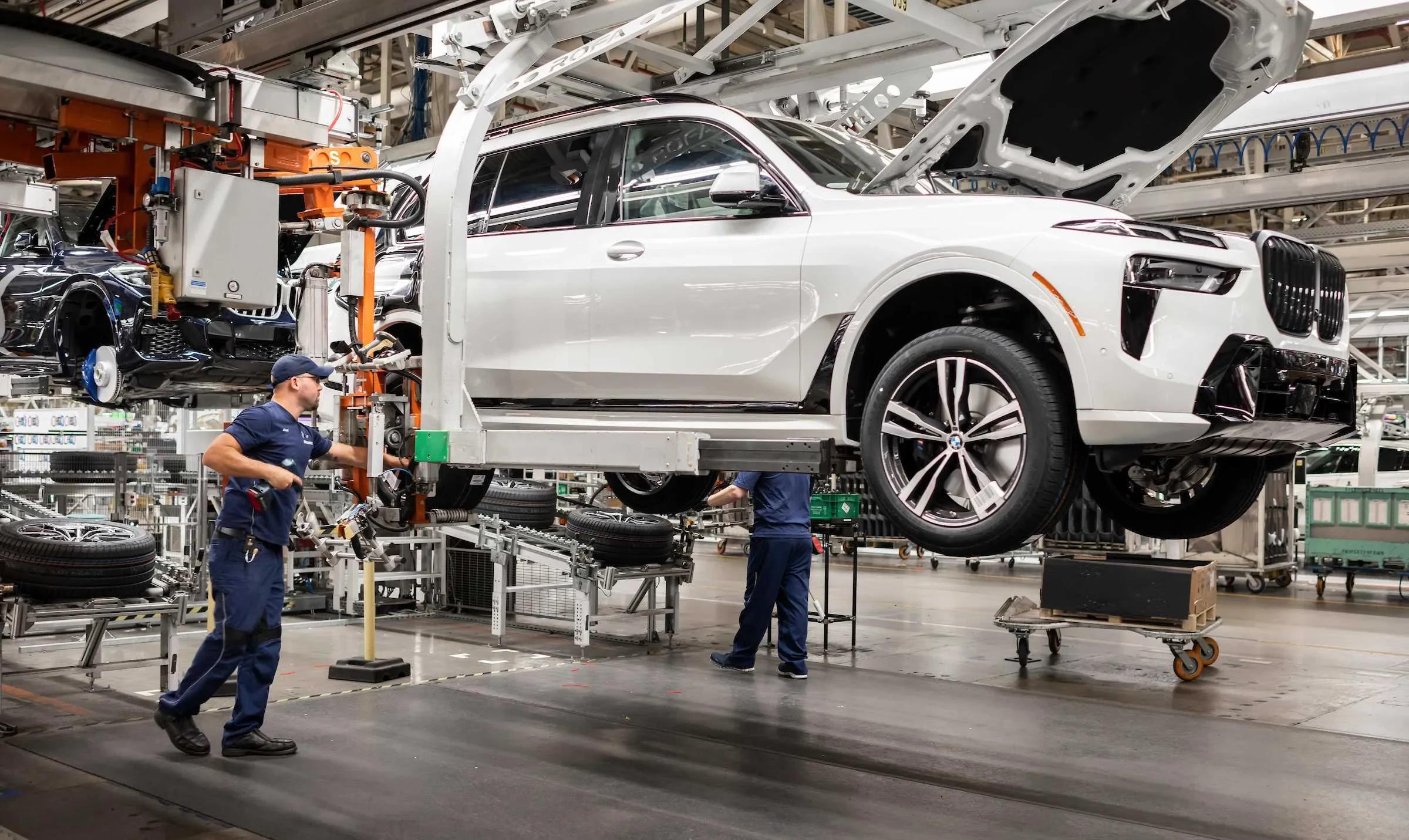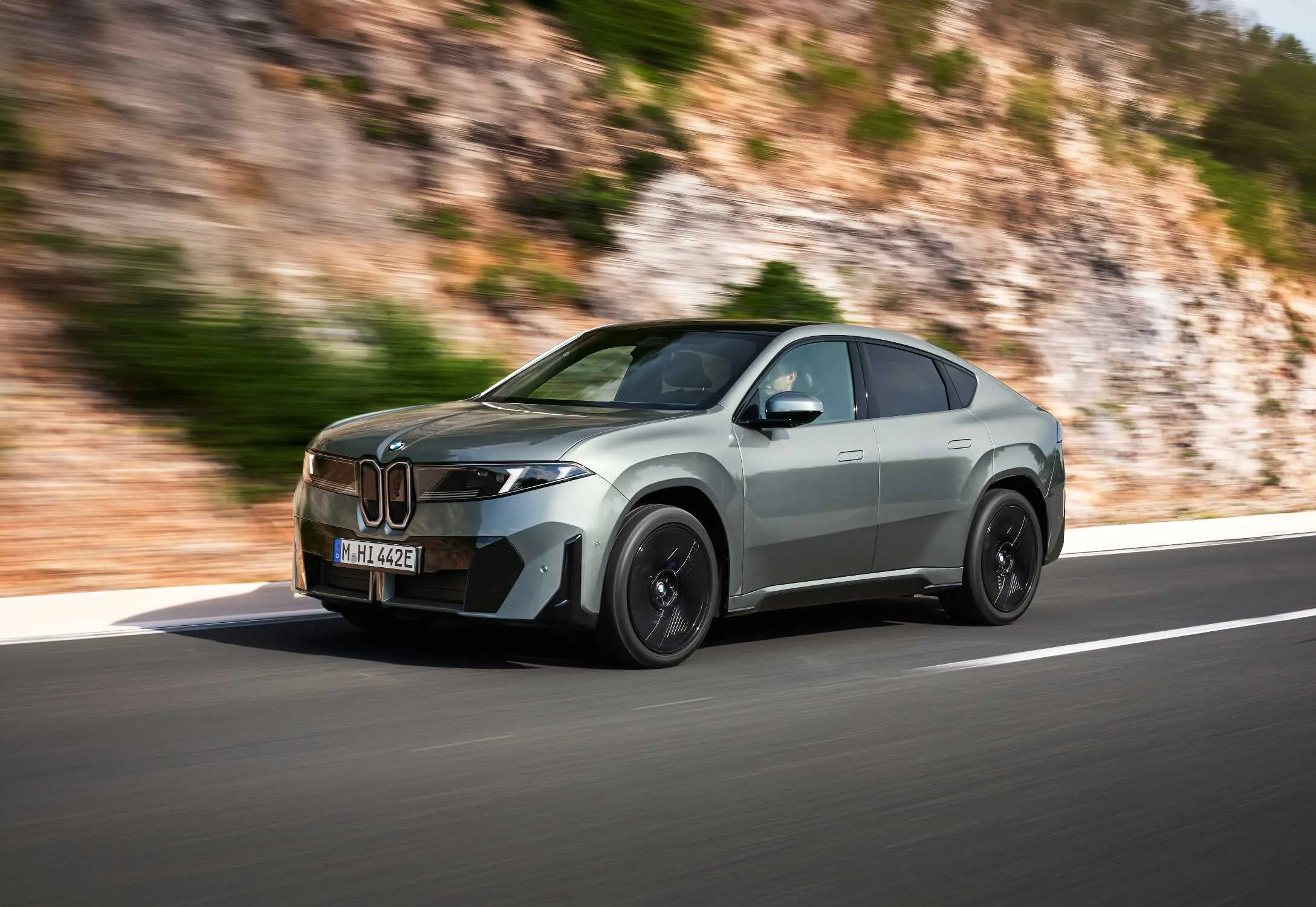
BMW Group began series production of the new iX4 at its Debrecen plant in Hungary in early November 2026. It is the second Neue Klasse model built there after the iX3. The iX4 40 xDrive and 50 xDrive are already on the line, although the commercial launch remains scheduled for March 2027.
The official announcement separates two milestones that are easily confused. BMW had already revealed the car and opened orders in selected markets. It is now confirming that customer-specification vehicles are being manufactured. That does not mean immediate showroom availability: cars still have to be allocated, shipped and prepared before deliveries begin.
A second Neue Klasse model in less than a year
The iX4 entered production less than two months after Debrecen introduced a third shift. The plant has operated around the clock since September 2026 to support iX3 output. BMW says 100,000 European customers ordered the iX3 during the first year after its world premiere.
The factory completed its 50,000th iX3 in July. According to BMW, reaching that output level took roughly eight months and represented the fastest production ramp-up at any new BMW Group plant. Adding the iX4 demonstrates the line's flexibility, but the company has not disclosed a separate annual capacity target for the coupe-shaped SUV.
More than 5,000 people now work at Debrecen. Plant president and CEO Hans-Peter Kemser credited their expertise and teamwork for the second model launch. Those employment and production figures come from BMW. The release does not say how the plant's total capacity will be divided between the iX3 and iX4.
The 40 and 50 xDrive are already being built
The iX4 40 xDrive uses one electric motor on each axle and produces 275 kW, or 374 hp, and 520 Nm. BMW quotes 5.6 seconds from 0 to 100 km/h and a maximum WLTP range of 638 km.
The iX4 50 xDrive raises output to 345 kW, equivalent to 469 hp, with 645 Nm. Its official 0–100 km/h time is 4.9 seconds. The battery provides 108.7 kWh of usable energy, while maximum claimed range reaches 828 km under WLTP. These are manufacturer homologation figures, not results from an independent Carboratory road test.
Real range will vary with speed, temperature, wheel size, payload and climate-control use. The highest WLTP figure is useful for standardised comparison, but it does not guarantee 828 km of motorway driving or winter travel.
A 400 kW peak needs the right conditions
The 50 xDrive can accept up to 400 kW of DC charging power. BMW says a ten-minute session at a suitable charger can add enough energy for as much as 387 km of WLTP range. That result requires infrastructure capable of supplying the peak and a battery at an appropriate temperature and state of charge.
The iX4 uses sixth-generation BMW eDrive technology, cylindrical cells, an 800-volt system and cell-to-pack construction. The 400 kW figure is a peak rather than a rate held throughout the session. A lower-powered charger will limit the car, and the complete charging curve matters more to journey time than a single maximum number.
The M60 will use the same factory
BMW confirms that the iX4 M60 xDrive will also be built in Debrecen and will follow shortly after the launch versions. The earlier technical presentation listed 450 kW, or 612 hp, 875 Nm and a 3.9-second 0–100 km/h time. Its maximum stated WLTP range is 777 km.
The November production release does not provide the exact day on which M60 assembly will begin or a planned volume. Romanian pricing already published for the regular models is €69,152 including VAT for the 40 xDrive and €74,597 for the 50 xDrive. Neither amount applies to the later M60.
Why the Debrecen plant matters
BMW designed Debrecen exclusively for electric-car production. During normal operation, the plant uses electricity from renewable sources and no fossil fuels, according to the company. Solar panels on the site can cover about a quarter of its annual electricity demand.
Surplus solar electricity can be converted to heat and stored in a 1,800 m³ thermal system with 130 MWh of capacity. Gen6 high-voltage batteries are assembled on the same site, close to vehicle production. These details describe the manufacturing process; they are not, on their own, a full independent life-cycle assessment for each iX4.
The plant was planned digitally around BMW's iFACTORY strategy. The manufacturer highlights flexible processes, data use and artificial intelligence. The measurable result in this announcement is simpler: one factory is now producing two Neue Klasse models before the iX4 reaches customers.
What remains to be tested
Starting production does not establish how long each buyer will wait. Specification, national allocation, transport and dealer preparation can all change an individual delivery date. BMW did not provide a specific timetable for Romanian orders in this production announcement.
Independent tests will also need to verify range, sustained charging performance and the space trade-off against the iX3. BMW quotes 490 litres of luggage capacity with the rear seats up and 1,600 litres with them folded. The lower roof is the visible difference, but everyday use will show how much it affects access and the ability to carry tall items.
Series production is therefore a concrete industrial milestone rather than a concept promise. The next sequence is clear: distribution preparation through the winter, the 40 and 50 xDrive market launch in March 2027, and the addition of the M60 afterwards.
Official BMW iX4 50 xDrive press image; the pictured car may include optional equipment. © BMW AG, official iX4 media gallery.