Mercedes-Benz is developing two ways to put information into vehicle glass: LED elements laminated into windows and a holographic projection system for the windshield. Its November 3, 2026 announcement explicitly describes research projects, rather than customer features or confirmed series-production applications. There is no announced model, order date or price for either display technology.
The distinction matters because the demonstration photographs can easily look like previews of an imminent option. What Mercedes has disclosed is how the systems could work and what they might display. Buyers still lack the product information needed to judge availability, specification or the cost of owning a car equipped with them.
A rear window that could send a warning
The external communication project places LED display elements within the laminated glass structure. Mercedes identifies the rear window as a possible location for warning symbols and traffic information directed at people behind the vehicle. The elements are intended to become almost invisible when they are not displaying content, according to the manufacturer.
Two LED approaches serve different proposed uses. Mini LEDs suit larger areas, with possible functions including brake lights, warnings and traffic messages. Micro LEDs offer high resolution for smaller areas and more detailed graphics, including animations. The announcement gives neither a production display resolution nor a final display size.
Those descriptions also leave an important distinction between a possible message and a delivered safety outcome. An illuminated warning is a proposed communication tool. Mercedes has not published accident-reduction results or road-user comprehension measurements alongside this announcement. Its safety rationale should therefore be read as the purpose of the research, rather than an independently demonstrated benefit.
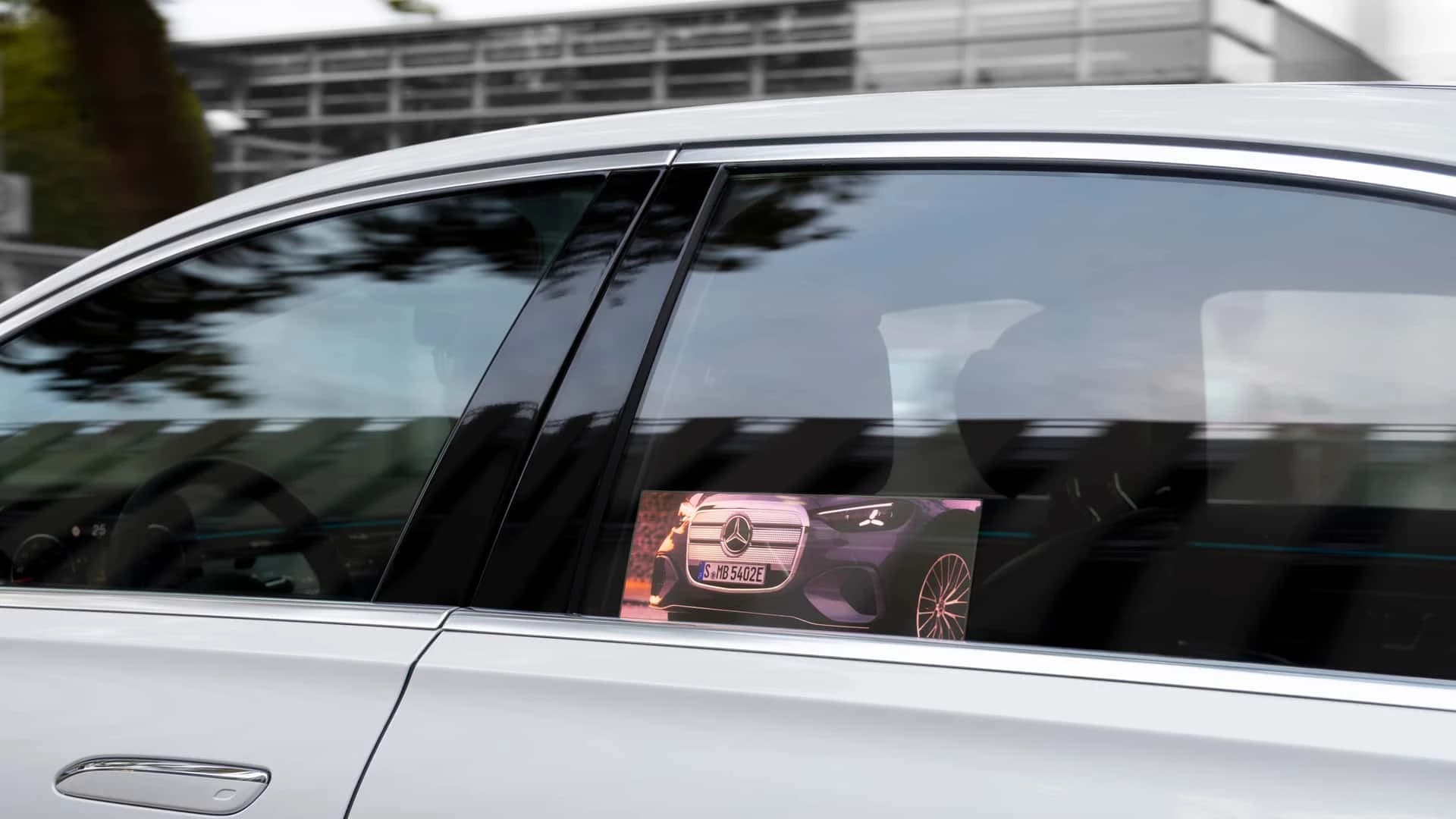
The photograph accompanying this story shows a colour image in the rear side-window area of a demonstration car. It is the Mercedes-Benz image used in the supplied Motor1 article. It should not be mistaken for evidence that a particular production trim now includes a window display; the official release discusses the rear-window warning applications separately.
The windshield uses a projector and optical film
The holographic system takes another route. A projector in the instrument panel directs content towards a transparent film laminated into the windshield. Holographic optical elements, or HOE, selectively reflect the wavelengths emitted by the projector. Mercedes says the light is concentrated so that the image can remain visible in sunlight.
A second property is directional visibility. In the configuration described by the company, the driver cannot see content shown on the passenger side, while the passenger cannot see the driver's display. The windshield becomes an optical surface with controlled viewing angles, rather than simply a larger version of a dashboard touchscreen.
That difference helps explain the proposed passenger applications. Navigation instructions for a driver and a film for a passenger are different tasks, even if both use the same broad area of glass. The optical concept aims to keep those views separate. It does not establish the exact range of seating positions or viewing angles supported by a future production system.
What Mercedes proposes showing
The manufacturer lists driving information, navigation, context about points of interest, films and video calls among possible uses. These are examples of potential functionality. They are not a declaration that a driver could watch every type of content while moving, nor a published specification of which functions would be enabled in a particular market.
Content would appear when needed instead of remaining permanently visible. This is relevant to the physical description: Mercedes is investigating a transparent optical layer and projection, not announcing an opaque television panel in place of the windshield. The release does not say that the whole windshield would become one uninterrupted video display.
Several measurements needed for a meaningful product comparison remain absent. Mercedes does not provide a final resolution, display area, power draw or measured brightness specification for the system. A photograph cannot establish readability across changing light conditions. It also cannot show how consistently the intended separation between driver and passenger would work in everyday use.
Repair costs are an open question
Putting display elements or optical film into glass creates a reasonable ownership question: what happens when that glass is damaged? The announcement does not answer it. There is no published replacement price, repair procedure, warranty schedule or explanation of whether individual electronic components could be serviced separately.
It would therefore be premature to attach a specific repair premium to the technology. Equally, there is no evidence here that replacement would cost the same as conventional glazing. Both claims would go beyond the material released. A buyer would need the final component design and service documentation before making a useful cost comparison.
The same caution applies to availability. Mercedes has not identified a first production vehicle for either glass-display project in this release. It has not specified launch markets or an ordering timetable. The presence of a demonstration car in an image does not supply those missing details.
What would turn the research into a buying decision
For customers, the useful next announcement would identify the vehicle, the functions actually offered and the markets where they can be ordered. An equipment list would also need to distinguish the glass-integrated LEDs from the holographic windshield: these are separate technical approaches with different audiences and uses.
Until then, an existing Mercedes order should be assessed against its own documented equipment. The November research presentation does not add a feature to an already configured car. It establishes two directions Mercedes is exploring and the optical mechanisms behind them, while leaving the production specification and ownership terms unresolved.
Image: Mercedes-Benz, as used in the supplied Motor1 article. Reproduced for editorial coverage under Mercedes-Benz Media terms; the photograph depicts a technology demonstration.