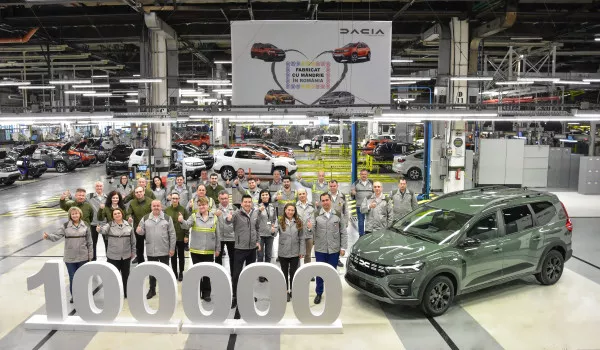
Romania's government is considering opening the Rabla vehicle-renewal programme earlier in 2027 and making it more generous than this year's scheme. Prime Minister Luca Niculescu outlined that direction on 25 November after visiting Dacia's Mioveni plant. His statement is not an approved funding decision: no 2027 budget, application date or grant values have yet been published.
What the government has actually proposed
Niculescu said the government wants Rabla to start earlier next year and is examining a more generous version. He did not define whether “more generous” means a larger total allocation, higher individual grants, wider eligibility or a mixture of those measures. Treating the phrase as a confirmed increase in the electric-car subsidy would therefore go beyond the announcement.
The prime minister also said the authorities would examine a stronger focus on vehicles manufactured in the European Union. Separately, he referred to unblocking purchases of Romanian-made vehicles by public bodies. These are distinct policies: consumer support under Rabla and public procurement have different rules, budgets and approval procedures.
For applicants, the binding documents will be the financing guide, government funding decisions and the session opened by Romania's Environmental Fund Administration, or AFM. Until those are available, a dealer cannot guarantee that a particular model, contract date or scrapped vehicle will meet the 2027 conditions.
The 2026 grants are a baseline, not a promise
Romania's Environment Ministry set a RON 300 million budget for individuals in 2026. The announced grants were RON 18,500 for a battery-electric or hydrogen fuel-cell car, RON 15,000 for a plug-in hybrid or electric motorcycle, RON 12,000 for a hybrid and RON 10,000 for an internal-combustion vehicle, including LPG or CNG, or a conventional motorcycle.
Those figures describe the 2026 scheme only. They can be changed through the next financing guide, and buyers should not build a deposit or finance agreement around an assumed 2027 amount. A larger overall programme could also add more funded applications without increasing the voucher paid for each car.
The ministry opened an additional RON 35.389 million session on 3 November 2026. It allocated RON 25.6 million to combustion and hybrid vehicles, RON 9.239 million to plug-in hybrid, electric and hydrogen cars, and RON 550,000 to motorcycles. The top-up illustrates how allocations can be adjusted during the year, but it does not reveal the structure of the 2027 programme.
Demand shows why timing and allocation matter
AFM's session list records how quickly the November funds were reserved. The motorcycle allocation was exhausted in one minute and 31 seconds, the electrified-vehicle component in five minutes and 48 seconds, and the combustion and hybrid allocation in 52 minutes and 10 seconds. Thousands of files were registered across the three components.
An earlier opening could give households and dealers more certainty near the beginning of the year. It would not by itself solve a mismatch between demand and available money. The amount assigned to each powertrain, reservation process, purchase deadline and rules for transferring or cancelling a file can be just as important as the launch month.
Prospective buyers should read order forms carefully. A vehicle ordered before the official session may be priced on the assumption that funding will be available. The contract should state what happens if Rabla is delayed, the model becomes ineligible or the relevant allocation is exhausted before the application is accepted.
An EU-production condition is not final yet
Romania's 2026–2028 government programme says Rabla should operate from 2027 to 2030 only for vehicles manufactured in the EU, with a calendar announced in the first quarter of each year. That document sets the government's intended direction, but the criterion still needs implementing rules before AFM can apply it to applicants and cars.
The Environment Ministry explained in July that it had not introduced geographical-origin limits for 2026 because the additional European procedures would have delayed the programme by at least three months. It said the required steps would be prepared for the following year. The precise legal wording, evidence required and any transitional provisions therefore remain open questions for the 2027 guide.
“Manufactured in the EU” is not the same as carrying a European badge or being built in Romania. European brands produce some models outside the Union, while manufacturers headquartered elsewhere operate factories inside member states. If the restriction is adopted, the model's actual production location and the guide's definition will matter more than the nationality associated with its brand.
What a buyer should verify
The first official checks should be the Environment Ministry's announcements and AFM's session portal. The decisive details will include the total budget, allocation by technology, voucher amounts, vehicle price ceiling, scrappage requirements, eligible applicants and the time allowed to complete the purchase and registration.
Buyers should ask dealers to confirm eligibility for the exact version and production location after the guide is published. A quotation should separate the pre-incentive price, the dealer discount and any estimated public grant. If financing is involved, the monthly cost should also be recalculated without Rabla so the exposure is clear if the application fails.
The Mioveni announcement is therefore a policy signal rather than a buyer entitlement. It points toward an earlier calendar, potentially more money and a possible EU-manufacturing test. It does not yet guarantee a larger voucher or justify delaying a purchase without comparing price, finance cost, delivery timing and the risk that the final rules differ from the 2026 scheme.