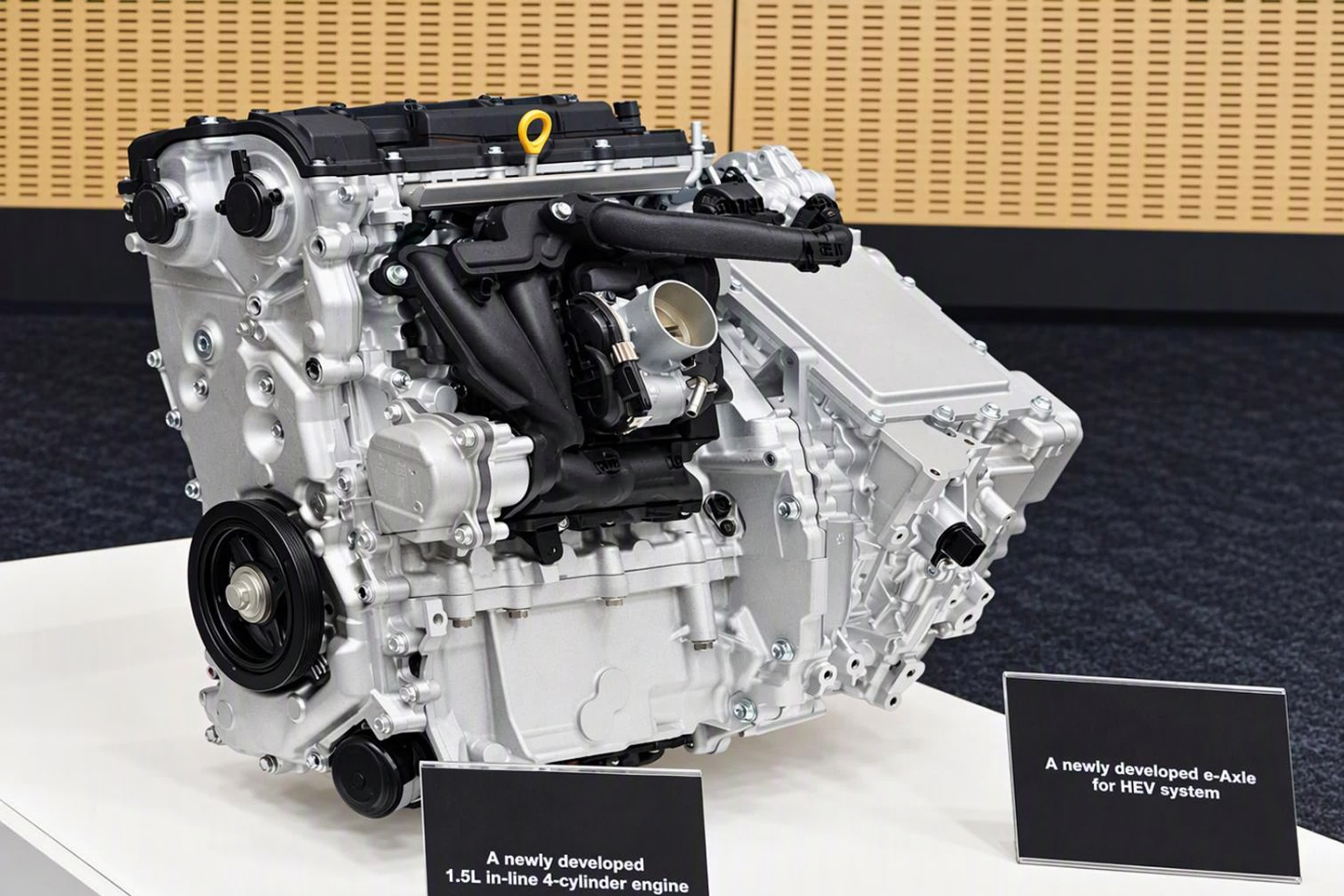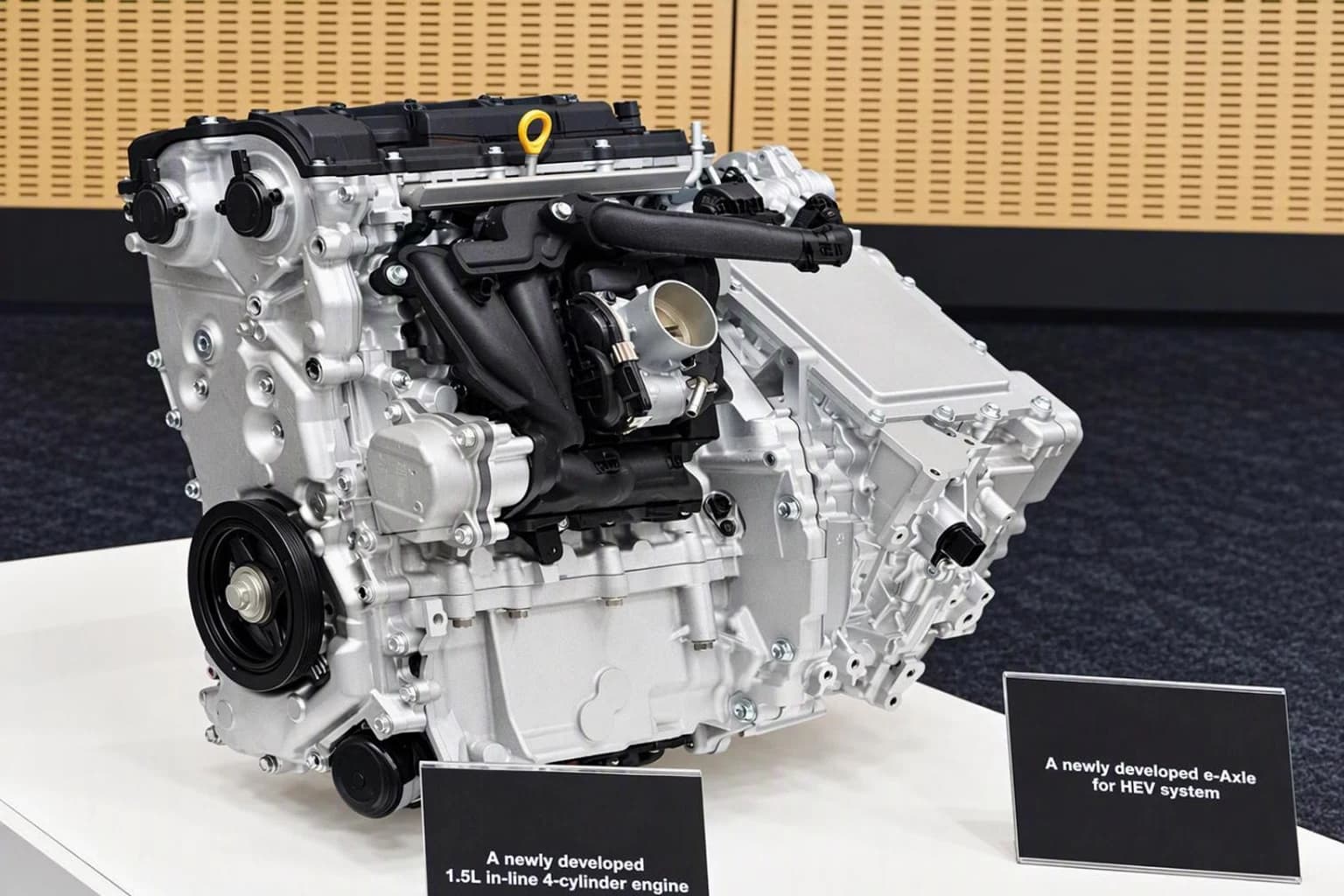
Toyota's official image of the new 1.5-litre four-cylinder engine. Photo source: Toyota Europe.
Toyota develops a new hybrid system with a 1.5-litre four-cylinder engine
Toyota is developing a next-generation hybrid powertrain for future multi-pathway vehicle platforms. Toyota Motor Europe announced the project on 28 October 2026, describing a new family of 1.5-litre four-cylinder petrol engines in naturally aspirated and turbocharged forms. The company is targeting more than 15 per cent better fuel economy through changes to the engine, electric drive components, thermal management and vehicle aerodynamics. Toyota has not yet named the first production model, announced a launch date or published a certified fuel-consumption figure for the system.
Engine and hybrid system developed together
Toyota says the new engine was designed for electrification from the beginning rather than adapted from an existing unit. The engine, hybrid system and power electronics were developed as one integrated powertrain. The family will include naturally aspirated and turbocharged versions, but the company has not released output, torque, compression ratio, engine codes or a complete technical specification.
The naturally aspirated engine is intended to cover the hybrid-system performance range currently served by Toyota's 1.8-litre engine and its current 1.5-litre three-cylinder unit. That statement describes Toyota's intended positioning within its range. It does not mean that the new engine will have identical output or that one unit will immediately replace every existing powertrain. Vehicle weight, transmission calibration and the size of the electric motor will still influence the final specification.
More than 15 per cent is a development target
Toyota is targeting a fuel-economy improvement of more than 15 per cent. The manufacturer attributes the expected gain to lower mechanical friction, improved thermal management, reduced electrical losses and lower aerodynamic drag. These are engineering targets for the powertrain and the future vehicles around it, not results from an independent test.
The announcement does not state the reference vehicle, test cycle or exact consumption value used for the comparison. It therefore cannot be converted into a promise that a future Toyota will achieve a particular number in litres per 100 kilometres, miles per gallon or WLTP emissions. Toyota has also not published electric-only range, battery capacity, combined system output or performance figures for the new hybrid family.
That distinction matters because efficiency depends on the complete vehicle. Body shape, mass, tyre choice, battery state, ambient temperature and transmission calibration all affect the result. The same engine could produce different official figures in a hatchback, crossover or larger vehicle.
Smaller electric motors and power electronics
Toyota is also developing lighter and more compact electric motors, power-control units and inverters. The components are being integrated more closely to reduce losses across the complete hybrid system. The company has not supplied individual weights or loss figures, so the benefit cannot yet be separated between the petrol engine and the electrical hardware.
The lower-profile engine and hybrid package may give designers more freedom. Toyota says the smaller system can enable lower bonnet heights and different vehicle proportions. That is an architectural objective rather than a preview of a particular Toyota model. No exterior design, interior layout or production vehicle has been announced with the powertrain.
One architecture for several powertrains
The project is linked to a new multi-pathway platform designed to accommodate battery-electric vehicles, plug-in hybrids and conventional hybrids. Toyota says the hybrid and plug-in hybrid systems can be integrated into the same basic architecture without compromising vehicle silhouette, interior space or capability. The release does not identify the first application or confirm that every version will be sold in Europe.
Toyota also sees a manufacturing benefit. A common architecture could spread engineering and production investment across higher combined volumes. Factory operations are intended to adjust the mix of battery-electric, plug-in hybrid and hybrid vehicles more easily as customer demand changes. This is a production objective, not an announcement of a particular factory, capacity or local-market allocation.
Renewable fuels remain part of the plan
Toyota says the new system is being developed to run on renewable and carbon-neutral fuels. The statement places the engine within the company's multi-pathway approach to carbon neutrality, alongside battery-electric and fuel-cell technologies. It does not mean that every future hybrid will use alternative fuel, nor that a compatible fuel supply or a Romanian market launch has been confirmed.
Toyota Motor Europe says it employs more than 26,000 people and operates eight manufacturing plants in Portugal, the United Kingdom, France, Poland, the Czech Republic and Turkey. The company says it has invested more than €12 billion in Europe since 1990 and sold 1,229,000 Toyota and Lexus vehicles in Europe during 2025, representing a 7.2 per cent market share. Those figures explain the scale of the regional operation, but they do not identify where the new hybrid system will be built.
What buyers can and cannot infer
For buyers, this is a technology announcement rather than a new model launch. Toyota has not released prices, power outputs, WLTP fuel consumption, emissions, electric range, battery size or a delivery timetable. The company has also not said which current models will receive the engine first.
The confirmed points are narrower: a new 1.5-litre four-cylinder engine family, naturally aspirated and turbocharged variants, smaller electric-drive hardware, a shared architecture for BEV, PHEV and HEV vehicles, and a target of more than 15 per cent better fuel economy. The first production application and its certified figures will determine whether the promised efficiency gain translates into a meaningful advantage for customers. Until Toyota publishes those details, claims about a specific model or an exact consumption number remain unconfirmed.