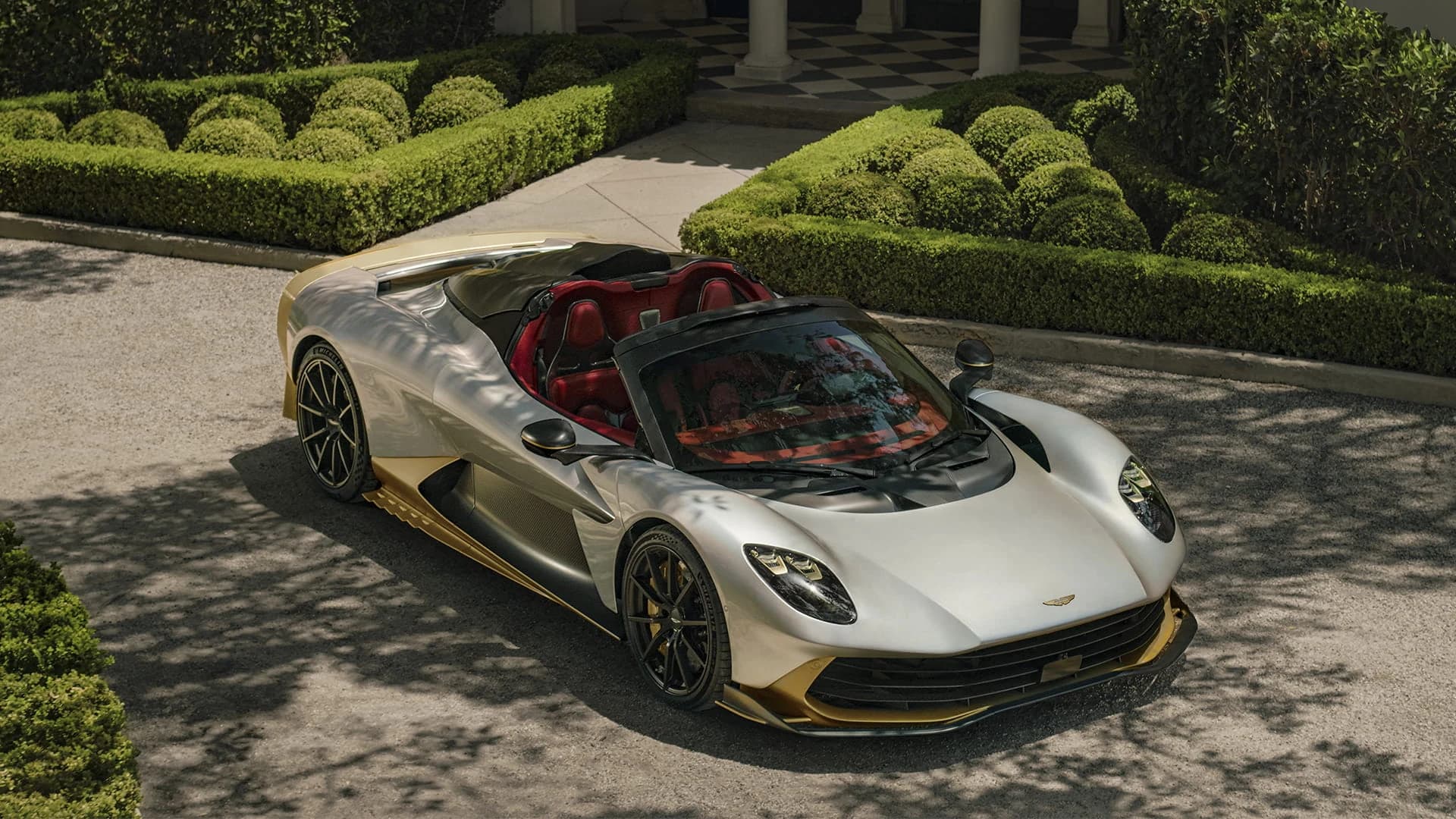
Official Aston Martin image of the Valhalla Spider. Image source: Aston Martin.
Aston Martin Valhalla Spider keeps 350 km/h with the roof removed
Aston Martin has revealed the Valhalla Spider, an open-cockpit version of its mid-engined plug-in hybrid supercar. The car keeps the Valhalla Coupé’s 4.0-litre twin-turbo V8, three-motor hybrid system and active aerodynamics, while adding a choice of removable roofs. Public deliveries are scheduled to start in the third quarter of 2027.
The headline figures remain unchanged: 1,079 PS of combined power, 1,100 Nm of torque, 0–100 km/h in 2.5 seconds and a 350 km/h electronically limited top speed. Aston Martin describes the Spider as its fastest open-cockpit road car. Its official website still lists fuel consumption and CO₂ as subject to homologation, so those figures should not be treated as final.
A removable roof rather than a folding mechanism
The Valhalla Spider is not a conventional convertible with a powered roof that disappears into a rear compartment. Buyers can specify a removable carbon-fibre hardtop, a removable fabric roof or drive with the cockpit open. With the fabric roof fitted, the stated limit is 200 km/h. The 350 km/h maximum is available with the carbon roof installed or with no roof fitted.
That arrangement reduces the packaging penalty of a heavy folding roof, but it changes how the car is used. The roof has to be removed before a roof-off drive and is not designed to be carried as if the car had a normal luggage compartment. Aston Martin has added two 15-litre storage compartments in the sills for smaller items and for the removable wind deflector.
The deflector clips into place and folds into three sections. Its job is to guide air over the occupants while maintaining cooling airflow towards the roof scoop behind the cabin. The Spider’s snorkel is 35 mm taller than the Coupé’s, and the surrounding bodywork has been revised for the open-cockpit configuration.
The same hybrid system, with a compact battery
Behind the occupants sits a dry-sump, flat-plane-crank 4.0-litre twin-turbo V8. It produces 828 PS. Two electric motors drive the front axle, while a third motor is integrated into the new eight-speed dual-clutch transmission at the rear. The front motors provide torque vectoring; the transmission-mounted motor supports shifts and supplies electric reverse.
The high-voltage battery is rated at 6.1 kWh, with a 400-volt electrical system and 150 kW of power. Aston Martin has not published a final electric range for the Spider on its technical page. That matters because the car is a plug-in hybrid, but it is not presented as a long-range electric vehicle. The battery’s main role is to support the combined powertrain and its control strategy.
An electronic rear differential works with front-axle torque vectoring. Aston Martin’s Integrated Vehicle Control system coordinates the powertrain, brakes, steering, suspension and active aerodynamic surfaces. The driver can select Sport or Sport+, while Race mode changes the aerodynamic and control-system calibrations for circuit use.
Carbon structure and active aero
The Spider uses a bespoke carbon-fibre monocoque developed with Aston Martin Performance Technologies, the consulting arm associated with the Aston Martin Aramco Formula 1 team. Its front suspension uses an F1-inspired pushrod layout with inboard Bilstein DTX adaptive dampers. The rear suspension is a multilink arrangement.
Aston Martin quotes more than 600 kg of downforce at 240 km/h in Race mode. The figure is a manufacturer claim for the development specification, not a Carboratory measurement. A dual-element rear wing rises by 255 mm in Race mode and can act as an air brake. The active front wing can react in about 0.5 seconds, according to Aston Martin.
Braking hardware includes Brembo carbon-ceramic discs measuring 410 mm at the front and 390 mm at the rear. Forged wheels measure 20 inches at the front and 21 inches at the rear. The standard Michelin Pilot Sport S 5 AML tyres are sized 285/30 ZR20 and 335/30 ZR21.
Small changes with a practical purpose
The Spider’s dihedral doors have revised operating geometry and frameless glass. Aston Martin says the mechanism was adjusted to make the doors easier to close. A Carbon Fibre Touring Seat is standard, with less aggressive side bolsters to improve access when a roof is fitted. The single-piece carbon seat from the Coupé can still be selected at no additional cost.
The stability-control and active-aero software has been retuned for roof-on and roof-off driving. Aston Martin’s stated target is to keep the Spider close to the Coupé in its responses, despite the small changes in mass and balance. No independent circuit comparison is available yet, so that target remains a development objective rather than a tested result.
The cabin includes a 10.25-inch digital driver display and a 10.25-inch central screen, plus Apple CarPlay and a digital rear-view mirror. Track telemetry displays draw on work with Aston Martin’s Formula 1 team. Q by Aston Martin offers tinted carbon finishes and bespoke interior combinations.
Limited production, price still unconfirmed
Aston Martin has capped total Valhalla production at 999 cars. Information presented around the Spider launch indicates that roughly one in four Valhallas will be a Spider, although the company has not published a final unit count for the open-cockpit version. First customer deliveries are expected in Q3 2027.
The official price has not been released. Several outlets have reported an expected premium of about 40 per cent over the Coupé, but that is an estimate and not an Aston Martin price list. Final mass, WLTP consumption, CO₂ emissions, market equipment and the exact allocation by country also remain to be confirmed.
For buyers, the interesting part is not only the roof. The Spider combines a rare carbon-fibre structure with a large hybrid powertrain, active aero and a usage pattern that is closer to a track-focused special than to an everyday convertible. Whether that compromise is worthwhile will depend on the customer’s access to roads and circuits, and on the final price and specification.