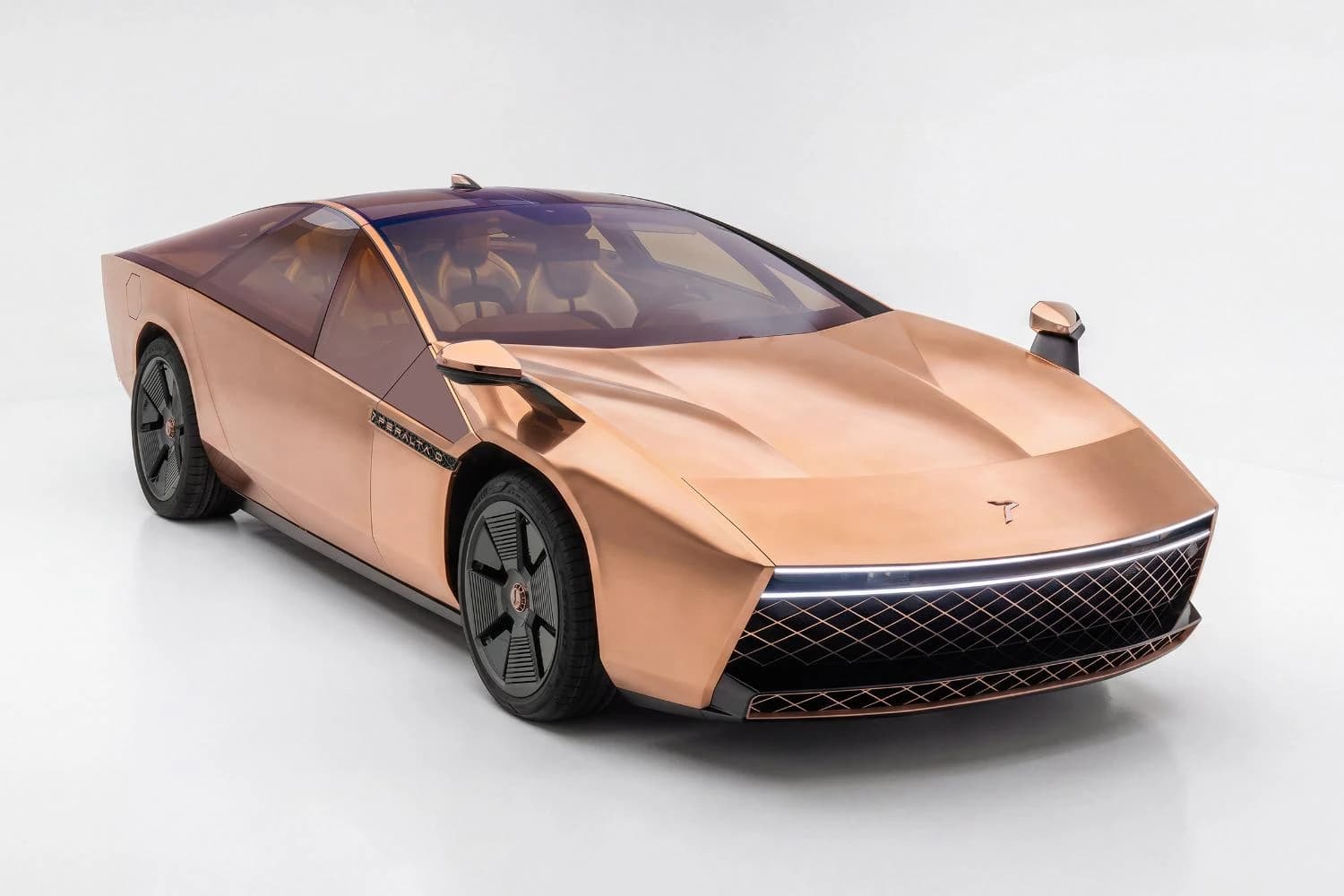
GFG Style Peralta D. Image source: GFG Style.
GFG Style Peralta D turns a Maserati GranTurismo into a copper one-off
GFG Style has unveiled the Peralta D, a one-off 2+2 grand-touring coupé based on the Maserati GranTurismo. The car was shown at the 2026 Pastejé Automotive Invitational in Mexico on October 24. It was commissioned by entrepreneur and collector Carlos Peralta and designed by Fabrizio Giugiaro. Its defining feature is not copper-coloured paint: the outer body panels are made from hand-hammered copper.
GFG Style has not published the Peralta D’s exact engine, power output, weight or performance. It should therefore be understood as a coachbuilt design project using the GranTurismo as its mechanical starting point, rather than as a new Maserati production variant. The price has not been disclosed either.
A project dedicated to Peralta’s daughters
The Peralta D follows the earlier Peralta S, another bespoke GFG Style project commissioned by Carlos Peralta. The previous car was based on the Maserati MC20 and was dedicated to his sons. The D in the new name refers to “daughters”, and GFG Style says that some of the design solutions were developed around that dedication. That is a description of the commission, not a general claim about female customers.
Fabrizio Giugiaro led the design work for GFG Style. The studio was founded by Giorgetto and Fabrizio Giugiaro and works on styling, prototypes and custom-built vehicles. The Peralta D continues the partnership with the Peralta family while moving the earlier project’s wedge-shaped, geometric language into a larger 2+2 grand tourer.
Copper below the beltline, treated glass above it
The lower body is formed from copper sheets shaped by hand. GFG Style selected the material for its warm colour and for the way artisans can work it into broad, uninterrupted surfaces. Above the beltline, the canopy is made from mirrored glass treated to echo the copper tone. Together, the two materials create the impression of a single monolithic volume.
Under the visible bodywork sits a carbon-fibre structure and an aluminium platform, according to GFG Style and the source reporting. The studio has not explained how the GranTurismo’s original structure was modified, nor has it published torsional-rigidity or mass data. Those details would be needed for a meaningful engineering comparison with the production car.
The wheels use an anthracite finish and a geometric pattern inspired by 1970s design. The dark wheels provide a clear contrast with the copper body. Carbon-fibre components, including the front blade spoiler and the rear exhaust outlets, are visually concealed or integrated so that they do not interrupt the relationship between the metal panels and the glass canopy.
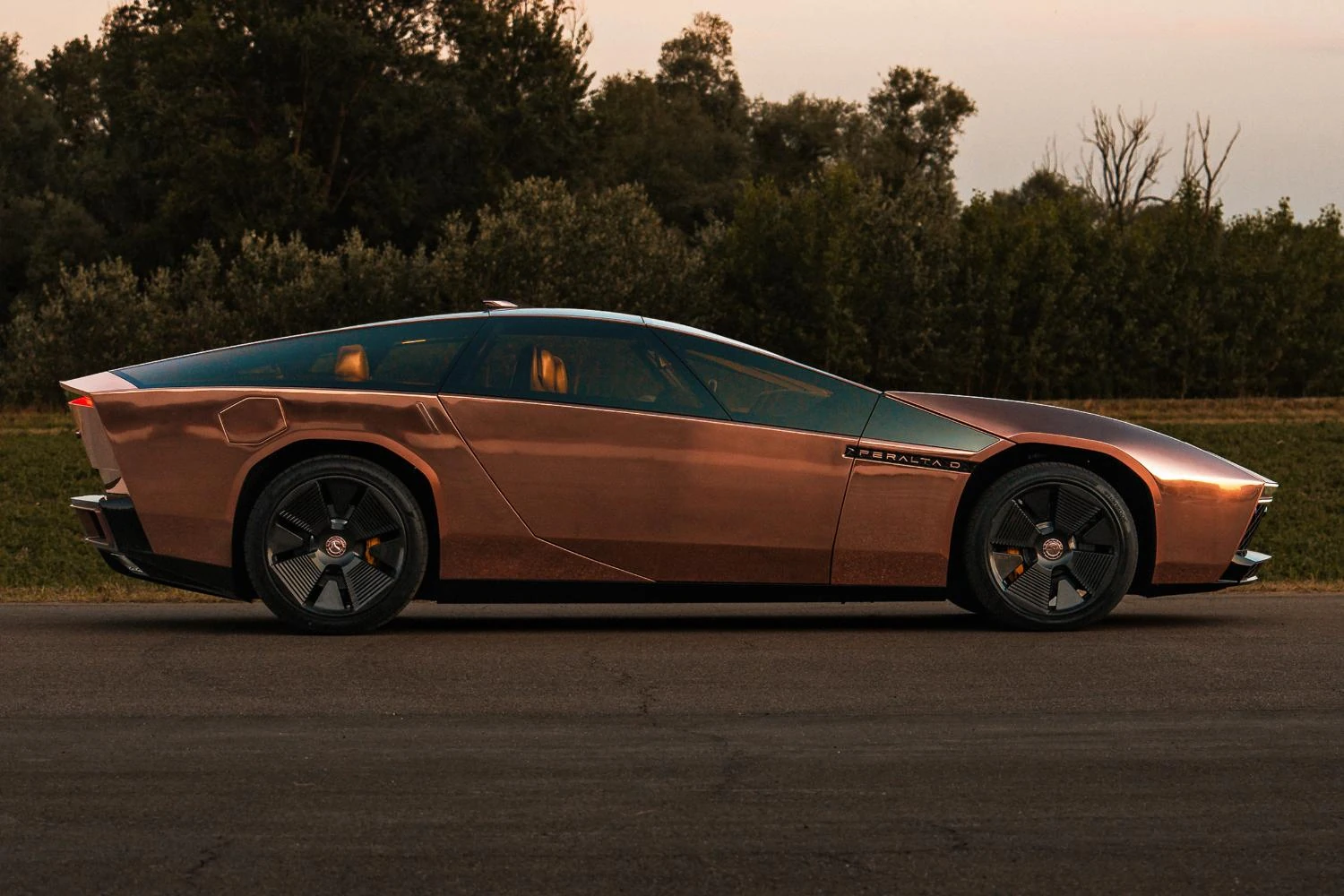
The side profile shows the GranTurismo proportions and the copper-and-glass treatment. Image source: GFG Style.
No conventional doors
The front cabin is accessed through a single-motion dome canopy derived from the solution used on the Peralta S. The side windows operate independently. At the rear, a new gullwing-style opening without a conventional lower structure is intended to make the two rear seats easier to reach.
The idea references a solution developed by Giorgetto Giugiaro for the 1967 De Tomaso Mangusta. That historical connection links GFG Style’s current work to the Italian design studio’s earlier experiments with access and body movement. On a 2+2 coupé, the rear opening also addresses a practical issue: reaching the second row through a low roof and around the front seats.
Thin full-width light blades define the front and rear. Auxiliary lights sit behind geometric diamond-pattern grilles made from milled and laser-engraved aluminium. GFG Style calls the effect “shadow lights”. It allows the lighting functions to remain visually quiet rather than adding separate lamps to the copper surfaces.
A cabin built around the same material theme
The seats, dashboard and interior panels are covered in metallic-effect leather whose colour echoes the body. Perforated Alcantara inserts add a different texture, while the stitching uses real copper thread. These details connect the cabin to the exterior without covering every surface in metal.
The dashboard is split into two symmetrical zones with different functions. The driver receives the instrumentation, while the passenger side includes a make-up station. The screen in front of the passenger can become an illuminated mirror and is accompanied by storage for cosmetics. This is part of the commission’s dedication to Peralta’s daughters and is not a standard GranTurismo feature.
A retractable refrigerator is hidden in the rear centre console. It is sized for a bottle of champagne and four copper glasses. The feature turns the rear section into a private lounge, but GFG Style has not published luggage capacity or other practicality measurements. The car’s interior is consequently better read as a bespoke environment than as a conventional grand-tourer package.
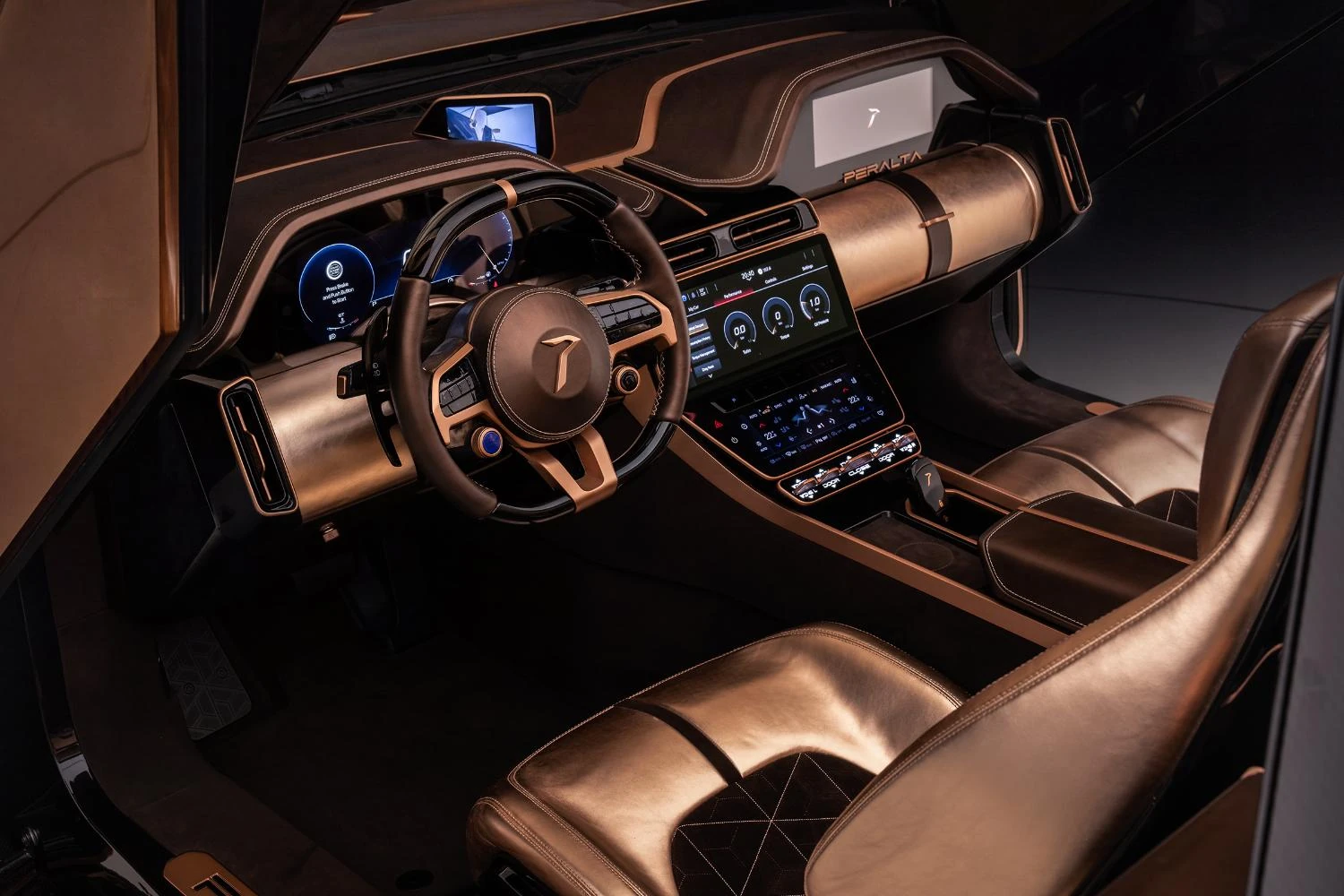
The interior uses metallic-effect leather, perforated Alcantara and copper-thread stitching. Image source: GFG Style.
What remains unknown about the Maserati base
Maserati’s current GranTurismo range includes Nettuno V6 versions and the fully electric Folgore, depending on market and specification. Maserati quotes acceleration figures ranging from 3.9 seconds for the standard GranTurismo to 2.7 seconds for the Folgore. Those numbers do not automatically apply to the Peralta D.
GFG Style has not said whether the one-off uses a V6 or the electric powertrain, and it has not described changes to the suspension, transmission, battery or all-wheel-drive system. Exhaust outlets visible in the images may suggest a combustion-based configuration, but that is a visual inference, not an official confirmation. Power, battery capacity, final weight and top speed remain unknown.
A single car, not a new model line
The Peralta D is described as a one-off commission, not as a limited production series or a Maserati catalogue model. Its value lies in the hand-worked copper, the family dedication, the unusual access system and the work required to create a new body around a production platform.
The project shows how far a GranTurismo can be reinterpreted when the standard body is treated as a starting point rather than a fixed design. It also shows why visual drama should not be confused with published performance. Until GFG Style or Maserati releases more technical information, the Peralta D is best described as a unique coachbuilt design object based on the GranTurismo.