The short answer
If you have a maximum of €20,000 and want a used family 4x4, the starting list is: Dacia Duster, Suzuki SX4 S-Cross, Škoda Octavia Scout, Toyota RAV4, Hyundai Tucson, Volkswagen Tiguan and Škoda Kodiaq. These are not seven unconditional recommendations, but seven different directions for snow, unpaved roads, holidays and commuting.
- Duster 4x4 makes sense for rough roads and a controlled entry price;
- S-Cross AllGrip is more compact and easier to live with daily;
- Octavia Scout offers estate boot space without SUV height;
- RAV4 AWD/AWD-i is worth analysing if you want petrol or hybrid, but the systems differ;
- Tucson 4WD is the volume alternative for a family;
- Tiguan 4MOTION offers a flexible interior, with more hardware to check;
- Kodiaq 4x4 is the choice for space and, optionally, seven seats, though under €20,000 it may come with high mileage.
Keep at least €1,500-2,500 of the budget for inspection, the first service, tyres and repairs already visible. On a used 4x4, four mismatched tyres or a neglected multi-plate clutch can quickly cancel the advantage of a good price.
How we chose the seven models
The list follows three needs that often meet in a family: room for two child seats and luggage, extra traction on snow or unpaved roads, and a used offer that can fall under the €20,000 ceiling. Price is a search filter, not a promise that every year, engine or trim fits the budget.
We also included an estate, because all-wheel drive does not force the buyer into an SUV. We left out heavily discounted premium models: the purchase price may drop under €20,000, but air suspension, large wheels, brakes and the transmission can demand running costs from another category.
| Model | Body | System to look for | Practical point | Main compromise |
|---|---|---|---|---|
| Dacia Duster | compact SUV | 4x4 with 2WD/Auto/Lock modes | ground clearance and access on rough roads | sound insulation and a more modest boot than large SUVs |
| Suzuki SX4 S-Cross | compact crossover | AllGrip Select | easy-to-manage size, four modes | the 4x4 offer is smaller than the 4x2 one |
| Škoda Octavia Scout | estate | 4x4 with multi-plate clutch | 610 l in the 2017 model documentation | ground clearance below a Duster |
| Toyota RAV4 | mid-size SUV | mechanical AWD or hybrid AWD-i | good space and several powertrain types | generation and exact architecture must be identified |
| Hyundai Tucson | compact SUV | 4WD, depending on engine and year | rear bench and access suited to a family | some combinations add DCT, turbo and emissions systems |
| Volkswagen Tiguan | compact SUV | 4MOTION | sliding rear bench and flexible boot | DSG, the 4x4 system and electronics must be checked separately |
| Škoda Kodiaq | large SUV | 4x4, five or seven seats | plenty of space; third row available | cars under the ceiling can have high mileage and large initial costs |
1. Dacia Duster 4x4: for rough roads, not for impression
For a family that often reaches a house on a gravel track, a mountain village or a cabin in winter, the Duster is the logical reference. The second generation kept the selector with 2WD, Auto and Lock modes, and Dacia documentation indicates ground clearance of about 210 mm and good angles for unpaved roads. That does not turn it into an expedition vehicle, but it makes it more suitable than a low crossover on ruts, loose snow and ramps with poor grip.
Not every Duster is 4x4. All-wheel drive was tied to certain engines and gearboxes, which differ by year. Confirm the version through the VIN and through components visible on a lift, not only through the badge on the tailgate.
What to check:
- that the 2WD, Auto and Lock modes work, without warning lights or error messages;
- the propshaft, joints/crosses, rear differential and leaks;
- impacts on undertrays, sills, floor and suspension mounting points;
- four tyres of the same brand, size and similar wear;
- the exact engine: diesel, turbo petrol and the older naturally aspirated unit have different checks;
- the clutch and flywheel on manuals, especially if the car towed or spent a lot of time off-road.
See also the dedicated guide Used Dacia Duster: dCi, TCe, LPG, 4x4 and body, then compare Duster listings up to €20,000.
2. Suzuki SX4 S-Cross AllGrip: compact 4x4 for daily life
The S-Cross is the choice for anyone who wants all-wheel drive but does not need a large SUV. The AllGrip Select system offers Auto, Sport, Snow and Lock modes. Suzuki explains officially that Auto prioritises consumption and sends torque to the rear axle when it detects slip, while Snow and Lock are intended for slippery surfaces or situations in which the car must be extracted from snow, mud or sand.
Very different versions can appear in budget: 1.6 naturally aspirated petrol, 1.6 diesel or 1.4 Boosterjet, manuals and automatics. Do not group them under the same reputation. Engine, gearbox and year change both consumption and the service bill.
What to check:
- whether the AllGrip selector changes modes and whether errors appear after a longer test;
- oils and any leaks at the transfer case and differential;
- even wear on all four tyres;
- the clutch on a manual or the automatic transmission history;
- rust and underside impacts, especially on a car used for fishing or on forest roads;
- real space for a child seat, pushchair and family luggage.
The S-Cross is closer to a raised hatchback than to an off-roader. The advantage is ease of parking; the compromise appears when you want three people on the rear bench or a boot for long holidays. Compare Suzuki S-Cross up to €20,000.
3. Škoda Octavia Scout: the family alternative to an SUV
The third-generation Octavia Scout shows why a 4x4 estate can be more suitable than an SUV. Škoda documentation for the 2017 model indicates a 610 l boot and 1,740 l with the rear seats folded. All-wheel drive uses an electronically controlled multi-plate clutch, and the Scout has more ground clearance than a regular Octavia Combi.
For motorway, commuting and holidays, the lower position can mean better boot access and road behaviour closer to a passenger car. In return, the roughly 171 mm of ground clearance in the technical sheet does not allow the same ruts as a Duster.
What to check:
- proof of 4x4 system maintenance, not only of the engine and gearbox;
- DSG behaviour when cold, in slow traffic and after warm-up, if the car is automatic;
- DPF, EGR, AdBlue and previous usage on diesel;
- oil consumption, cooling and timing history for the exact engine;
- the floor, undertrays and suspension after use on unpaved roads;
- traces of fleet use, towing and mileage that does not match interior wear.
The Scout should not be confused with an Octavia Combi 4x4 dressed up later. Check the VIN, equipment codes and ground clearance. See Škoda Octavia listings up to €20,000.
4. Toyota RAV4 AWD or AWD-i: the same badge, different systems
The RAV4 is interesting for a family that wants a mid-size SUV and is willing to compare generations carefully. In this price area you may find cars from the generation launched in 2013, with conventional all-wheel drive, as well as AWD-i hybrids. On the hybrid, the rear axle is driven electrically; there is not the same mechanical link between axles as on a thermal AWD version.
Toyota indicated 547 l for the boot of the generation presented in 2012 and 580 l for the following generation, but the figures differ by year, measurement method and powertrain. A test with your pushchair and luggage says more than comparing brochures from different years.
What to check:
- generation, engine, transmission and the exact AWD type;
- the traction battery, its cooling and the 12 V battery on a hybrid;
- the differential, propshaft and leaks on versions with a mechanical link;
- oil and coolant history;
- rust, especially on cars from areas with a lot of salt;
- brakes, bearings, tyres and geometry after a full test.
For the hybrid, read separately what to check on a RAV4 Hybrid, the traction battery, e-CVT and AWD-i. Then compare Toyota RAV4 under €20,000.
5. Hyundai Tucson 4WD: a volume SUV with many configurations
The 2015-2020 Tucson is spacious enough for two child seats and appears in many combinations of engine, gearbox and drivetrain. That variety is the risk: an advert that simply says “automatic Tucson 4x4” does not clarify whether you have diesel, turbo petrol, DCT or a torque-converter automatic.
Some engines were front-wheel drive only; others could be ordered as 4WD. Do not assume that a rich trim automatically includes a driven rear axle. Ask for a photo of the registration document, the VIN and a physical check of the transmission.
What to check:
- smooth engagement of rear-axle drive and the absence of stored errors;
- the DCT on take-off, on a slope, in manoeuvres and after warm-up, if applicable;
- DPF, EGR and road history on diesel;
- the turbo, injection and cooling on T-GDi petrol;
- the wear difference between front and rear tyres;
- the tailgate, camera, sensors, climate control and ADAS of the specific trim.
The guide Used Hyundai Tucson: T-GDi, CRDi, DCT, Hybrid and 4x4 goes into the details of each generation. For the market, use the Tucson filter up to €20,000.
6. Volkswagen Tiguan 4MOTION: flexible space, hardware to check
The second-generation Tiguan, launched in Europe in 2016, brought a sliding rear bench and a boot of up to 615 l, according to Volkswagen, with volume dependent on bench position. 4MOTION versions received a mode selector for different surfaces, and some configurations have high towing approvals.
Under €20,000, a Tiguan II can have high mileage, fleet history or simple equipment. The Tiguan I is cheaper, but age shifts the discussion to corrosion, suspension, timing and repairs already postponed. Do not compare only the year and mileage in the advert.
What to check:
- 4MOTION system maintenance and any pump/multi-plate clutch errors;
- the DSG or manual clutch, including cold and hot manoeuvres;
- timing and water-pump history for the exact engine;
- DPF, EGR and AdBlue on diesel, and cooling and oil consumption on TSI;
- electronics, multimedia, climate control and all cameras/sensors;
- identical tyres, geometry and bearing noises.
An unmaintained 4MOTION is not a bargain just because the engine starts nicely. Include in the check the guide for Haldex, differentials, propshaft and tyres, then compare Tiguan under €20,000.
7. Škoda Kodiaq 4x4: plenty of space, but not necessarily much budget left
The Kodiaq is the largest model on the list. Škoda launched the first generation with five or seven seats and with 4x4 versions. In the initial documentation, the five-seat variant had 720 l, while the seven-seat one offered 270 l with all seats raised and 630 l with the third row folded. That shows the compromise that advert photos hide: seven passengers and a lot of luggage do not fit at the same time without an extra solution.
Under the €20,000 ceiling, look first at condition and history, not maximum equipment. A cheap Kodiaq with DSG, 4x4, tired suspension and large tyres can quickly consume the cash reserve.
What to check:
- whether the car has five or seven seats both on paper and physically;
- that the second- and third-row mechanisms work;
- the DSG, the 4x4 system and fluid history;
- DPF, EGR, AdBlue and timing on diesel;
- the powered tailgate, cameras, sensors and rear climate control;
- towing traces and the maximum authorised mass in the car’s documents.
See the dedicated guide Used Škoda Kodiaq: TSI, TDI, DSG, 4x4 and 7 seats, then check Kodiaq listings up to €20,000.
What to choose for your family
For unpaved roads and hard winters
The Duster 4x4 is the first direction if ground clearance and access on a bad road matter more than refinement. The S-Cross AllGrip is the alternative for snow and tarmac, with dimensions easier to manage in town.
For motorway and a long boot
The Octavia Scout uses body length more efficiently and has an estate load sill. If the family travels more on tarmac than off-road, it can be a more coherent choice than an SUV.
For town, holidays and two child seats
RAV4, Tucson and Tiguan deserve to be placed side by side in a static test. Fit the child seats, set the driver’s seat and check whether there is still room for an adult on the rear bench. A car’s declared width does not guarantee that three people sit comfortably in the back.
For six or seven people
The Kodiaq is the only car on the list with a relevant third row, but check legroom and the boot with all seats raised. For daily use in seven, a van can be more practical than an SUV.
What 4x4 drive does not do
4x4 helps the car pull away and send torque to the wheels that have grip. It does not automatically shorten braking and cannot compensate for unsuitable tyres. In snow, four correct winter tyres matter for stopping and turning regardless of how many driven axles there are.
Ground clearance does not come automatically with an AWD badge either. The Octavia Scout and an SUV have different geometries, and a Tiguan with low spoilers can scrape where a Duster passes. For a trailer or caravan, check the masses in the registration document and the tow-bar approval; the maximum figure in a press release does not apply to every engine and gearbox.
Test-drive and inspection in 12 steps
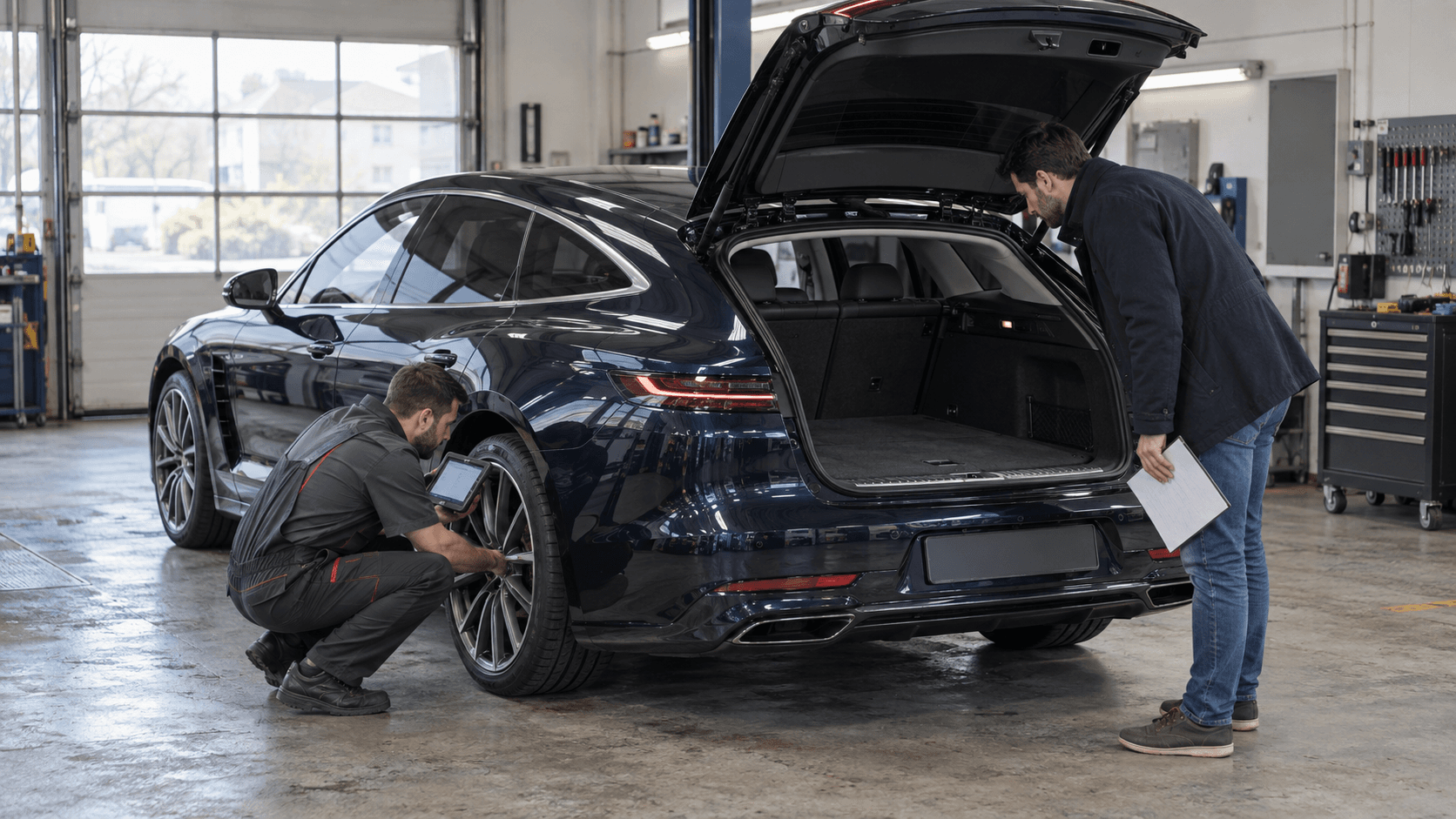
- Ask for the VIN before viewing. Confirm the engine, gearbox, drivetrain and number of seats.
- Start the car from cold. Watch warning lights, noises and smoke in the first minutes.
- Check all four tyres. Size, brand and circumference must be compatible with the manufacturer’s requirements.
- Make tight turns at low speed. Listen for knocks, rubbing and unusual tension in the transmission.
- Pull away gently on a slope. Watch the clutch, DCT or torque converter, without brutal acceleration.
- Test the AWD modes. Do this only where it is allowed and without forcing Lock on dry tarmac if the handbook forbids it.
- Drive until normal temperature. Some gearbox or drivetrain errors appear only when hot.
- Listen at 50-90 km/h. Rumbling can come from tyres, bearings, propshaft or differentials.
- Brake progressively. The car must stay straight, without vibration in the steering wheel.
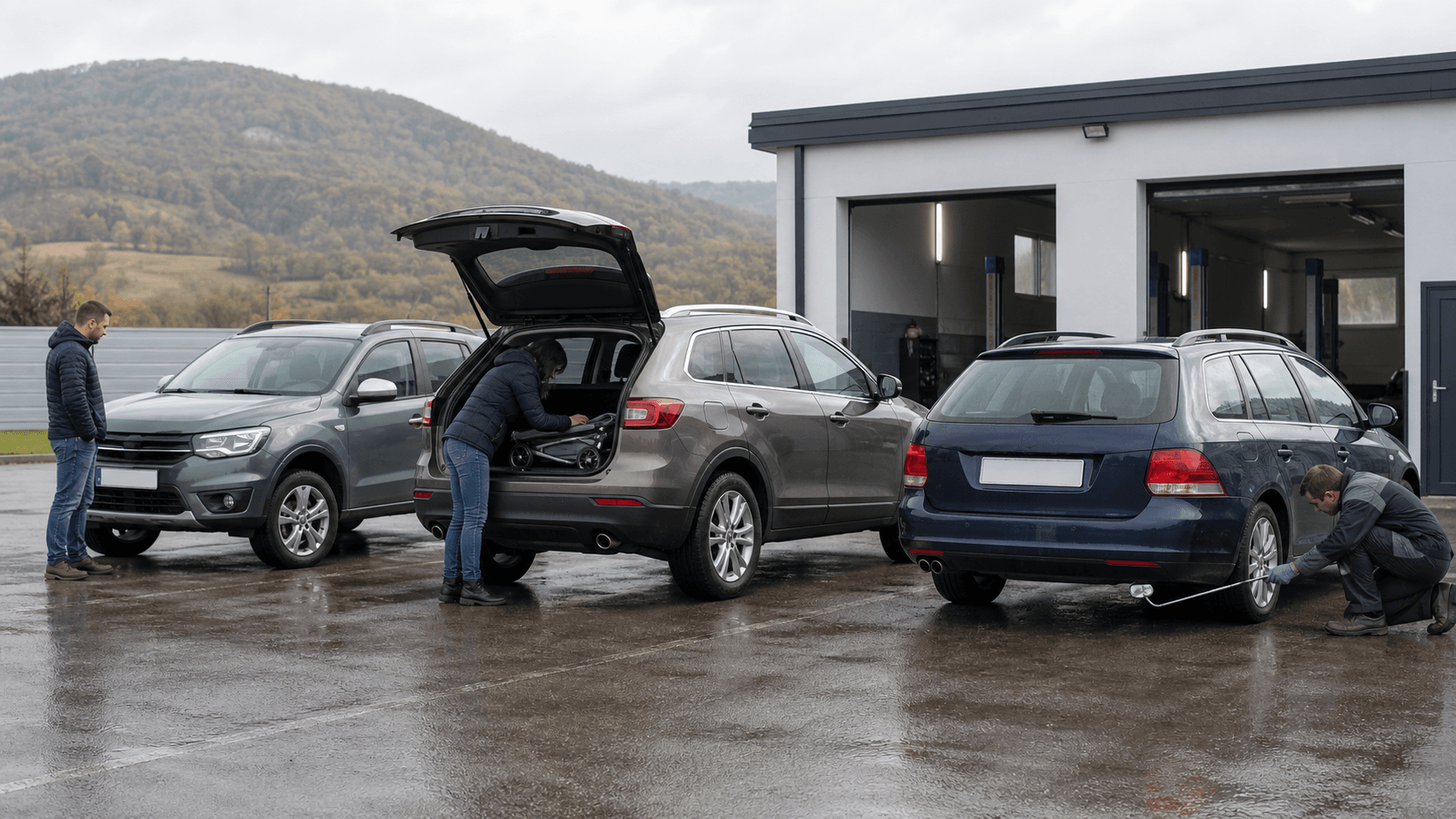
- Fit the child seats and pushchair. Do not buy the space in the spec sheet; buy the space you can use.
- Put the car on a lift. Look for leaks, impacts, rust and repairs to the rear transmission.
- Run diagnostics after the test. Read all modules, not only the engine computer.
Checklist before you pay
- The VIN matches on the car, registration document, logbook and provenance papers;
- the version is factory 4x4, confirmed technically and on paper;
- engine and gearbox are identified by code, not only by displacement;
- there are invoices for services and for transmission maintenance;
- the four tyres have the approved size and similar wear;
- there are no AWD, ABS, ESP, gearbox or engine warning lights;
- drivetrain modes work as in the handbook;
- the propshaft, differentials and multi-plate clutch do not leak oil;
- there are no vibrations or rumbling on acceleration and deceleration;
- the clutch, DSG/DCT, CVT/e-CVT or conventional automatic have been tested separately;
- the engine was started from cold and then tested at normal temperature;
- DPF, EGR and AdBlue have coherent diagnostics, if it is a diesel;
- the traction battery has a dedicated test, if it is a hybrid;
- the floor, sills and mounting points have no structural impacts;
- the suspension does not knock and geometry does not pull to one side;
- child seats fit without compromising the driver’s position;
- the real pushchair and luggage fit with the bench in use;
- all belts, airbags and ISOFIX points are present and intact;
- towing history is known, and the tow bar is approved;
- you have obtained RAR Auto-Pass, if data exist for the VIN;
- the inspection is done by a workshop chosen by the buyer;
- the contract correctly describes the car, VIN, price and any defects;
- the financial reserve remains available after transfer and paperwork.
How to split the €20,000 budget
Do not set the filter at €19,900 if that is the entire sum available. For a family 4x4, a cautious split can be:
- €16,500-18,000 for the car;
- €200-500 for travel, checks, diagnostics and paperwork;
- €500-1,000 for the initial service and fluids without proof;
- €800-1,500 for tyres, brakes, a 12 V battery or repairs already identified.
The amounts are indicative. A set of four large tyres or a DSG job can change the calculation. The quote after inspection is more useful than a fixed percentage of the price.
Frequently asked questions
What is the best family 4x4 under €20,000?
It depends on the route. The Duster is suitable for rough roads, the S-Cross for mixed use and town, the Octavia Scout for motorway and luggage, and the Kodiaq for space and the seven-seat option. The inspected example matters more than the place on the list.
Is 4x4 worth it if I only drive in town?
Usually not. All-wheel drive adds mass, parts and costs, and the advantage is small if you run on cleared tarmac. For frequent mountain trips, a private sloping drive or unpaved access, the benefit can justify the difference.
Is a 4x4 SUV safer in snow?
It may pull away more easily, but braking and steering depend first on tyres, speed and grip. 4x4 does not replace winter tyres or a safe following distance.
Can I use two new tyres and two old ones on a 4x4?
Follow the manufacturer’s tolerances. Large circumference differences can load the centre clutch or the differentials. The safest direction is a compatible set of four tyres with similar wear.
Diesel or petrol for a family 4x4?
Diesel makes sense on long journeys and high annual mileage. For short urban routes, petrol or hybrid can avoid some problems linked to DPF regeneration. The decision is taken after the route, not after the consumption in the advert.
Is Toyota AWD-i the same as mechanical 4x4?
No. On the RAV4 Hybrid AWD-i, the rear axle is driven by an electric motor. Other versions have a mechanical link to the rear. Behaviour, parts and checks are not identical.
Which document must not be missing before a deposit?
Ask for the VIN, provenance documents, the registration/logbook when they exist and the service history. RAR Auto-Pass adds official data available in RAR databases, but it does not replace an independent technical inspection.
Sources
- Dacia Media — Duster, 2WD and 4WD versions
- Dacia — data for the second-generation Duster
- Dacia — 2018 Duster brochure and the 2WD/Auto/Lock selector
- Global Suzuki — ALLGRIP Select and Auto, Sport, Snow, Lock modes
- Škoda Storyboard — Octavia Scout 2017, 4x4 and boot
- Toyota Media — RAV4 2013, engines, AWD and load space
- Toyota Media — RAV4 Hybrid AWD and technical data
- Hyundai Motor Europe — Tucson 2018 technical data and 4WD versions
- Volkswagen Newsroom — second-generation Tiguan, 4MOTION and boot
- Škoda Storyboard — Kodiaq, five or seven seats, 4x4 and boot volumes
- RAR — what the RAR Auto-Pass certificate contains