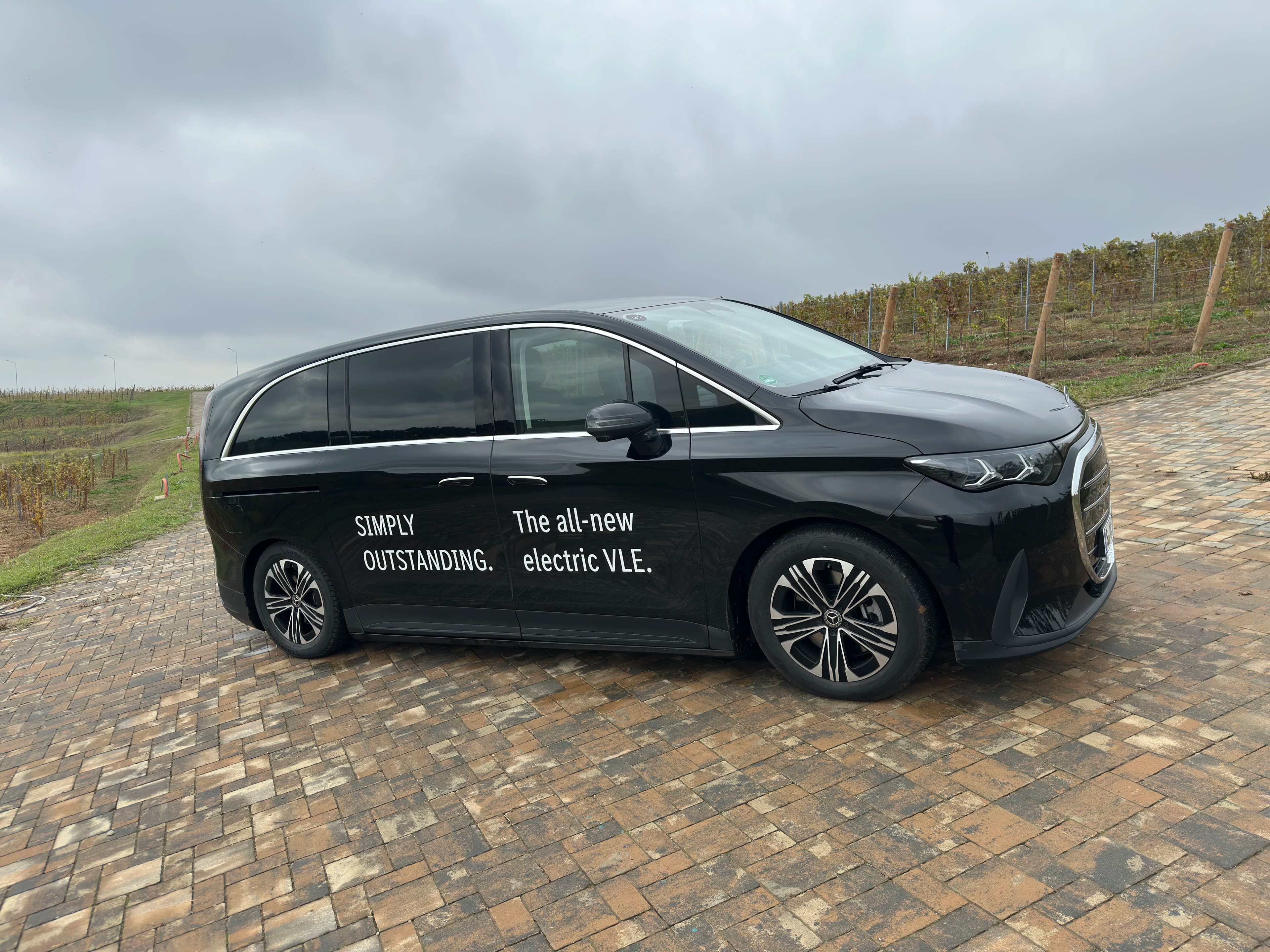
The Mercedes-Benz VLE 300 electric is an unusually convincing luxury family vehicle, but it is not a simple recommendation. Its strongest qualities are the ones that matter after the novelty wears off: a calm ride, generous passenger space, electric sliding doors, a large battery and an interior that can be configured around the people travelling in it. Its biggest complication is the legal weight limit. In the seven-seat configuration we reviewed, the vehicle has a 3,500 kg maximum authorised mass and only 489 kg of payload, which leaves less room for luggage than the cabin suggests.
The VLE is Mercedes-Benz’s new electric “Grand Limousine”. It is more than an electric replacement for the V-Class, at least in the way the company presents it. The model uses a dedicated van architecture, offers seating layouts for up to eight people and is designed to combine limousine-like comfort with the flexibility of a large MPV. The VLE 300 is the front-wheel-drive version, with 203 kW, or 276 PS, and a 115 kWh usable battery.
A large MPV designed around passengers
The VLE is 5,309 mm long, 1,999 mm wide without its mirrors and 1,943 mm tall. Those dimensions create substantial room inside, but they also affect daily use. The vehicle is too large for many compact parking spaces, and its height should be checked before entering older underground car parks. With the mirrors extended, the width reaches 2,248 mm.
The electric sliding doors are one of the most useful features. They make it easier to install child seats in a narrow parking space and give passengers a clear route into the rear compartment. The seating layout can be adapted to different uses, from a family vehicle with a third row to a more executive arrangement with individual comfort seats.
The VLE does not try to disguise its size with a pretend-SUV driving position. You sit high, have a clear view over the nose and can place the vehicle accurately using the cameras and rear-axle steering. Mercedes-Benz quotes a turning circle of around 11.6 metres for the configuration reviewed. That is helpful in town, although it does not make the VLE a small vehicle.
Comfort is the main reason to choose it
The test vehicle was fitted with AIRMATIC air suspension. It is the option that best matches the VLE’s purpose. The suspension filters poor surfaces without turning the body into a soft, uncontrolled platform, and the electric powertrain keeps acceleration smooth. The VLE 300 is not a performance vehicle: 0–100 km/h takes 8.9 seconds and the top speed is limited to 180 km/h. Those figures are sufficient for a fully loaded family car, but they are not the point of the model.
The more relevant question is how relaxed the occupants feel after several hours. The seating position, low drivetrain noise and available rear comfort equipment make the VLE particularly suited to long trips. The rear compartment can be treated as a passenger space rather than simply as the back of a van, especially in higher specifications.
There are compromises. Wind noise from the door mirrors was noticeable above roughly 80 km/h in the vehicle reviewed. That is not a major defect, but it stands out in an electric vehicle because there is no combustion engine to mask exterior noise. The standard audio system also felt ordinary for a vehicle costing close to €95,000 in the tested configuration. Buyers who care about rear-passenger comfort should budget for the better audio option rather than assume the standard system matches the rest of the cabin.
Battery, range and charging
The VLE 300 uses a 115 kWh usable battery. Mercedes-Benz publishes a WLTP range of up to roughly 700 km, with the exact figure depending on the country, body configuration, equipment and wheels. The Romanian specification page lists 709 km for the VLE 300, while the German page presents a range band of 658–714 km for the relevant versions. These are official figures, not independent measurements.
The same distinction matters when estimating motorway range. A large MPV carrying several passengers and luggage will consume more energy at 130 km/h than it does in the WLTP cycle. Using the test vehicle’s battery capacity, a theoretical 25 kWh/100 km would correspond to about 460 km before keeping a reserve. At 30 kWh/100 km, the theoretical figure falls to about 383 km. These are calculations, not results from a complete range test.
Charging is one of the VLE’s stronger technical arguments. The 800-volt system supports DC charging at up to 300 kW, and Mercedes-Benz quotes approximately 25 minutes for a 10–80% session under suitable conditions. AC charging can reach 22 kW when the relevant option is fitted. For a battery this large, access to home, workplace or destination charging remains important even if the vehicle can charge quickly on a long journey.
The VLE therefore makes more sense for an owner who can charge regularly. Public fast charging can support long-distance use, but the running-cost advantage of an electric MPV is easier to realise when most energy is bought at home or at work.
The payload issue is more important than it looks
The VLE’s interior can accommodate a large family, but passenger space and legal carrying capacity are different things. The reviewed vehicle had a maximum authorised mass of 3,500 kg and a kerb mass of 3,011 kg including its equipment and a 75 kg reference driver. That leaves 489 kg of payload.
Six additional passengers weighing 75 kg each would use 450 kg before any luggage is added. The real calculation changes with the passengers’ actual weights, but the principle remains: a seven-seat VLE may not be able to carry seven adults plus a full holiday load while staying within its legal limit. Buyers should check the final registration documents for the exact version they order, especially after adding premium seats, entertainment equipment, a panoramic roof and other heavy options.
Some VLE configurations can also exceed 3,500 kg. In markets where that changes the licence category, customers may need to consider C1 or C rather than an ordinary car licence. This is not a theoretical detail for a family vehicle. The payload and licence implications should be checked before the order is signed.
Official starting prices across Europe
Mercedes-Benz does not sell an identical VLE specification at one harmonised European price. Taxes, standard equipment, seat layout, delivery charges and market-specific offers all affect the result. The following figures are the official starting prices displayed or announced by Mercedes-Benz for the VLE 300 electric in the respective markets, checked in October 2026. They should not be compared as if they represented the same equipment level.
| Market | Official starting price | Status and source context |
|---|---|---|
| Germany | €71,187.59 | Current Mercedes-Benz Germany model overview, including VAT |
| Spain | €93,492.46 | Current Mercedes-Benz Spain configurator price |
| France | €87,667 | Current Mercedes-Benz France recommended retail price |
| Italy | €81,700 | Current Mercedes-Benz Italy configurator price |
| Austria | €80,478 | Current Mercedes-Benz Austria configurator price |
| Romania | €84,858.51 | Current Mercedes-Benz Romania configuration price |
| United Kingdom | Not announced | Mercedes-Benz UK currently lists the VLE as coming soon |
The figures explain why a Romanian review should not simply be translated with the same price paragraph. The VLE 300 starts at different levels depending on the market and the equipment included. The €94,333 test vehicle in Romania was a heavily optioned seven-seat example, not a universal European list price. In France, Mercedes-Benz has also published earlier launch pricing below the current displayed recommended price, so buyers should treat promotional or launch figures separately from the current configurator price.
Verdict: an excellent family vehicle with a practical warning
The Mercedes-Benz VLE 300 electric is one of the most comfortable ways to move a large family, a group of business passengers or a hotel shuttle over long distances. Its space, seating flexibility, quiet electric drivetrain, air suspension and fast charging create a package that an ordinary SUV cannot reproduce.
It is less convincing if you do not need the space. A family with one or two children may find the price and size difficult to justify, especially when a premium electric SUV can offer similar range with easier parking and a lower kerb weight. The VLE earns its place when the passenger compartment is used frequently and the owner values comfort above compact dimensions or outright acceleration.
The final decision should be based on the exact registration documents, not only the brochure. Check the country-specific price, seating layout, maximum authorised mass, payload, licence requirements and options list. The VLE can be a superb electric family limousine, but its generous cabin does not automatically mean generous luggage capacity.
Sources
- Mercedes-Benz Germany – VLE prices and specifications
- Mercedes-Benz Spain – VLE prices and specifications
- Mercedes-Benz France – VLE prices and specifications
- Mercedes-Benz Italy – VLE prices and specifications
- Mercedes-Benz Austria – vehicle configurator
- Mercedes-Benz Romania – VLE prices and specifications
- Mercedes-Benz UK – VLE model page