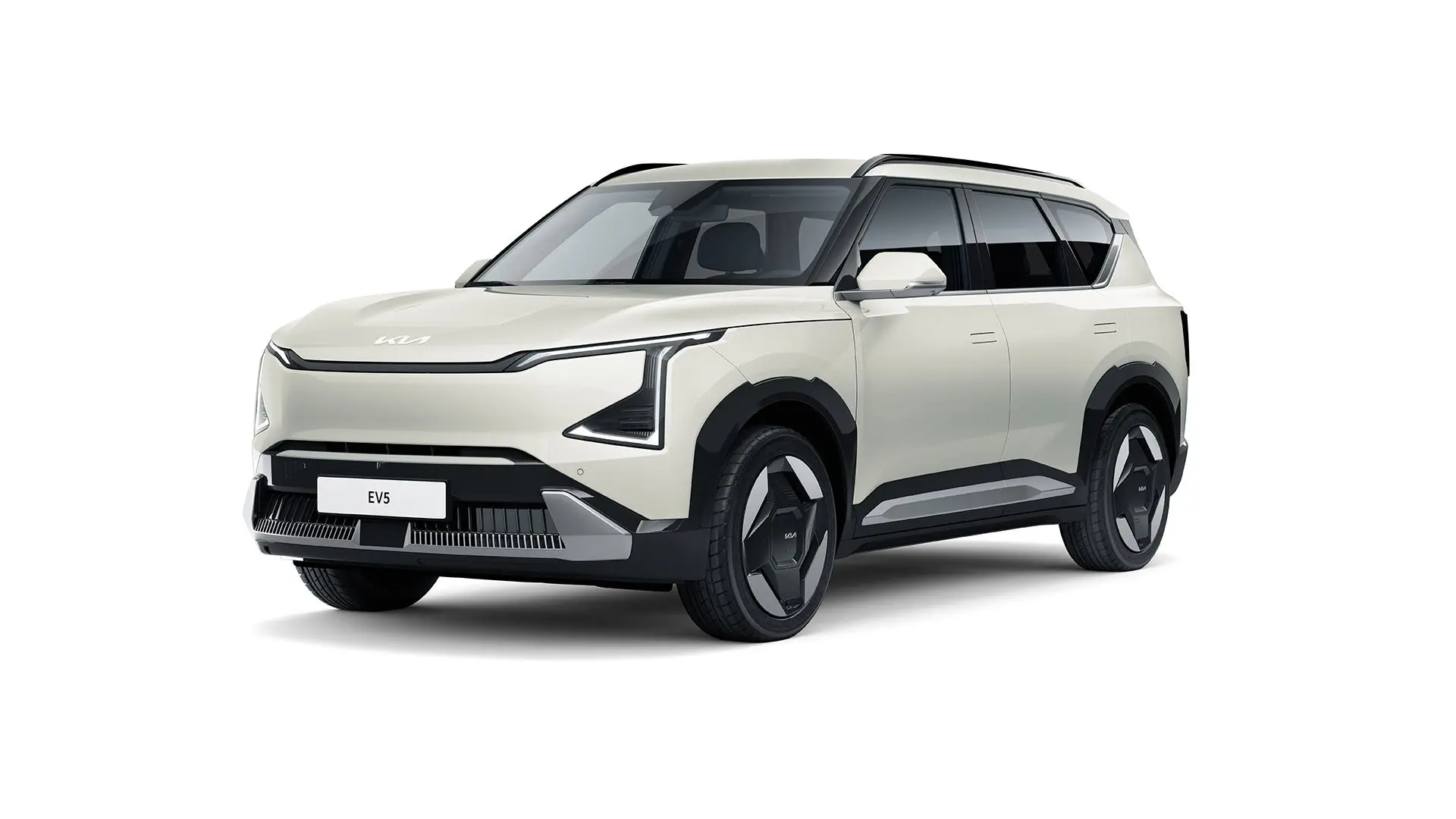
The Kia EV5 GT-Line 2WD is a family electric SUV built around space, efficiency and predictable performance rather than headline acceleration. The tested version uses a front-mounted motor with 217 hp, a 81.4 kWh battery and a claimed WLTP range of up to 503 km, depending on specification.
The source road test recorded 17.5 kWh/100 km. That is an observed figure from the test described by CautiMasina, not an independent Carboratory measurement, and it gives the EV5 a useful theoretical range of about 465 km before charging losses and reserve are considered. The car is not flawless: rear suspension responses can be firm over short bumps, tyre and wind noise become noticeable at speed, and the 400-volt charging system is slower than the best newer rivals.
A practical size for a family SUV
The EV5 measures 4,610 mm long, 1,875 mm wide and 2,750 mm between the axles. Those numbers put it close to the Volkswagen ID.4, Skoda Enyaq and Tesla Model Y in the European market. It is large enough to provide useful rear-seat room without reaching the awkward footprint of a five-metre SUV.
The square body is also useful. Rear passengers get generous legroom and headroom, and the almost flat floor helps when three people share the second row. The boot holds 566 litres, increasing to 1,650 litres with the rear seats folded. A front storage compartment of roughly 44 litres is useful for charging cables, although neither storage area is class-leading.
For a family, this matters more than a very quick 0–100 km/h time. Child seats are easier to position, rear doors open wide and adults do not have to sit with their knees raised. The boot has a regular shape, but buyers who travel with bulky prams or several large suitcases should compare it directly with the roomier alternatives.
An interior that keeps useful controls
The dashboard combines a 12.3-inch driver display, a separate 5.3-inch climate-control screen and a 12.3-inch infotainment display. Kia has not moved every frequent function into one deep touchscreen menu. Physical controls remain available for important climate and driving functions, which is helpful when the road surface is uneven.
The test car included equipment such as a Harman Kardon sound system and other comfort and assistance features, but equipment depends on the market and trim. Kia’s local configurators should be checked before comparing prices because the same badge does not guarantee the same standard equipment in every country.
The main ergonomic omission is the instrument cluster. It shows speed, consumption, range and assistance information, but the source test notes that it cannot display the navigation map directly in front of the driver. The central screen remains clear, yet a head-up display or a configurable map view would make unfamiliar routes easier to follow.
Comfortable enough, but not exceptionally quiet
The single motor develops 217 hp and 295 Nm. The official 0–100 km/h time is 8.4 seconds, with a top speed of 165 km/h. Those figures are sufficient for motorway entries and ordinary overtaking. They also fit the EV5’s character: the power delivery is smooth, the front-wheel-drive layout is easy to predict and the steering is light enough for urban use.
The rear suspension is less convincing. On smooth roads the EV5 is comfortable, but short bumps, joints and repeated imperfections can produce a firmer response from the rear axle than expected in a family-focused SUV. The difference is particularly easy to notice on damaged urban roads.
Noise insulation is another compromise. The absence of a combustion engine makes low-speed driving quiet, but tyre and wind noise become more apparent as speed rises. This does not make long trips unpleasant, yet it prevents the EV5 from feeling as refined as some premium-priced competitors.
Range and charging
The 81.4 kWh battery is the EV5’s strongest long-distance argument. The official WLTP range reaches approximately 503 km in the tested 2WD specification. At the observed 17.5 kWh/100 km, simple arithmetic gives about 465 km, but this is not a full battery-to-empty measurement. Temperature, speed, heating, wind and wheel size all affect the result.
At motorway speeds, a higher consumption should be expected. A scenario of 20–23 kWh/100 km would imply roughly 354–407 km before leaving a practical reserve. Those are calculations, not measurements from the source test.
DC charging from 10% to 80% takes about 30 minutes in favourable conditions at a suitable high-power station. The EV5 uses a 400-volt system, unlike the 800-volt architecture in the Kia EV6. The charging time is adequate for family travel, but it is not a class-leading reason to choose the car. An 11 kW AC wallbox can refill the battery overnight; home charging remains the most convenient way to use the EV5.
Prices depend heavily on the market
The Romanian source test used a GT-Line 2WD listed at €52,720 including VAT, before optional equipment. The local EV5 range started at €47,980 for the Long Range 2WD Air.
Prices are not transferable between markets. Kia Italy’s January 2026 price list showed the EV5 Air at €44,750 and the GT-Line at €49,750, while Kia France currently lists the Air from €44,990 and the GT-Line from €49,990, including VAT. Kia Germany advertises the EV5 Air from €45,990. In Spain, Kia Iberia advertises the EV5 from €35,400, but the page does not establish that this is the same GT-Line specification tested in Romania. In the United Kingdom, the comparable front-wheel-drive GT-Line starts at £42,645, while the Air starts at £39,345.
These figures should be read as local list prices or advertised starting prices, not as a like-for-like European price comparison. Equipment, taxes, delivery charges, campaigns and the exact battery or drivetrain can change the final invoice.
Verdict
The Kia EV5 GT-Line 2WD is a well-rounded family electric SUV. Its rear-seat space, 566-litre boot, useful controls and reasonable energy consumption make it easy to understand as a daily car. The 217 hp motor is sufficient, and the 81.4 kWh battery gives it a credible role beyond urban commuting.
The compromises are equally clear: the rear axle can feel firm on broken surfaces, high-speed noise is more noticeable than expected, and 30-minute DC charging is merely adequate. The price also needs careful market-by-market comparison because trim and equipment differ.
For buyers who value space and efficiency more than outright performance, the EV5 deserves a place on the shortlist. It is a strong all-rounder, but not the obvious choice for drivers who prioritise the fastest charging or the quietest cabin.