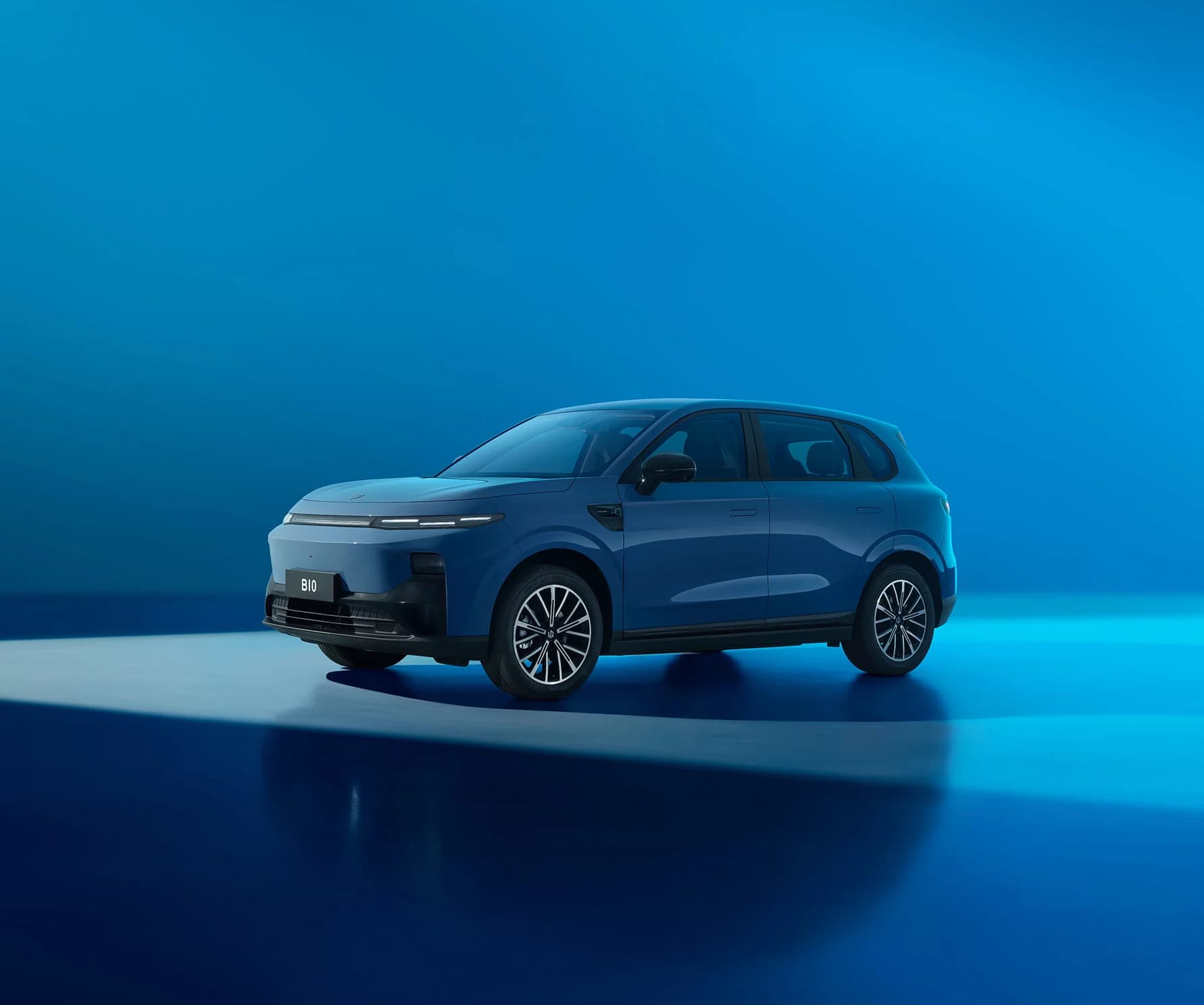
Official image: Leapmotor. The photograph shows the B10 from the manufacturer’s European range.
Leapmotor and Stellantis have officially started production of the B10 electric SUV at Stellantis’ Zaragoza plant in Spain. The event took place on 16 October 2026 at the Figueruelas facility. It gives the partnership between the Chinese electric-vehicle company and the European group a physical manufacturing base in Europe, while leaving annual output, market-by-market delivery schedules and local prices open.
What has been confirmed
Stellantis says the Zaragoza site was selected for its quality record, available capacity and industrial expertise. The factory already builds the Opel Corsa, Peugeot 208 and Lancia Ypsilon. The B10 therefore joins an established production environment rather than arriving at a new plant created specifically for Leapmotor.
The official announcement confirms that production has begun. It does not state how many B10s will be built per year, how many shifts will be assigned to the model or how many new jobs are linked directly to the programme. It also does not say that every B10 delivered in Europe will immediately be Spanish-built. Those questions require separate confirmation from the company or local distributors.
For Leapmotor, production in Spain is part of its internationalisation strategy. The company is headquartered in Hangzhou and develops electric motors, batteries, software and vehicle-control systems. European assembly places the manufacturing operation closer to the market, but the official material does not provide a complete origin breakdown for every component used in a Spanish-built B10.
The wider Stellantis partnership
The Zaragoza programme follows a sequence of agreements. Stellantis said it acquired approximately 21% of Leapmotor in October 2023, becoming the Chinese company’s largest single shareholder. In May 2024, the partners launched Leapmotor International B.V., a joint venture owned 51% by Stellantis and 49% by Leapmotor. The venture has exclusive rights to sell and manufacture Leapmotor vehicles outside Greater China.
In May 2026, the partners announced their intention to deepen the relationship. The plan included increasing production at Figueruelas, bringing the B10 to the plant and studying a new line for an all-new electric Opel C-SUV. The Opel project was still subject to evaluation, with a potential start in 2028. The B10 has now moved from the planning stage to official production.
Stellantis describes the cooperation as a combination of Leapmotor’s technology and innovation with its own manufacturing experience, quality systems and European market presence. That is the companies’ description of the alliance, not an independent assessment of the completed vehicles. The concrete industrial result is that a Stellantis facility is now assembling a Leapmotor model for the European programme.
The B10 specification in Europe
Leapmotor’s Spanish product page lists the B10 at 4.51 metres long. The battery-electric versions use 56.2 kWh and 67.1 kWh batteries, with official WLTP ranges of 361 km and 434 km. These are homologation figures. Cold weather, motorway speed, gradients, traffic and heating or air-conditioning use can reduce the distance achieved in daily driving.
The manufacturer quotes 218 hp and up to 168 kW of DC charging power. For the fully electric versions, it lists a 30–80% charging time of 19 minutes under compatible conditions. Charging speed depends on the battery’s temperature and state of charge, as well as on the charger itself. The published number should therefore be treated as a specification, not a universal promise at every public station.
The European range also includes a REEV configuration with an 18.8 kWh battery and a 1.5-litre petrol engine. Leapmotor lists up to 86 km of electric driving and up to 900 km total WLTP range for that version. The Zaragoza production announcement specifically refers to the fully electric B10. It would be inaccurate to infer that every unit built in Spain uses the range-extender system.
Interior, storage and driver assistance
According to Leapmotor Spain, the B10 offers a 430-litre boot that can expand to 1,700 litres with the rear seats folded. A 25-litre front compartment is intended for smaller items such as charging cables. The cabin uses a 14.6-inch 2.5K central screen, with Apple CarPlay and Android Auto compatibility. The manufacturer also lists a dedicated application and over-the-air software updates.
Seventeen advanced driver-assistance functions and a 360-degree camera are listed on the Spanish product page. The same page refers to a five-star Euro NCAP result. Buyers should confirm which trim and equipment level the result covers, because standard and optional systems can vary between markets.
What European production means for buyers
Spanish assembly brings the manufacturing operation closer to European sales, but it does not automatically set a Romanian price or guarantee immediate local availability. Leapmotor’s Spanish page displays a promotional offer that includes Spanish support programmes and has a stated validity period. That figure cannot be used as a Romanian retail price without confirmation from the local importer.
Romanian customers will need to check the official version, registration requirements, warranty, service network, parts availability and charging support. Local production may affect logistics and the company’s industrial positioning, but ownership depends on these practical details as much as on the battery and range figures.
The Zaragoza start is a tangible step for both companies. The B10 becomes the first Leapmotor model officially assembled in Europe, at a factory that already builds Stellantis products. Its next test will be operational: how quickly the Spanish line supplies different countries, how the retail network supports the car and whether the partnership turns production proximity into a competitive offer for European drivers.