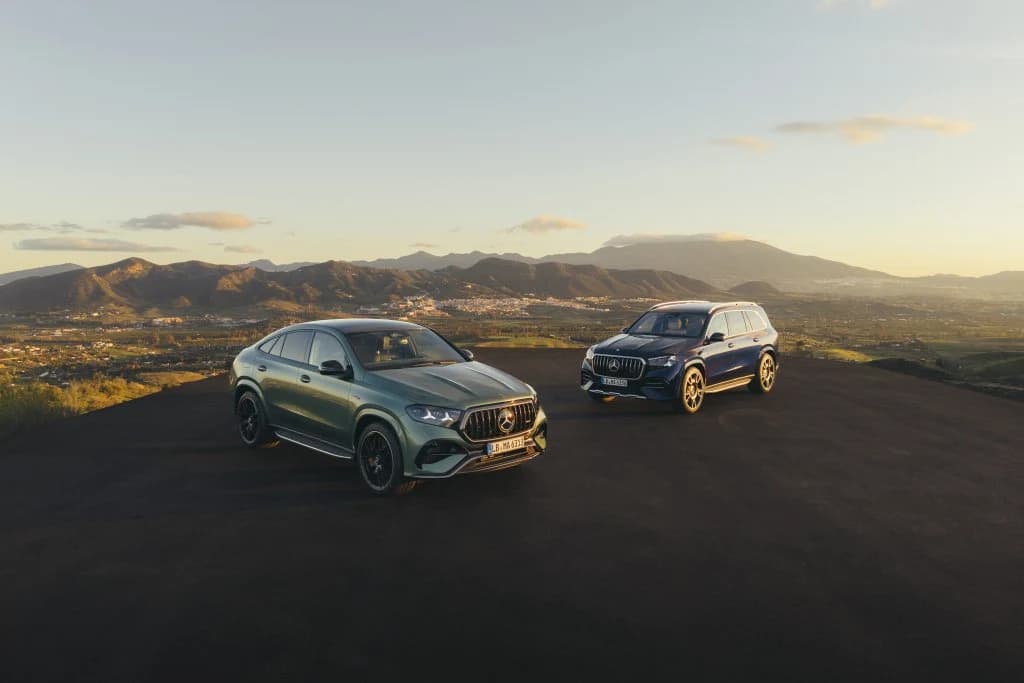
Official image supplied by Mercedes-Benz USA / Mercedes-AMG.
Mercedes admits it misjudged V8 fans as AMG confirms a V8 CLE 63
Mercedes-Benz has acknowledged that it underestimated the size and importance of the customer group attached to V8 engines. Ola Källenius, chief executive of Mercedes-Benz Group, defended the engineering behind the current four-cylinder hybrid C 63, but said the company had not brought the entire “good old V8 crowd” with it. Stefan Weckbach, head of Mercedes-AMG, then confirmed that the next CLE 63 will use a V8 and pointed to a 2027 launch, according to reporting by Autoblog.
The announcement is narrower than a general return to large engines. Mercedes has not confirmed a new V8 C 63 or E 63. It is also continuing to develop electric AMG models and a high-performance AMG.EA architecture. The company’s investor material describes a future with both electrified combustion engines and dedicated battery-electric performance cars.
Why the current C 63 exposed a product problem
The current Mercedes-AMG C 63 S E PERFORMANCE combines a 2.0-litre turbocharged petrol engine with an electric drive system and a high-performance battery. The layout brings all-wheel drive, energy recovery and a high system output. It is technically more complicated than the V8-powered C 63 generations that came before it, and its performance cannot be judged only by the number of cylinders.
That is precisely where the commercial problem appeared. Many AMG customers did not buy a C 63 simply because it was quick. They also bought the engine’s response, sound and mechanical character. Replacing a V8 with four cylinders changes the product even if the hybrid system delivers impressive acceleration. A software strategy, a large electric motor and a high peak output can solve some performance targets, but they do not reproduce the same combustion-engine experience.
Mercedes-AMG had already suggested that it needed to explain the technology better. In 2025, former AMG chief executive Michael Schiebe said the brand could have communicated the four-cylinder hybrid concept more effectively to dealers and customers. Källenius’s newer comment adds another conclusion: the issue was not only a communication gap. A significant part of the audience wanted the V8 itself.
What is confirmed about the next CLE 63
The confirmed information is limited but clear. The next Mercedes-AMG CLE 63 will have a V8, and the launch is planned for 2027. Mercedes-AMG has not yet published the engine displacement, power, torque, official fuel consumption, emissions, pricing or European delivery schedule.
The current CLE family includes four- and six-cylinder versions, depending on the market and specification. The CLE 53 uses a six-cylinder engine and is not the V8 model referred to in the new announcement. The future CLE 63 will sit higher in the range, but the name alone does not establish its final technical specification.
Mercedes has also not said that the C 63 or E 63 will receive the same engine. Those models should therefore be treated separately. A confirmed V8 CLE 63 is evidence of a product decision, not proof of a complete AMG policy reversal.
The engine may also be electrified. Mercedes-Benz investor documents refer to a next-generation, high-tech electrified V8. That wording could include a 48-volt starter-generator, energy recovery and other assistance systems, but the company has not released a complete data sheet for the CLE 63. No reliable claim can yet be made about its power or hybrid configuration.
AMG is still investing in electric performance
The V8 announcement does not cancel Mercedes-AMG’s electric programme. AMG.EA is the company’s dedicated high-performance electric architecture, and Mercedes-AMG is presenting battery-powered models alongside its combustion products. The electric GT 4-Door Coupé is part of that direction, while future launches will expand the range.
AMG describes its identity through four areas: drive systems, driving dynamics, sound and design. That helps explain why the V8 debate is not simply a dispute about acceleration figures. An electric performance car can deliver immediate torque and precise control, but it does not mechanically generate the same vibration, induction noise or exhaust note as a V8. Digital sound and simulated gear changes can create an atmosphere, yet they remain an electronic layer rather than a combustion event.
The V8 also has disadvantages. It is larger and heavier than a smaller engine, and its fuel use and emissions can be higher in real driving. Future emissions rules add engineering cost. A V8 therefore makes more sense in an expensive, low-volume performance model than in every AMG vehicle. Mercedes can retain the engine where its customers are prepared to pay for the character, while using electric or smaller hybrid systems elsewhere.
What the decision means for buyers
For European buyers, the V8 CLE 63 is still a future product. Mercedes has not announced a Romanian price, a local ordering date or final homologation figures. Fuel consumption and CO₂ emissions should not be estimated from other AMG models because the body, engine and certification specification may all differ.
Customers shopping for a new AMG already face several distinct choices: four- and six-cylinder hybrids, plug-in systems, existing V8 models higher in the range and fully electric cars. The right option depends on access to charging, running costs, sound, mass, daily usability and the kind of performance the driver values.
Mercedes is not promising that every AMG will return to eight cylinders. It is confirming that the company listened to the response and changed the plan for at least one important model. The next CLE 63 will be the clearest test of whether a modern, possibly electrified V8 can combine regulatory requirements with the character that AMG customers expected in the first place.