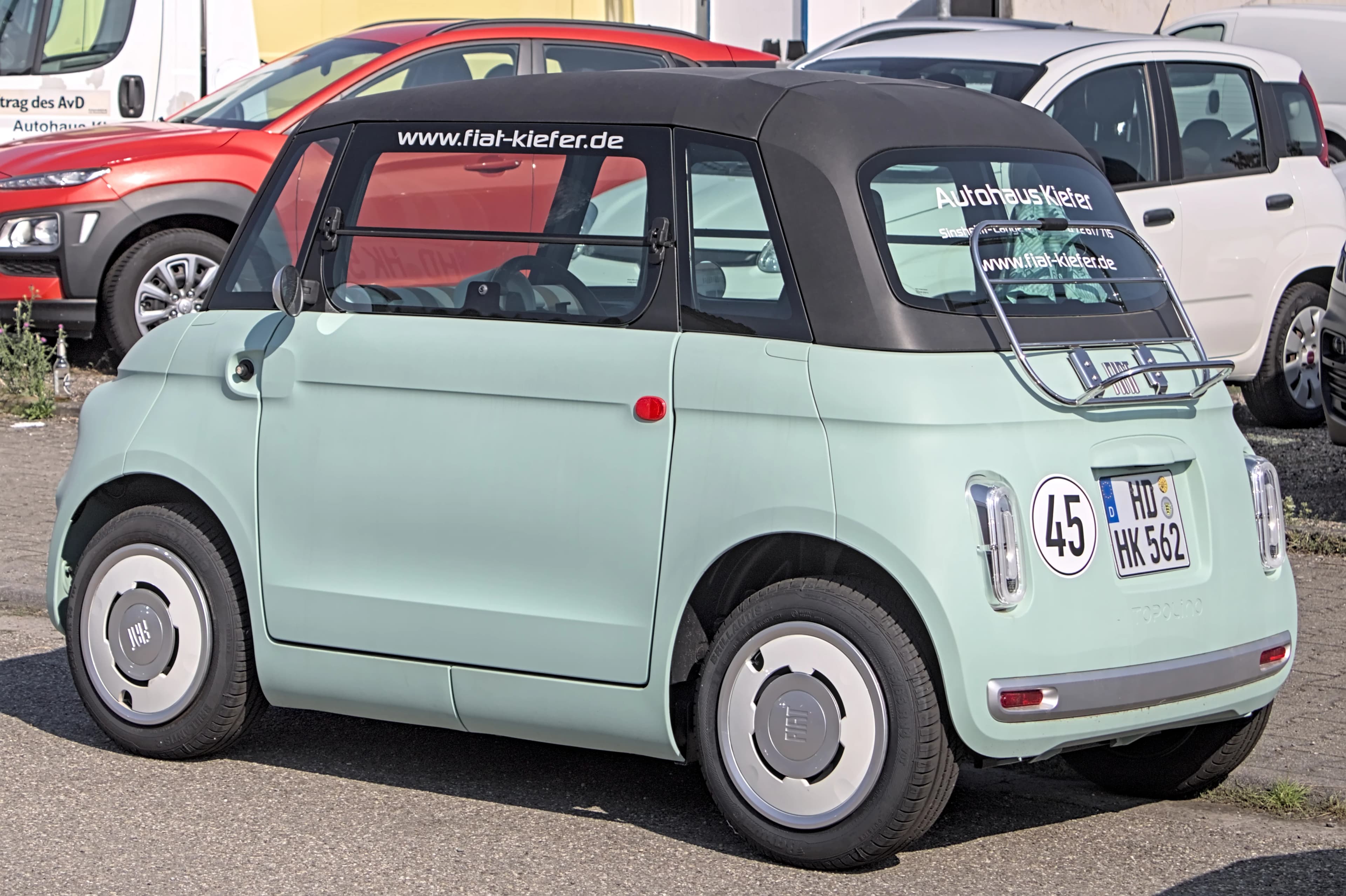
Image: Alexander-93/Wikimedia Commons, CC BY-SA 4.0. The image published by TIME is not reused because its credit is assigned to Devin Oktar Yalkin.
The Fiat Topolino has been included in TIME’s Best Inventions of 2026, under Design. The selection recognises the way Fiat packages short-distance electric mobility in a small, recognisable vehicle. It does not amount to an independent test of range, crash protection or ownership cost, and it should not be read as a comparison victory over every electric quadricycle.
A design award, not a road test
Fiat and Stellantis describe TIME’s process as a combination of nominations from editors and correspondents and online submissions. The criteria named in the company’s release are originality, efficacy, ambition and impact. The Topolino appears in the Design category, which puts the emphasis on the product idea and its execution rather than on acceleration or battery efficiency measured by an outside laboratory.
That distinction is important for a vehicle with such a clearly defined role. Topolino is a light electric quadricycle, not a conventional small car. The award tells us that the concept stood out to TIME’s selection process. The technical boundary remains set by its homologation, its speed limit, its two-seat cabin and the conditions in which its official range was established.
The numbers behind the concept
Fiat’s official launch information gives the Topolino a 2.53-metre body, a 45 km/h top speed and up to 75 km of stated range. It is powered exclusively by electricity and can be charged from a domestic socket, using the supplied charging solution and an appropriate installation. These figures put it in a different class from an electric supermini.
That difference changes the useful comparison. A Topolino may be easier to place in a narrow urban space and less demanding to manoeuvre than a full-size car. It also carries only two people and is built around short trips. A buyer planning motorway journeys, regular inter-city travel or family transport would be asking it to do a job outside its intended envelope.
Fiat’s small dimensions are therefore both a benefit and a restriction. The vehicle takes less physical space, but it offers less room for passengers and luggage. The 45 km/h ceiling can be appropriate in dense urban areas while becoming a major limitation on roads where surrounding traffic moves much faster.
Closed body or Dolcevita
The launch range includes a closed Topolino and the Dolcevita interpretation. The latter uses an open-bodied design with details that recall seaside scooters. Both versions express the same electric quadricycle idea, but they communicate it differently. The enclosed model is the more weather-focused choice. Dolcevita makes the visual and recreational side of the concept more prominent.
Topolino’s identity is built from compact proportions, simple surfaces and details connected to Fiat’s Italian design language. There is no attempt to make the product look like a reduced sports car. The point is to make a very small vehicle legible as a Fiat and to give it a clear place in city life.
For customers, the body choice is practical as well as aesthetic. Rain, wind, cold weather and secure overnight parking matter more when the vehicle has a highly open configuration. The official range and speed remain the headline technical figures, but daily comfort depends on the exact body and on the local climate.
Fiat’s commercial context
Stellantis says Fiat was Europe’s electric quadricycle market leader in 2025 and kept that position in 2026. The same release points to strong performance in Italy, Germany, the Netherlands, Austria and Switzerland, and says Topolino became number one in France from July. These are manufacturer claims. The release does not provide a complete independent dataset, market definition or monthly sales table that would allow readers to reproduce the ranking from that page alone.
The statement nevertheless explains why Fiat connects the TIME recognition with market performance. The Topolino is being presented as a product that has found buyers, not just as a styling exercise. Those are separate claims: TIME selected the product editorially, while Fiat reports a sales position for the electric quadricycle category.
What 75 km means in practice
The stated 75 km is an official maximum and not a guaranteed distance in every season. Temperature, gradient, passenger load, traffic, tyre pressure and the use of heating or ventilation can affect consumption. The sensible way to assess the figure is to compare it with a real daily route and leave a margin for unexpected detours.
Charging from a domestic socket can be convenient for an owner with a private parking space. It is less simple for someone who parks on the street or in a shared garage without an accessible outlet. A small battery may shorten charging needs, but it does not solve the practical question of where electricity is available.
The vehicle’s 45 km/h limit also requires route planning. Topolino can fit urban streets and low-speed districts; it is not designed to keep up with traffic on faster inter-city roads. In a compact city with short journeys, that constraint may be manageable. In a region where every trip involves a high-speed connection between towns, the same constraint can rule it out.
The missing local details
The official material consulted confirms the design selection and the principal specifications, but it does not set a Romanian retail price, stock level or every local registration rule. A Romanian buyer should ask the importer or dealer about the vehicle category, licence requirements, insurance, service support, warranty and charging equipment before ordering.
Fiat Topolino’s appeal is therefore easy to define and just as easy to misunderstand. TIME has recognised a compact design solution with a clear urban purpose. Fiat’s own figures describe a two-seat electric quadricycle limited to 45 km/h and up to 75 km of official range. It may work well as a short-trip vehicle, but it is not a universal substitute for a passenger car. The correct decision depends on the owner’s routes, parking situation and tolerance for those limits.