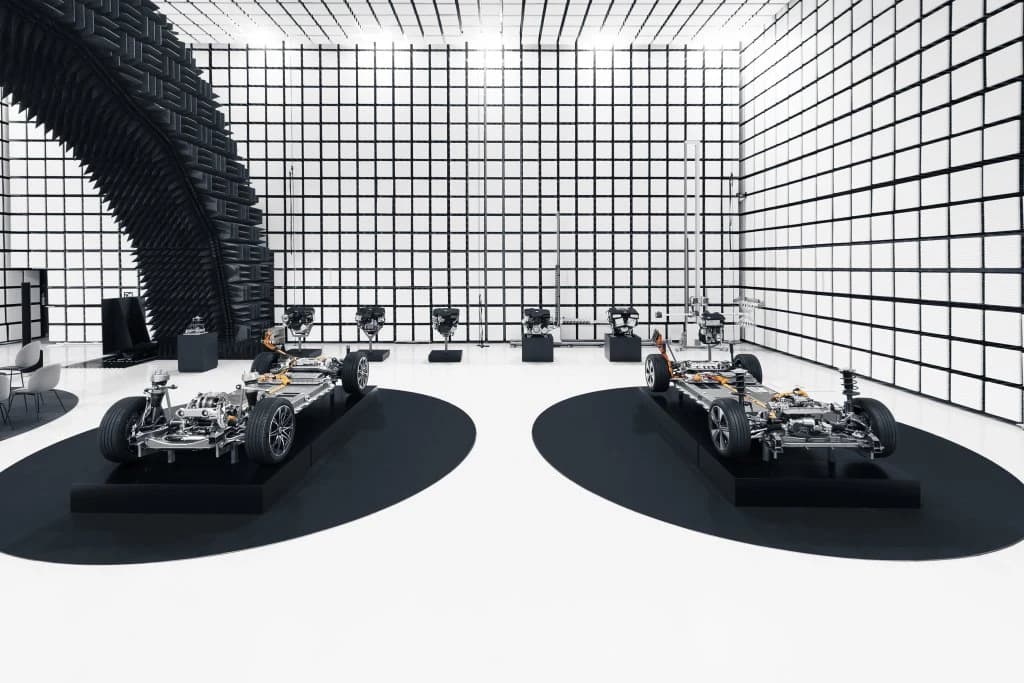
Official Mercedes-Benz Media image from the company’s powertrain development release.
Mercedes-Benz develops new battery chemistries for electric cars
Mercedes-Benz is working on several next-generation battery cell chemistries as it tries to improve electric-car range, charging time, performance and cost. The company says it is developing manganese-rich LMO/NMC and LNMO platforms, while also continuing solid-state battery testing with Factorial Energy and ProLogium.
The announcement, published on 27 October 2026, is a technology update rather than a production-car launch. Mercedes-Benz has not named a model that will use the new chemistries, and it has not provided a series-production date, pack capacity or official vehicle range for them.
Two manganese-rich chemistry programmes
One development route combines lithium manganese oxide, or LMO, with a nickel-manganese-cobalt cathode. Mercedes-Benz says the approach uses more manganese and less nickel and cobalt, aiming for a balance between energy density and cost. It is a cell-chemistry platform under development, not a confirmed specification for a current Mercedes electric car.
The company is also advancing lithium nickel manganese oxide, known as LNMO. Mercedes-Benz says the chemistry could remove cobalt and use considerably less nickel than today’s NMC cells. Its potential depends on high-voltage operation, with the company referring to values of up to 5 volts. That figure describes the chemistry’s development potential; it is not a stated operating specification for a production vehicle.
Mercedes-Benz says LNMO could offer up to a 30% range advantage over LFP at comparable weight and packaging volume. The wording is conditional and comes from the manufacturer. It is not a WLTP result and cannot be converted into a vehicle range without knowing the pack capacity, vehicle mass, aerodynamics, software calibration and test conditions.
Why cell chemistry matters
Battery chemistry affects how much energy a pack can store, how quickly it can accept power, how it behaves at different temperatures and how much its materials cost. Higher energy density can mean a smaller pack for the same range or more range in the same space. A lighter pack can also reduce vehicle energy consumption, although the result depends on the full vehicle and not on the cell alone.
LNMO’s high-voltage potential also creates engineering work. The cells, insulation, inverter, battery-management system and thermal system must all be designed for the operating conditions. A chemistry that looks promising in a laboratory still has to prove cycle life, abuse tolerance, fast-charging durability and production consistency.
Reducing cobalt and nickel could make supply chains less dependent on those materials, but it does not remove every raw-material challenge. Lithium, manganese, copper, graphite and other inputs remain part of the battery supply chain. The final cost also depends on factory yield, cell format, module design and production volume.
Smaller and lighter battery systems
Mercedes-Benz says it wants battery systems that are more compact and lighter while maintaining or increasing performance. The practical benefit could be more freedom for interior packaging, crash structures, cooling hardware or storage space. Lower mass may reduce consumption, but the size of that benefit cannot be calculated from the announcement alone.
The battery programme is being developed alongside modular electric powertrain work. Mercedes-Benz describes the high-voltage battery, electric drive unit, thermal management, charging system and software as one system. The company also says it is scaling an 800-volt architecture towards larger vehicle ranges and developing the EDU 2.0 electric drive unit in-house.
That system approach matters because a battery cannot be assessed in isolation. Charging speed depends on the pack, the charger, the thermal system and the charging infrastructure. Vehicle range depends on cell energy, usable capacity, mass, tyres, aerodynamics, speed and weather. A new chemistry may improve one part of the equation while creating new requirements elsewhere.
Solid-state work continues with two partners
Mercedes-Benz is pursuing solid-state batteries with Factorial Energy and ProLogium. With Factorial, the carmaker has developed a lithium-metal solid-state battery that was tested in an EQS development vehicle. Mercedes-Benz says the prototype covered 1,205 kilometres from Stuttgart to Malmö without recharging. That is a demonstration-vehicle result, not a certified range figure for a production EQS or another customer car.
The company is also testing next-generation solid-state cells with several partners, including ProLogium’s Gen4 technology. The announced work covers performance, safety and thermal properties. Mercedes-Benz says the aim is to assess whether the cells could be suitable for future series production. No production model, battery capacity, charging curve or launch timetable has been confirmed.
The ProLogium programme should be kept separate from the Factorial road test. The suppliers, cell designs and test conditions are different. A result achieved with a Factorial prototype cannot be presented as a result for ProLogium’s Gen4 cells.
From a cell to a road car
Several steps remain between a promising cell and a battery sold in a vehicle. Mercedes-Benz would need to validate the module and pack, cooling circuit, battery-management electronics, crash protection, durability and repair strategy. It would also need a repeatable manufacturing process and a cost structure that works for the intended vehicle segment.
The company’s current announcement therefore describes a wider technical programme rather than a showroom product. The next meaningful evidence would be a named demonstrator, published test data with clear conditions or a production vehicle announcement. Until then, Mercedes-Benz has confirmed several development directions, while the final performance and commercial timing remain open.