Illustrative image; the cars do not represent specific models or brands.
7 used cars with a large boot under €15,000 in Romania in 2026
The short answer
If you have a maximum of €15,000 and want a used car with a large boot, a useful starting list is Škoda Superb III liftback, Renault Talisman saloon, Škoda Octavia III liftback, Ford Mondeo Mk5 liftback, Dacia Logan III saloon, Fiat Tipo saloon and Opel Insignia B Grand Sport. Official reference volumes sit between 490 and 625 dm³/litres, but the largest figure does not automatically guarantee the most practical boot.
Quick verdict:
- Superb III offers the largest volume on the list and liftback access;
- Talisman has 608 dm³ VDA, but it is a saloon, with a smaller opening;
- Octavia III is more compact than Superb and keeps the large tailgate;
- Mondeo Mk5 has good space in the five-door version, but volume varies a lot with the spare wheel and powertrain;
- Logan III and Tipo saloon are the simple options for anyone who wants volume without a very large car;
- Insignia Grand Sport has the smallest number in the table, but the liftback opening makes bulky objects easier to load.
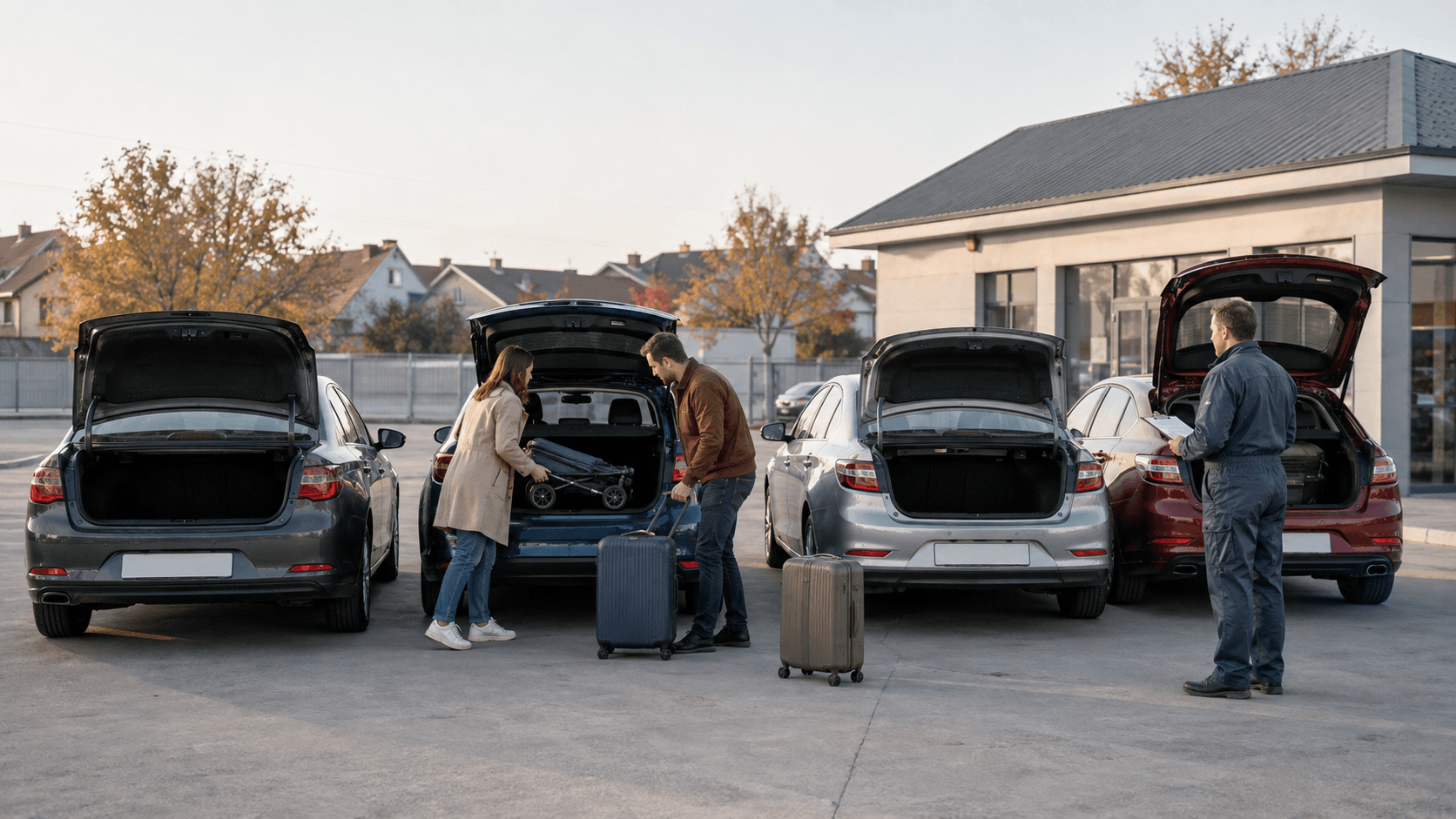
A rigid pushchair, a dog crate or two large suitcases can fit more easily in a 490-litre liftback than in a 520-litre saloon. Go to the viewing with the objects you actually carry, not only with the figure from the spec sheet.
Quick comparison
| Model and generation | Body | Official reference volume | What to clarify |
|---|---|---|---|
| Škoda Superb III | liftback | 625 l | tailgate, water ingress, fleet wear, engine and DSG |
| Renault Talisman | saloon | 608 dm³ VDA | load opening, 4Control, EDC and diesel history |
| Škoda Octavia III | liftback | 590 l | do not confuse it with the Combi; check fleet use, engine and DSG |
| Ford Mondeo Mk5 | 5-door liftback | up to 550 l | spare wheel, HEV, Powershift and boot floor |
| Dacia Logan III | saloon | 528 dm³ VDA | LPG/CVT, load sill and usage history |
| Fiat Tipo | saloon | 520 l | exact engine, timing belt/chain and traces of fleet or taxi use |
| Opel Insignia B Grand Sport | liftback | 490 l | kerb weight, diesel, automatic gearbox and tailgate |
The figures come from manufacturer documentation, but they are not all expressed by the same method. VDA uses standardised one-litre blocks, while some data sheets also publish a volume measured with liquid or up to a given reference. Do not compare 628 litres measured up to the seat back with 528 dm³ VDA as if they were two different boots.
1. Škoda Superb III liftback: 625 litres and access close to an estate
Superb III, launched in 2015, is the car with the largest boot in this selection. Škoda quotes 625 litres for the liftback, 30 litres more than the previous generation. The tailgate rises with the rear window, so you can load boxes, a pushchair or tall luggage much more easily than through a classic saloon lid.
Under €15,000, take your time and separate cars by generation, engine, gearbox and history. Superb was often used on long journeys, in fleets or for passenger transport. Documented high mileage can be easier to assess than low mileage without invoices.
At the viewing:
- lift the floor and look for water, signs of panel beating or welding in the spare-wheel area;
- check the struts and tailgate closing, including electric operation if fitted;
- test the folding rear seat and access for long objects;
- identify the engine, the exact DSG type and any 4x4 system from the VIN;
- check DPF, EGR and SCR/AdBlue on diesel, where fitted;
- test the gearbox from cold, on a slope, in slow traffic and after it has warmed up.
Compare Superb under €15,000, but discard listings without a VIN and a coherent history from the start.
2. Renault Talisman saloon: 608 dm³ VDA, with a narrower opening
Renault published a volume of 608 dm³ VDA for the Talisman saloon. The official launch sheet also notes that the space could take four golf bags. The figure is very good, but the boot lid does not raise the rear window. The shape of the object matters more than on Superb or Octavia.
Talisman should be chosen by configuration, not by equipment level. The range included TCe petrol engines, dCi/Blue dCi diesels, manuals and EDC, and some versions have 4Control and adaptive damping. Every extra system must be tested and included in the quote.
Check the boot with a real box or pushchair. Inspect the hinges, seal, lock, floor and side recesses. If the rear seat folds, see how large the opening into the cabin remains; 608 dm³ does not mean you can load any 608-litre object.
On diesel, diagnosis should include DPF, EGR, injection, turbocharger and SCR/AdBlue, depending on version. On EDC, repeat the manoeuvres from cold and hot. On 4Control, ask a workshop that can read the system and inspect the rear axle. See Talisman under €15,000 only after you have decided which configuration you can maintain.
3. Škoda Octavia III liftback: 590 litres in a body that is easier to park
The Octavia III liftback has 590 litres, and the Combi has 610 litres, according to Škoda documentation for the range updated in 2017. The 20-litre difference is small on paper. In practice, the estate has an extended roof, while the liftback is shorter and can be easier to use in town.
Octavia is widespread in fleets. Look at the steering wheel, seat, pedals, boot sill and seat-back edges. A recently cleaned floor does not tell you whether the car constantly carried heavy loads. Check springs, dampers, bump stops, tyres and geometry.
TSI and TDI engines, manuals and DSG variants are not assessed together. The engine and transmission codes determine the relevant jobs and intervals. The dedicated used Škoda Octavia guide explains the inspection order. For supply, start from Octavia under €15,000 and confirm from the papers whether it is a liftback or a Combi.
4. Ford Mondeo Mk5 liftback: volume changes with the spare wheel
The five-door Mondeo looks like a saloon from a distance, but uses a tailgate. Ford’s European technical sheet shows how risky a single number is: the version with a puncture kit has 550 litres up to the parcel shelf, the one with a space-saver spare has 541 litres, and the one with a full-size spare 458 litres. The five-door HEV is listed at 383 litres because the battery changes the floor.
This is the detail that can overturn the ranking. A Mondeo Hybrid bought on the 550-litre figure from a generic article does not offer the same boot. Lift the floor, identify the equipment and check whether the seller removed the spare wheel only for photographs.
On the engine, separate petrol, diesel and hybrid. For diesel, check the emissions systems and usage pattern. For hybrid, ask for diagnosis of the battery and high-voltage system. Identify the automatic transmission from the VIN: the commercial name “automatic” does not say whether the car has Powershift or another solution. Compare Mondeo under €15,000 by body and powertrain, not only by year.
5. Dacia Logan III saloon: 528 dm³ VDA and costs that are easy to understand
The Dacia technical sheet published in 2022 gives two figures for the same boot: 528 dm³ VDA and 628 litres measured to the top of the seat back. The official document shows why you must read the method, not only the largest number.
Logan III is shorter than the mid-size models on the list and can be a suitable choice for a family, commuting or taxi work. It is still a saloon: the opening does not compare with the tailgate of an Octavia or Insignia. Try a pushchair before buying and check whether the lid hinges or arms intrude into the luggage area.
The range included petrol, LPG and CVT, and combinations changed over time. On a commercially used car, check the driver’s seat, handles, belts, boot and mileage against the papers. On LPG, inspect the system, tank, approval date, pipes and operation on both fuels. On CVT, test from cold and hot. For differences between generations and transmissions, read the used Dacia Logan guide.
The Logan under €15,000 filter includes very different generations; do not compare a Logan II diesel with a Logan III LPG on price alone.
6. Fiat Tipo saloon: 520 litres in a compact car
The Fiat Tipo saloon has 520 litres, according to official Stellantis documentation. The model is about 4.54 m long and has a 60/40 split rear seat on the configurations mentioned by the manufacturer. The boot is large for the car’s footprint, but access remains that of a saloon.
Tipo was sold with petrol, diesel and, in different periods, manual or automatic transmissions. Identify the exact engine and model year. Do not transfer a recommendation for a naturally aspirated 1.4 onto a turbo or diesel engine. For the timing belt, ask for the invoice, part codes and mileage; do not accept only the mention in the advert.
Inspect the boot floor, sill, rear seat and rear suspension for signs of heavy transport. Some examples worked in fleets or as taxis; check the history, interior wear and data from RAR Auto-Pass. The used Fiat Tipo guide separates engines and bodies.
See Tipo under €15,000, then confirm that the listing is for a saloon, not a hatchback or Station Wagon.
7. Opel Insignia B Grand Sport: 490 litres, but a large tailgate
Insignia B Grand Sport has 490 litres with the rear seat up and up to 1,450 litres with it folded, according to Opel’s technical release. It is last in the table on the base figure, but the large tailgate and access almost to the roof can make the difference with a bulky object.
The car is long and heavy. Check brakes, tyres, suspension, geometry and the cost of consumables before comparing it with Logan or Tipo. On diesel, read DPF, EGR, injection and SCR/AdBlue, depending on version. On an automatic, ask for the history and repeat the test after it has warmed up.
The electric tailgate, camera, sensors and assistance systems must be tested separately. A repair at the rear can affect the boot floor, closing, sealing and sensor calibration. Lift the car, measure the paint and check the symmetry of the tailgate gap. Compare Insignia under €15,000 only after you have also calculated the costs after purchase.
Saloon or liftback: what to choose for your luggage
Choose a saloon if you carry small objects and want good separation from the cabin
A saloon has a lid that does not include the rear window. Luggage is better separated from the cabin, and noise and cold air on opening reach passengers less easily. Logan, Tipo and Talisman work well for suitcases, bags and objects that pass easily through the boot opening.
The problem appears with rigid pushchairs, tall boxes, appliances or bicycles. Measure the opening, the height to the parcel shelf, the distance between the wheel arches and the length with the rear seat folded.
Choose a liftback if you load bulky objects
On Superb, Octavia, Mondeo and Insignia Grand Sport, the tailgate rises with the rear window. The opening is larger, and folding the rear seat turns the car into a space close to an estate. The drawback is a heavier tailgate, with struts, lock and electric operation on some versions.
If you often load to the roof, secure the objects. In a hard stop, unsecured luggage can enter the cabin. A net, hooks and anchor points matter more than ten extra litres.
Compare with an estate before you pay
An estate usually has a longer floor, a straighter roof and better access for a dog, bicycles or holidays. It can, however, be longer, noisier and more used in fleets. The used estates under €15,000 round-up offers direct alternatives to the models here.
The 10-step boot test
- Measure the hardest object to transport: pushchair, crate, folding chair or box.
- Note the width and height of the boot opening, not only the total volume.
- Lift the floor and check what occupies the space: full-size spare, space-saver, puncture kit, battery or LPG system.
- Look for water, mould smell, rust, silicone, welds and beaten metal.
- Check the seal, leaks under the tailgate/lid and the lights for condensation.
- Test the hinges, struts, lock, buttons and electric opening.
- Fold each section of the rear seat and check whether the floor remains usable.
- Fit child seats and see whether the rear seat can still fold when you need it.
- Put real luggage in the car and keep visibility through the rear window.
- Repeat the inspection on a lift; a floor dressed from above can hide a repair underneath.
Checklist before buying
- The VIN is identical on the body, in the CIV, registration document, invoices and diagnosis.
- Generation, body and model year are confirmed.
- Boot volume matches the configuration, not another body.
- You know whether the figure is VDA, volume to the parcel shelf or to the seat back/roof.
- The spare wheel, puncture kit, battery or LPG tank are present and correctly secured.
- The load opening accepts the objects the family uses.
- The floor, spare-wheel well, chassis rails and rear panel have no suspicious accident traces.
- There is no water, mould, condensation or persistent smell.
- The tailgate or lid stays up and closes without play or abnormal effort.
- Electric operation, the kick sensor and buttons work, if fitted.
- The rear seat folds and locks correctly.
- Rear belts and seat mounts have not been affected by transport.
- The rear suspension is not sagging, noisy or improvised.
- Tyres have homologated sizes and even wear.
- The engine, gearbox and emissions systems have been checked for the exact configuration.
- Diagnosis includes all modules, not only the engine ECU.
- Mileage is compared with RAR Auto-Pass, ITP certificates and invoices.
- Recalls have been checked by VIN with the manufacturer or dealer.
- An independent workshop has inspected the body on a lift.
- You have a quote for defects and separate money for the post-purchase service.
For a full inspection, follow the step-by-step guide to buying a used car. If the car comes from a fleet, add the checks from the guide to cars coming out of leasing.
Frequently asked questions
Which used car on this list has the largest boot under €15,000?
The Škoda Superb III liftback has the largest official volume on the list, 625 litres. It is not automatically the best buy: examples in budget can have high mileage, complex equipment and higher costs than Logan or Tipo. History and inspection decide.
Is Superb a saloon or a hatchback?
Superb III has a saloon silhouette but a liftback body: the tailgate includes the rear window. The same principle applies to Octavia liftback, five-door Mondeo and Insignia Grand Sport. Talisman, Logan and Tipo on the list are classic saloons.
Why does Mondeo have several boot figures?
The floor and usable space change with the spare wheel or puncture kit. On Mondeo HEV, the battery reduces volume further. Check the version sheet and the actual car; do not use the 550-litre figure for every Mondeo.
What does dm³ VDA mean?
It is a standardised method that fills the space with rigid 200 × 100 × 50 mm blocks, each one cubic decimetre. It helps comparisons, but the blocks do not reproduce the shape of a pushchair, a suitcase or an animal crate.
Is a saloon less practical than a liftback?
For bulky objects, usually yes, because the opening is smaller. For suitcases and shopping, a saloon can be enough and separates luggage better from the cabin. The test with your objects is more relevant than the body type written in the advert.
Does LPG reduce the boot?
It can occupy the spare-wheel well or part of the space under the floor, depending on the system and model. On Logan and Tipo, check the installation, papers, tank date, mounting and the remaining puncture solution.
How much should be kept for costs after purchase?
There is no universal sum. Ask for a quote on the inspected example and add a full service, the timing belt where it is due, transmission oil if the procedure requires it, brakes, tyres and defects found. If the car’s price consumes the whole budget, look for a cheaper example.
Technical sources
- Škoda: Superb III, 625-litre boot
- Renault: Talisman saloon, 608 dm³ VDA
- Škoda: Octavia III liftback 590 l and Combi 610 l
- Ford: Mondeo volumes by body, spare wheel and powertrain
- Dacia: Logan, 528 dm³ VDA and 628 l to the seat back
- Fiat/Stellantis: Tipo saloon, 520 l boot
- Opel/Stellantis: Insignia Grand Sport, 490–1,450 l