A plug-in LED bulb marketed as a direct replacement for a halogen headlight bulb is not automatically federally compliant for on-road use in the United States. A bulb fitting the socket, producing a white beam, or carrying a seller's “DOT” claim does not prove that the original headlamp remains compliant with Federal Motor Vehicle Safety Standard No. 108.
The low-risk upgrade is a replacement bulb of the type specified by the vehicle or a complete headlamp assembly certified for that vehicle and light source. State inspection and equipment rules can add requirements, but they do not turn a noncompliant federal lighting product into a compliant one.
Why the socket is only part of the system
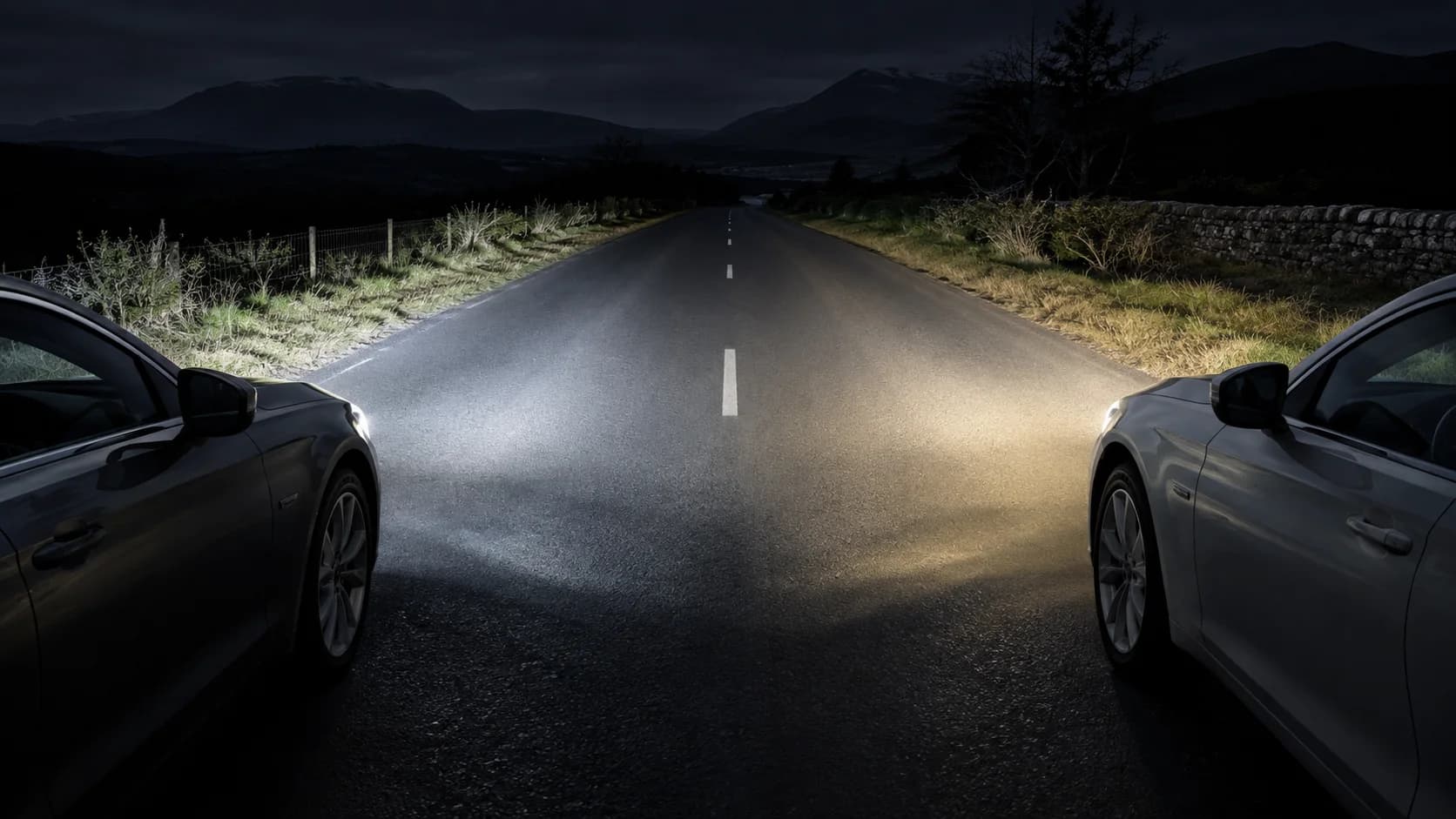
A headlamp is an optical system. The reflector or projector, lens and light source are designed to place light in a defined pattern. A halogen filament has a particular size and position. An LED retrofit places multiple emitters and a heat sink in a different geometry, even when its base locks into the same socket.
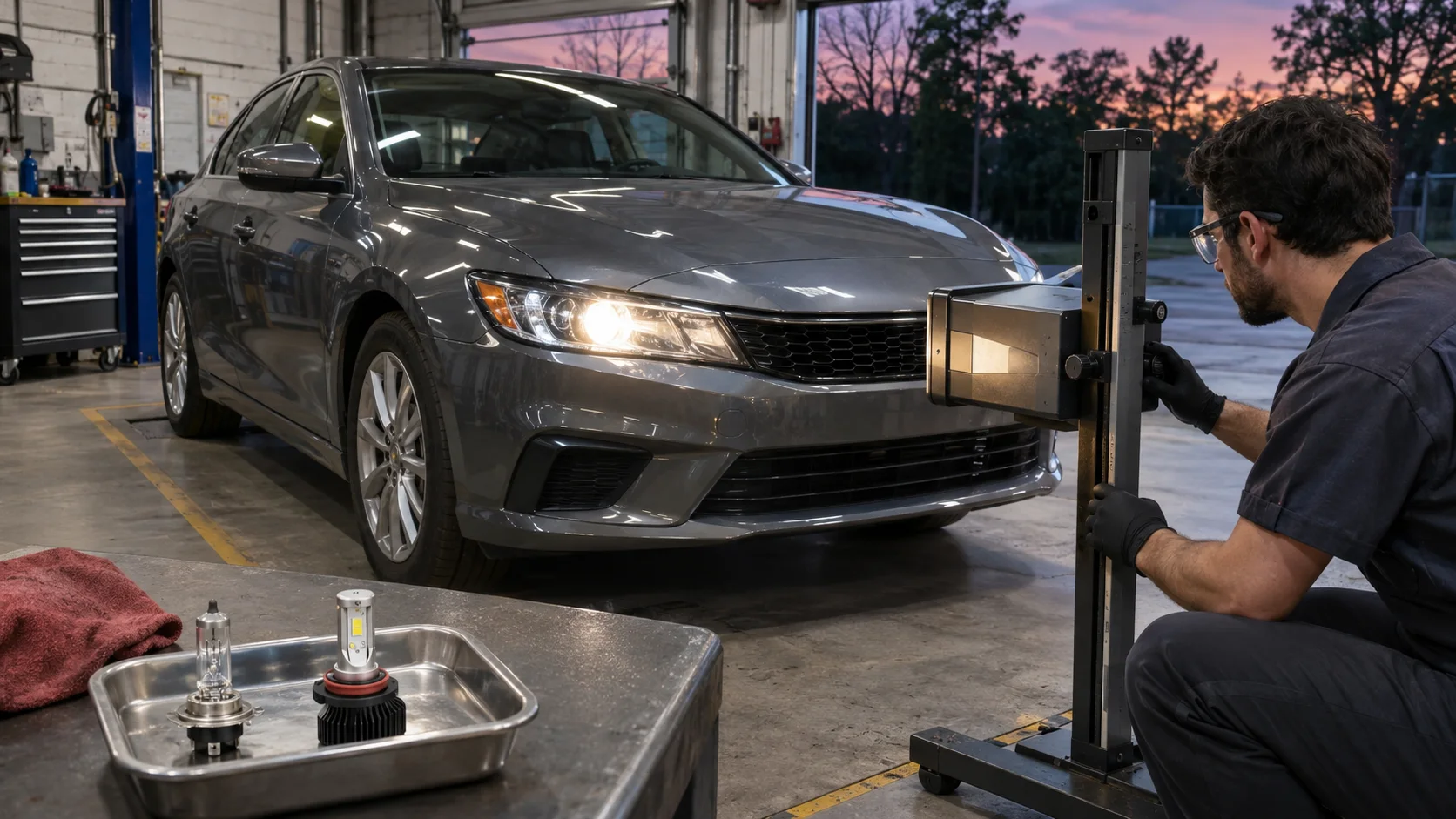
That difference can move light above the cutoff, create dark areas or put excessive intensity where an approaching driver sees glare. A garage-door pattern may reveal a serious aiming error, but it cannot measure the full photometric requirements in FMVSS 108.
Factory LED headlamps are legal when the vehicle or lamp assembly is certified with that lighting system. The problem is not LED technology itself. It is substituting a different light source in an assembly that was designed and certified for another one. Our explanation of matrix LED headlamps covers a factory system, not a bulb conversion.
What FMVSS 108 actually regulates
49 CFR 571.108 sets federal requirements for lamps, reflective devices and associated equipment on new vehicles and replacement lighting equipment. It covers matters including required lamps, color, location, markings, light-source specifications and photometric performance.
NHTSA has repeatedly explained that a replacement headlamp must meet the applicable requirements with the light source intended for that headlighting system. In its interpretation concerning HID conversion kits, the agency rejected the idea that a different source becomes acceptable merely because it can be installed in a halogen headlamp.
The same optical issue applies to LED retrofit bulbs. NHTSA's published material notes that illegal LED replaceable light sources remain available online even though they do not conform to FMVSS 108. A 2020 equipment recall required replacement of certain LED bulbs with compliant halogen bulbs, illustrating that a retail listing is not a certification.
Does a DOT mark make an LED bulb legal?
Not by itself. The Department of Transportation does not pre-approve individual aftermarket bulbs in the way a consumer-product testing laboratory might. Manufacturers certify their own regulated equipment, and NHTSA can investigate or recall noncompliant products.
A vague “DOT approved” phrase on a marketplace page is therefore not enough. Ask the seller for the exact compliance basis, the regulated light-source designation and the vehicle/headlamp applications covered. If the answer is only “off-road use,” “fits H11” or “brighter than stock,” it does not establish on-road compliance.
Also distinguish a bulb from a complete replacement assembly. A complete assembly may be designed for LED operation and certified for a specific application. Its documentation, permanent markings, beam pattern and installation instructions matter. An LED bulb placed in the original halogen housing is a different product and a different compliance question.
Federal and state rules are separate checks
Federal law governs the manufacture and sale of new motor vehicles and regulated replacement equipment. It also includes a “make inoperative” restriction for certain commercial businesses that knowingly disable federally required safety compliance.
States regulate vehicle operation, inspections and enforcement. A state may check headlamp color, aim, intensity, number and condition. Passing a quick state inspection does not demonstrate that the bulb was a compliant replacement light source, while a federally compliant lamp can still fail if it is damaged or badly aimed.
Before modifying the car, check the current inspection manual and vehicle-equipment law for the state where it is registered. If the car will be sold or moved, keep the original compliant parts and installation records.
A practical upgrade path that avoids glare
Start with the cause of poor lighting rather than assuming the bulb technology is obsolete:
- Clean the outer lenses and inspect them for haze, cracks and condensation.
- Verify charging voltage and the condition of connectors and grounds.
- Install the exact bulb type and wattage listed in the owner's manual.
- Replace halogen bulbs in pairs when their output or color has diverged.
- Have aim checked with proper optical equipment after suspension, collision or lamp work.
- If more performance is needed, look for a complete, documented assembly certified for the exact vehicle.
Higher-wattage halogen bulbs can overheat wiring or lamp materials and are not a safe shortcut. Blue-coated bulbs may reduce usable output. Auxiliary light bars also have their own state-use restrictions and cannot substitute for required low beams.
The decision rule
Do not buy an LED retrofit because it physically fits or because the listing displays a DOT-shaped logo. Use the specified replacement source unless the manufacturer can document that the complete lamp-and-source solution is compliant for the exact vehicle.
If the evidence is unclear, restore the original bulb type and have the lamps aimed. Better road lighting is measured by a controlled beam that helps the driver see without dazzling everyone else, not by the highest lumen number in an online listing.