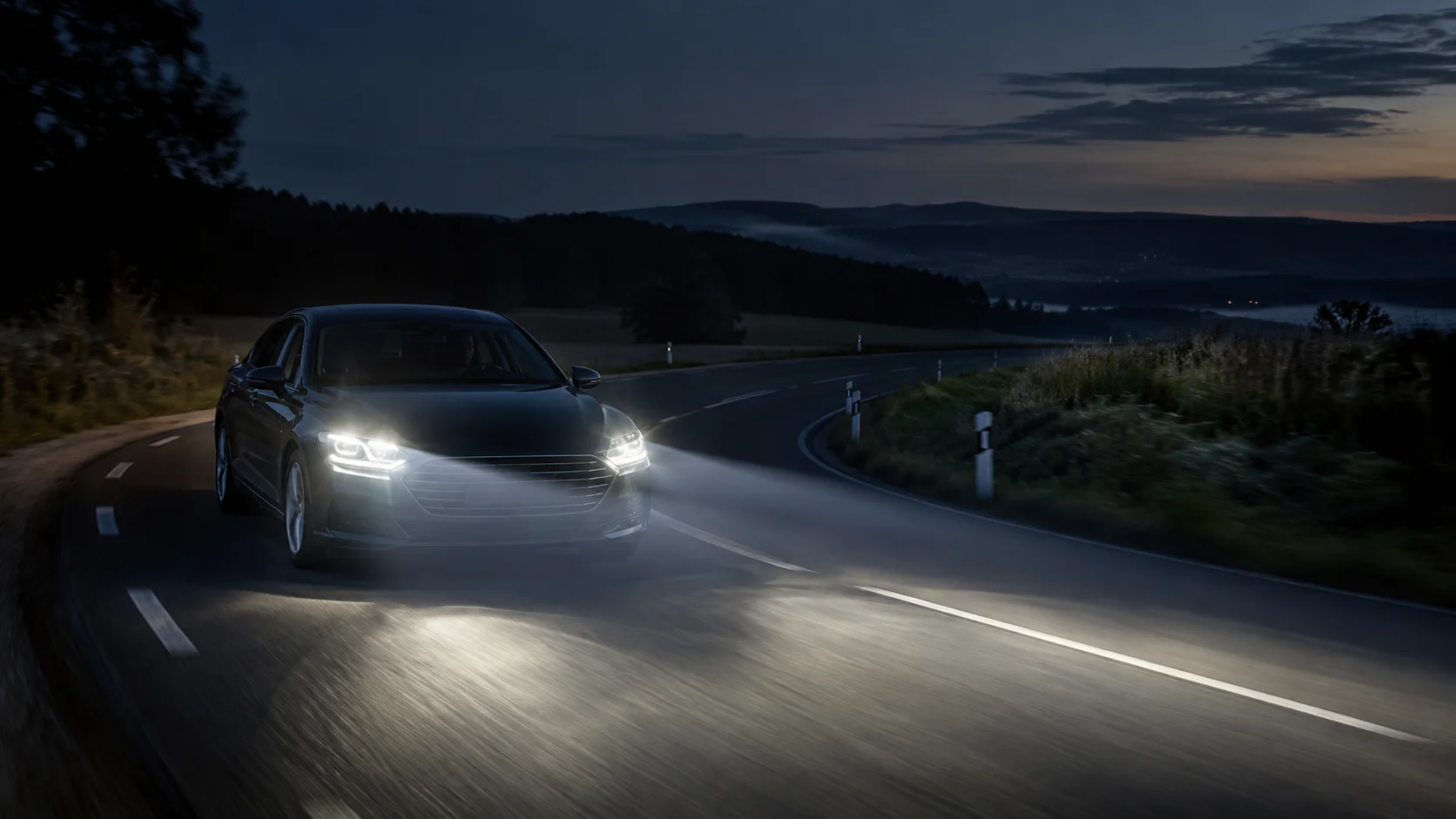
Matrix LED headlights are an adaptive lighting technology that can selectively dim or switch off individual light-emitting diodes (LEDs) within the headlamp array. This allows the vehicle to maintain a high-beam pattern for the driver while creating dynamic shadow areas to avoid dazzling other road users.
How matrix LED systems operate
Traditional high-beam headlights illuminate the road ahead uniformly. When an oncoming vehicle or a vehicle travelling in the same direction is detected, the driver must manually switch to low beam to prevent glare. Matrix LED systems automate this process. A forward-facing camera, typically mounted behind the windscreen, continuously monitors the road ahead for other vehicles' headlamps or tail lamps.
Upon detection, the system's control unit processes the camera data and identifies the precise location of other road users. It then instructs specific LEDs within the matrix headlamp to dim or switch off, creating a "tunnel" or "shadow" around the detected vehicle. The remaining LEDs continue to operate at high intensity, illuminating the areas of the road not occupied by other traffic. This allows the driver to benefit from extended visibility without causing discomfort to others. The system can adapt in real-time as vehicles move, dynamically adjusting the shadow areas.
The evolution from conventional lighting
Conventional halogen and xenon (HID) headlamps typically offer a fixed beam pattern. While some advanced xenon systems incorporated dynamic curve lighting, where the beam swivels with steering input, they lacked the granular control over light distribution that matrix LEDs provide. Early LED headlamps also often featured fixed patterns, though they offered advantages in energy efficiency and longevity.
The significant step change with matrix LED technology is the ability to control individual light segments. This is distinct from automatic high-beam assist systems, which simply switch between a full high beam and a full low beam. Matrix LED systems offer a continuous, adaptive high beam, enhancing safety by maximising illumination for the driver for longer periods.
Practical benefits for drivers
For a driver undertaking a hypothetical cross-border journey from, for instance, Belgium to Germany at night, matrix LED headlights offer tangible benefits. On unlit rural roads, the system can maintain a high-beam pattern, illuminating distant hazards, road signs, and the road shoulders. When encountering an oncoming vehicle, instead of switching to low beam and reducing forward visibility, the matrix system creates a precise shadow around the other vehicle, allowing the driver to continue seeing further ahead in their own lane and to the side.
This continuous high-beam functionality reduces driver fatigue by minimising the need for manual high-beam operation. It also allows for earlier detection of potential obstacles, such as pedestrians or animals, on the unlit portions of the road. Euro NCAP's Safety Assist protocols, which assess advanced driver-assistance systems, include evaluations of "Advanced Driver Assistance Systems (ADAS) for Night Driving" and specifically consider the performance of adaptive driving beam (ADB) systems like matrix LEDs in their assessments.
Limitations and operational considerations
Despite their advantages, matrix LED systems have limitations. Their effectiveness relies on the accuracy of the forward-facing camera and the processing speed of the control unit. In adverse weather conditions, such as heavy rain, snow, or dense fog, the camera's visibility can be impaired, potentially reducing the system's ability to accurately detect other vehicles. In such scenarios, the system may revert to a conventional low-beam pattern or operate with reduced adaptive functionality.
The performance can also be affected by very bright ambient light sources, such as strong street lighting, which might interfere with the camera's detection algorithms. Furthermore, the resolution of the matrix system, meaning the number of individual LEDs and their ability to be controlled independently, varies between manufacturers and vehicle models. A system with fewer, larger segments will offer less precise shadow creation than one with a higher number of smaller, individually controllable LEDs.
Drivers should be aware that these systems are assistance features and not a substitute for driver attention. The vehicle's owner's manual will detail the specific operational parameters, limitations, and any conditions under which the system may not function optimally.
Regulatory framework and compatibility
In the European Union, the General Safety Regulation (EU) 2019/2144 mandates certain safety features for new vehicles. While it does not specifically mandate matrix LED headlights, it sets out requirements for lighting systems to ensure they do not cause undue glare to other road users. UNECE Regulation No. 171 on driver-control assistance systems, which includes provisions for adaptive front-lighting systems (AFS), provides a framework for the approval of such technologies, ensuring they meet specific performance and safety criteria.
For a buyer or driver, verifying the compatibility and specific features of a matrix LED system involves consulting the vehicle's official documentation. The owner's manual will describe the system's capabilities, how to activate and deactivate it, and any specific warnings or operational notes. Vehicle brochures and manufacturer websites often highlight the presence of "adaptive high beam," "matrix LED," or "intelligent light system" features. It is important to distinguish these from simpler "automatic high beam" systems that only switch between full high and low beam. The presence of a specific symbol on the instrument cluster, often a headlight icon with an 'A' or an arrow, typically indicates that an adaptive high-beam system is active.
Matrix LED vs. Digital Light
While matrix LED systems offer advanced adaptive capabilities, a further evolution is "Digital Light" or "HD Matrix" technology. Digital Light systems use micro-mirror arrays or high-resolution projectors to generate light, allowing for even finer control over the beam pattern. Instead of simply dimming or switching off individual LEDs, Digital Light can project high-resolution patterns, symbols, or guidance lines onto the road.
For example, a Digital Light system could project warning symbols onto the road ahead of a detected hazard, or project lane-guidance lines in narrow construction zones. This level of precision goes beyond simply creating shadow areas around other vehicles.
In scenarios where the primary goal is to maximise illumination for the driver without dazzling others, a well-engineered matrix LED system offers significant advantages over conventional lighting. For situations requiring highly detailed projections onto the road surface for enhanced communication or guidance, Digital Light systems offer additional capabilities. The choice between these technologies often depends on the specific features desired and the vehicle's overall technological package. Both aim to improve night-time visibility and safety, but with differing levels of granularity and functionality.