A passenger car becomes exempt from federal motor-vehicle safety standards 25 years after its date of manufacture, not on January 1 of its 25th model year. That exemption can make a non-U.S.-market car eligible for permanent import, but it does not waive the EPA emissions declaration, Customs entry, duty or a state's title and registration rules.
The practical mistake is to treat “25 years old” as a complete approval. There are two federal age tests, several forms and a final state-level decision. Confirm all of them before paying an overseas seller or booking shipping.
The 25-year clock belongs to NHTSA
NHTSA's rule concerns compliance with Federal Motor Vehicle Safety Standards, bumper standards and theft-prevention standards. A car that is at least 25 years old may enter under Box 1 of Form HS-7 without being brought into compliance with the standards that applied when it was built.
Age runs from the actual manufacture date. A car built in December 2001 does not reach 25 years in January 2026 simply because advertisements call it a 2001 model. It reaches the threshold in December 2026. Ask for a clear photograph of the manufacturer plate and supporting registration or sales documents before committing money.
If the vehicle is younger than 25 years and lacks a U.S. certification label, permanent import normally requires a NHTSA eligibility determination and a Registered Importer. Some vehicles cannot be made eligible at a reasonable cost. “Show or Display,” racing and temporary entries are separate, limited routes; they are not substitutes for a normal road-car import.
EPA uses a different 21-year test
The emissions exemption is not the same as the NHTSA safety exemption. Customs and EPA guidance describes a Code E exemption for a vehicle at least 21 years old that remains in its original, unmodified configuration.
An engine swap can break that simple route. CBP states that a vehicle with a replacement engine does not qualify for the age exemption unless the engine and emissions controls meet the applicable equivalent-or-newer EPA requirements. A car can therefore be old enough for NHTSA while its modified powertrain still creates an EPA problem.
This produces a useful pre-purchase test:
| Question | Why it matters |
|---|---|
| Is the manufacture date at least 25 years before entry? | Determines the NHTSA age exemption |
| Is the vehicle at least 21 years old and still in original emissions configuration? | Determines whether the simple EPA Code E route fits |
| Does the VIN, engine and foreign title describe the same car? | Connects the exemption to the actual vehicle |
| Will the destination state title this configuration? | Federal entry does not guarantee state registration |
When originality is uncertain, obtain a written determination from the relevant agency or use a qualified importer before the car is shipped.
The documents needed at the port
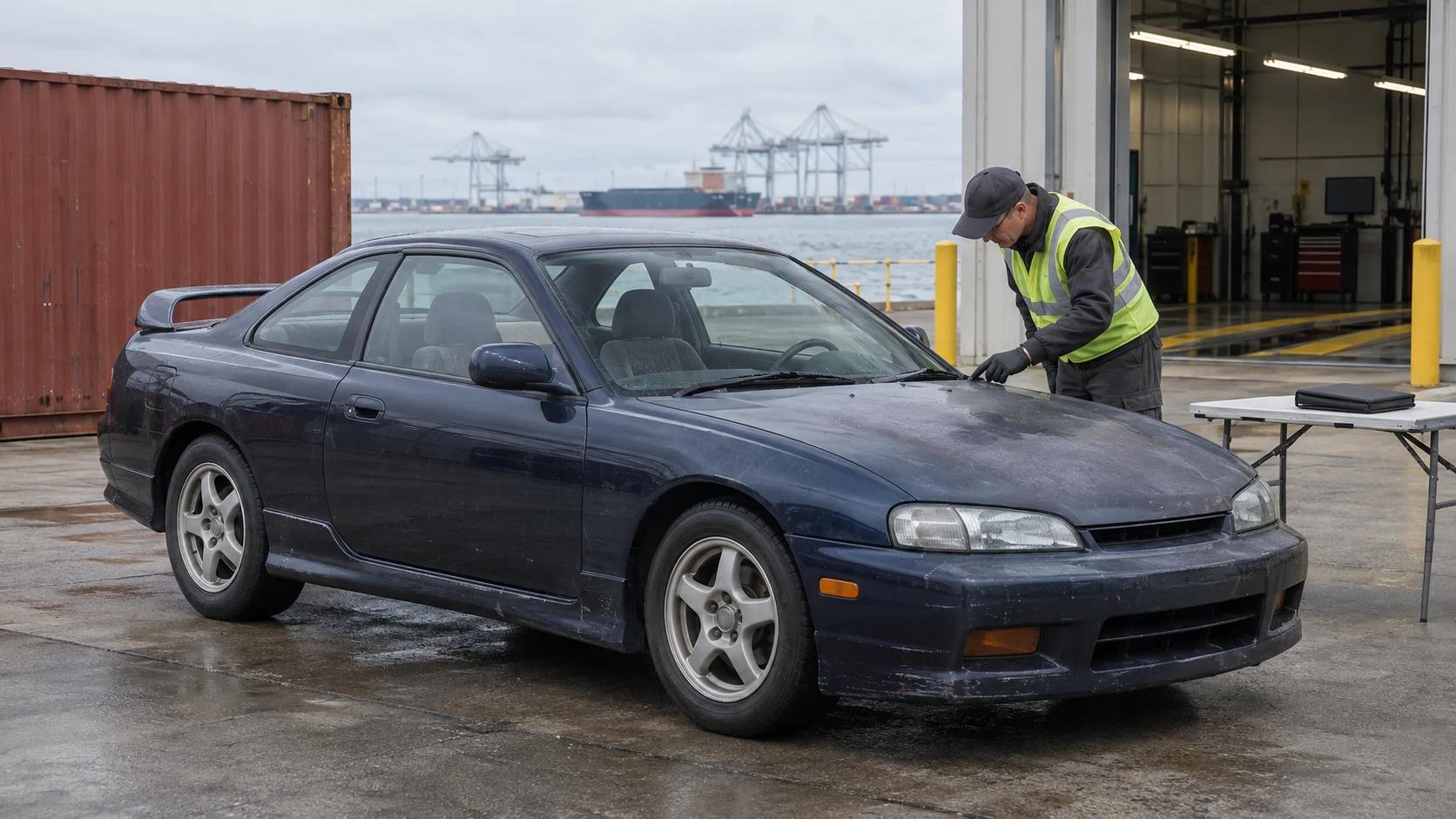
CBP requires the vehicle to be declared at entry. The core file normally includes:
- original title or another accepted proof of ownership;
- bill of sale and shipping documents;
- DOT Form HS-7 stating the NHTSA basis for entry;
- EPA Form 3520-1 stating the emissions basis;
- evidence of the manufacture date and original configuration;
- the Customs entry paperwork and payment of any applicable duty.
After processing, CBP Form 7501 is important evidence that the vehicle was formally entered. CBP warns that a state motor-vehicle agency may refuse registration without proof of entry. A vehicle brought across a land border must still be declared; driving it through and trying to repair the paperwork later can leave the car unregistrable or exposed to seizure.
The 25-year exemption is not a duty exemption. Customs duty, port fees, broker charges, inland transport and storage can still apply. Get a written landed-cost estimate that separates the purchase price from every import and delivery charge.
Federal entry is not a state title
NHTSA, EPA and CBP decide whether the vehicle may enter under federal law. The state decides whether it can receive a title, registration and plates. Requirements can include a VIN inspection, translated ownership documents, emissions or safety inspection, tax payment and proof of insurance.
Ask the destination DMV about the exact make, year, foreign ownership document and right-hand-drive status before shipping. Do not accept a seller's statement that another example was registered in a different state as proof that yours will be accepted.
Insurance is also vehicle-specific. Send the VIN and import documents to an insurer before purchase. A policy quote for a generic model name does not guarantee agreed coverage for a gray-market vehicle or its replacement parts.
Check the car, not just its eligibility
Legal eligibility says nothing about corrosion, crash repairs, odometer history or parts availability. A 25-year-old vehicle can be correctly imported and still be a poor purchase.
Arrange an inspection in the export country and reconcile the VIN across the body, title, service records and shipping documents. Check for structural repair, fluid leaks, obsolete tires, non-original emissions equipment and undocumented engine changes. If the car already entered the United States, demand CBP Form 7501 plus the HS-7 and EPA declarations rather than relying on a state plate alone.
Our salvage-title guide covers the separate title and structural checks when a vehicle has a damage history.
The decision rule
Do not send a deposit until the manufacture date clears the 25-year NHTSA threshold on the planned entry date, the EPA basis matches the actual engine and emissions configuration, and the destination DMV confirms its document path. Budget duty and state costs separately. If one of those three chains depends on a seller's verbal assurance, pause the import.