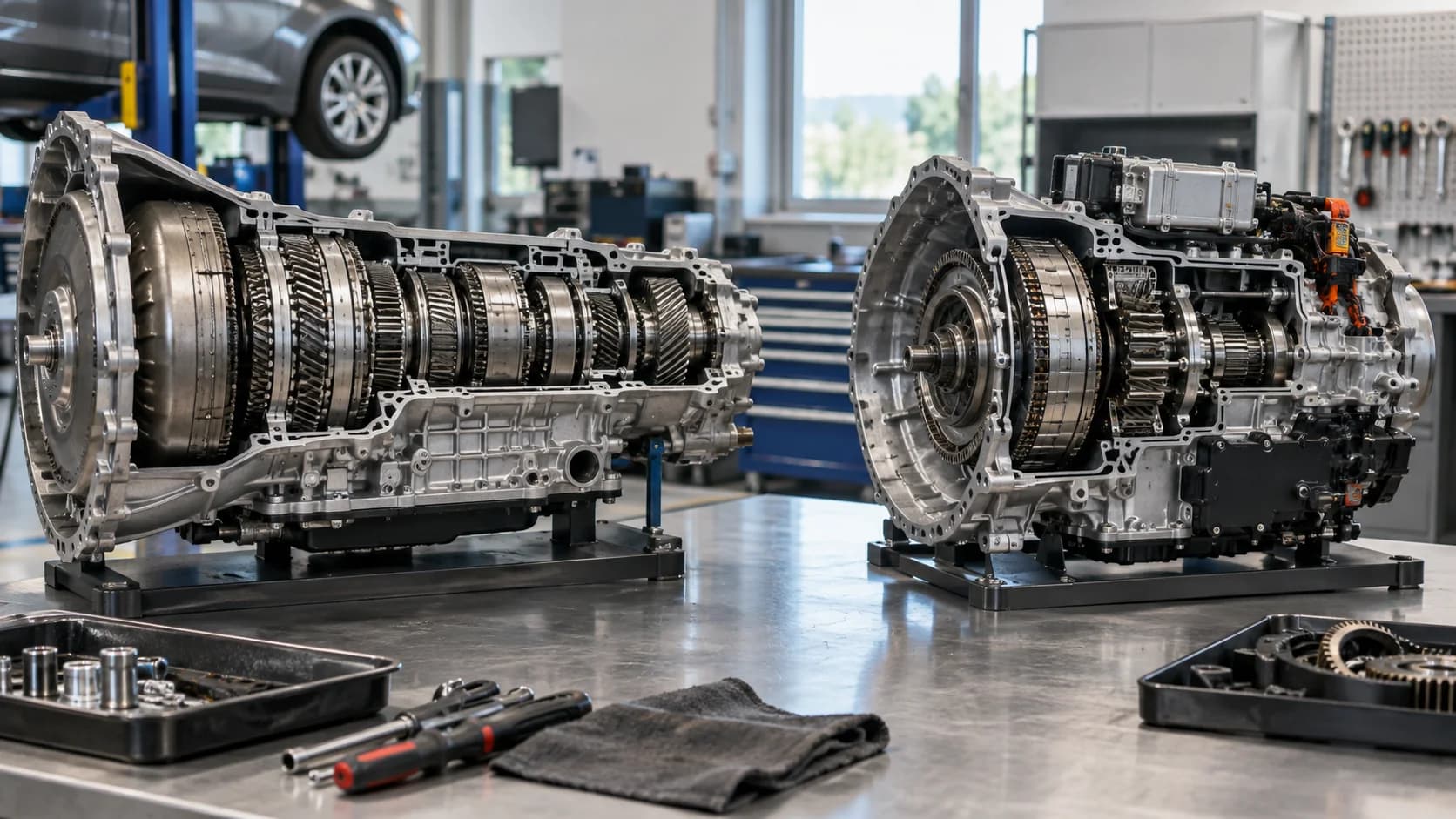
Dual-clutch transmissions (DCTs) generally offer faster, more direct gear changes and can contribute to lower fuel consumption in specific driving conditions. Torque-converter automatics (TCAs) typically provide smoother low-speed operation and greater torque multiplication, which can be advantageous for towing or heavy loads.
Understanding Dual-Clutch Transmissions
A dual-clutch transmission operates with two independent clutches, one for odd-numbered gears and one for even-numbered gears. While one gear is engaged, the next anticipated gear is pre-selected on the other clutch, allowing for rapid shifts with minimal interruption to power delivery. This design fundamentally reduces the time spent disengaged from the engine, which can translate to a more direct driving feel and, in certain scenarios, improved efficiency compared to a traditional manual gearbox or older torque-converter designs.
DCTs are often found in performance-oriented vehicles due to their shift speed. However, their application has broadened to include many mainstream passenger cars. The efficiency gains are most pronounced during steady-state driving or when accelerating through gears without significant changes in driver demand. In stop-start urban traffic, some early DCT designs exhibited hesitation or jerkiness at very low speeds, as the system managed clutch engagement and disengagement. Modern DCTs have largely mitigated these characteristics through sophisticated software control and hardware refinements, but the inherent mechanical design still involves clutch friction and wear, similar to a manual gearbox.
How Torque-Converter Automatics Function
Torque-converter automatics use a fluid coupling, the torque converter, to transmit power from the engine to the gearbox. This fluid coupling allows for smooth, continuous power transfer, even when the vehicle is stationary with the engine running and a gear engaged. The torque converter also provides a degree of torque multiplication at low engine speeds, which can be beneficial for initial acceleration or when pulling away with a heavy load.
The primary advantage of a TCA is its inherent smoothness, particularly at low speeds and during gear changes. The fluid coupling absorbs minor shocks and vibrations, contributing to a refined driving experience. Modern TCAs, often with eight or more forward gears, have significantly improved their efficiency through wider gear ratios and the implementation of lock-up clutches within the torque converter. These lock-up clutches mechanically connect the engine to the gearbox once a certain speed is reached, bypassing the fluid coupling to reduce slip and improve fuel economy. However, the fluid coupling still introduces some energy losses compared to a direct mechanical connection.
Efficiency and Emissions Considerations
Both DCTs and TCAs have evolved to meet increasingly stringent emissions regulations and consumer demand for better fuel economy. Official laboratory figures, such as those derived from the Worldwide Harmonised Light Vehicle Test Procedure (WLTP), provide a standardised basis for comparing declared fuel consumption and CO2 emissions. Manufacturers publish these figures, and they are typically found in the vehicle's Certificate of Conformity or technical specifications.
In real-world driving, the efficiency advantage of one transmission type over another can vary significantly based on driving style, road conditions, and vehicle load. A DCT might demonstrate better efficiency during a steady-speed journey across Europe, for example, from Berlin to Amsterdam, where frequent gear changes are not required, and the direct mechanical connection minimises losses. Conversely, a TCA might prove more efficient in heavy urban traffic, where its smoother low-speed operation and torque multiplication reduce strain on the engine and driveline, potentially avoiding excessive clutch slip or engine lugging. Drivers can verify the official consumption figures in their vehicle's manual or on the manufacturer's official website.
Driving Experience and Practicality
The choice between a DCT and a TCA often comes down to driving preference and intended use. Drivers who prioritise a direct, sporty feel and rapid gear changes may prefer a DCT. The immediate response to throttle inputs and the absence of a noticeable power interruption during shifts can enhance the perception of performance.
For drivers who value smoothness, refinement, and ease of use, particularly in congested environments or when manoeuvring at low speeds, a TCA typically offers a more relaxed experience. The ability to creep forward smoothly without precise throttle input, and the seamless nature of gear changes, are often cited as advantages. For applications involving towing, the inherent torque multiplication and robustness of a TCA can be a significant benefit. The vehicle manual will specify the maximum permissible towing mass, both braked and unbraked, which is a critical factor for verifying compatibility with towing requirements.
Longevity and Maintenance
Both transmission types are designed for the operational life of the vehicle, provided they are maintained according to the manufacturer's schedule. This typically involves periodic fluid changes and filter replacements. The specific maintenance intervals and fluid specifications are detailed in the vehicle's owner's manual. Adhering to these schedules is crucial for ensuring optimal performance and longevity.
DCTs, with their dry or wet clutch packs, are subject to wear similar to a manual clutch, although the wear characteristics are managed by the transmission's control unit. Wet-clutch DCTs, which immerse the clutches in oil, generally offer better heat dissipation and potentially longer clutch life. TCAs, while not having friction clutches in the same way, rely on the integrity of their fluid and internal components. Overheating or contamination of the transmission fluid can compromise performance and durability in both types. Drivers should consult their vehicle's manual for specific maintenance requirements and fluid types.
Driver Assistance Systems and Transmission Integration
Modern vehicles integrate transmission control with various driver assistance systems. For example, Adaptive Cruise Control (ACC) and Traffic Jam Assist systems rely on precise transmission control for smooth acceleration and deceleration. UNECE Regulation No. 171, concerning driver-control assistance systems, outlines performance requirements for such technologies. Both DCTs and TCAs are capable of seamless integration with these systems, though the specific tuning and calibration will influence the perceived smoothness of operation.
The General Safety Regulation (EU) 2019/2144 mandates certain safety features, including Intelligent Speed Assistance (ISA) and event data recorders. While these regulations do not directly dictate transmission type, the transmission's ability to respond accurately to driver inputs and system commands is fundamental. For instance, an emergency braking manoeuvre, potentially triggered by a system compliant with Euro NCAP Safety Assist protocols, requires the transmission to disengage power effectively and smoothly. The vehicle manual or official technical documentation will describe the specific driver assistance features and their operational parameters. In the event of an accident, the eCall system (European Commission 112 eCall) automatically alerts emergency services, irrespective of the transmission type.