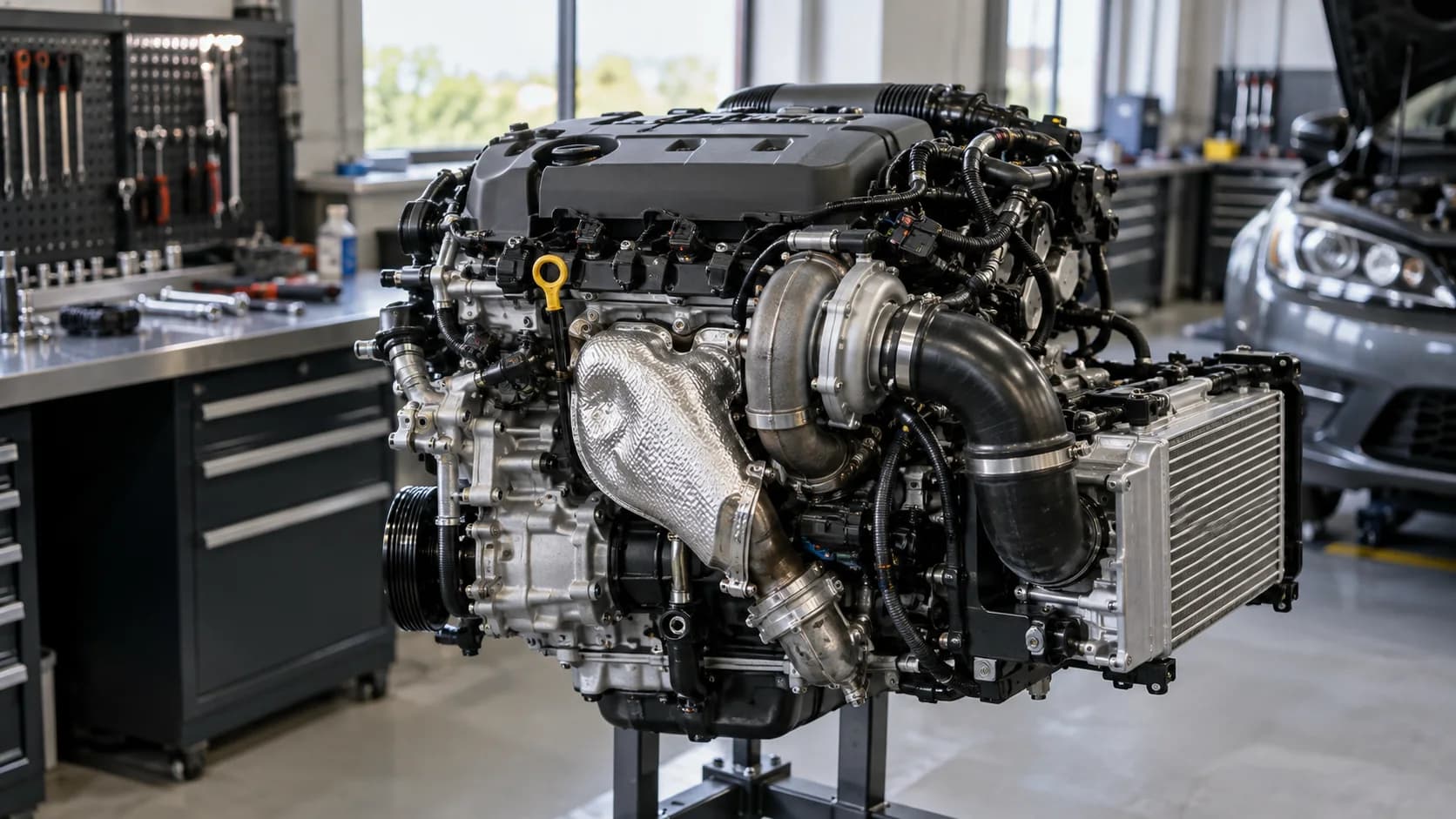
Small turbocharged engines use an exhaust gas-driven turbine to force more air into the cylinders than atmospheric pressure alone, increasing power output from a smaller displacement. This allows manufacturers to achieve performance comparable to larger naturally aspirated engines while potentially improving fuel efficiency and reducing emissions under specific operating conditions.
The principle of forced induction
A conventional internal combustion engine draws air into its cylinders as the pistons descend, creating a vacuum. This is known as natural aspiration. The amount of air, and thus the amount of fuel that can be efficiently burned, is limited by the engine's displacement and the ambient atmospheric pressure. Turbocharging overcomes this limitation by using a turbine, spun by the engine's exhaust gases, to drive a compressor. This compressor forces additional air, at higher pressure, into the engine's intake manifold. More air means more oxygen, allowing for a greater quantity of fuel to be combusted in each power stroke, thereby increasing power and torque.
Downsizing and its implications
The primary motivation for adopting small turbocharged engines is "downsizing." This strategy aims to reduce engine displacement and cylinder count while maintaining or even exceeding the power output of larger, naturally aspirated predecessors. For example, a 1.0-litre three-cylinder turbocharged engine might produce similar power and torque figures to a naturally aspirated 1.6-litre or 1.8-litre four-cylinder engine. This reduction in displacement can lead to lower internal friction and pumping losses, particularly at lower engine loads. The smaller engine also weighs less, contributing to overall vehicle mass reduction.
Fuel efficiency and emissions: laboratory vs. real world
Under official laboratory test cycles, such as the Worldwide Harmonised Light Vehicle Test Procedure (WLTP), small turbocharged engines often demonstrate favourable fuel consumption and CO2 emissions figures. This is partly because the test cycles typically involve moderate acceleration and cruising speeds, conditions where the engine can operate efficiently within its boosted range without excessive fuel enrichment.
However, real-world driving conditions can differ significantly. When a driver demands high power output, such as during rapid acceleration, sustained high-speed cruising, or when carrying heavy loads, the turbocharger operates at higher boost pressures. This can lead to increased fuel consumption as the engine control unit may enrich the fuel mixture to prevent pre-ignition (knocking) and manage exhaust gas temperatures. Consequently, the gap between official laboratory figures and real-world fuel economy can be more pronounced for small turbocharged engines compared to their naturally aspirated counterparts, especially when driven assertively.
Turbo lag and power delivery
One characteristic of turbocharged engines is "turbo lag." This refers to the brief delay between the driver pressing the accelerator pedal and the turbocharger spooling up to provide full boost. During this interval, the engine behaves more like a smaller, naturally aspirated unit. Modern engine design and control strategies, such as using smaller, low-inertia turbochargers, variable geometry turbines, or electric assistance, have significantly reduced turbo lag. However, it can still be perceptible in some applications, particularly at very low engine speeds. For city driving with frequent stop-start conditions, a naturally aspirated engine might offer more immediate throttle response from idle, while a turbocharged engine excels once the turbocharger is spooled up, providing a surge of torque for overtaking on motorways.
Maintenance and longevity considerations
The components of a turbocharged engine operate under higher thermal and mechanical stresses than those in a naturally aspirated engine. The turbocharger itself spins at extremely high speeds and is exposed to hot exhaust gases. This necessitates robust materials and effective lubrication and cooling systems. Regular oil changes with the manufacturer-specified lubricant are crucial for turbocharger longevity. The vehicle's manual will detail the recommended oil specifications and service intervals. Drivers should also be mindful of allowing the engine to idle for a short period after a demanding drive before switching it off, allowing the turbocharger to cool down and its bearings to be adequately lubricated as oil pressure drops.
Verifying vehicle compatibility and features
When considering a vehicle with a small turbocharged engine, drivers should consult the vehicle's official documentation. The owner's manual provides detailed information on engine specifications, recommended fuel types, service schedules, and any specific operating instructions. For example, the manual will specify the minimum octane rating for fuel required to prevent engine damage and ensure optimal performance.
Information regarding safety assist systems, such as those covered by UNECE Regulation No. 171 on driver-control assistance, and the EU General Safety Regulation (Regulation (EU) 2019/2144), will also be found in the vehicle manual or supplementary documentation. These regulations mandate certain safety features, which are then assessed by programmes like Euro NCAP. For instance, the presence and operation of systems like Autonomous Emergency Braking (AEB) or Lane Keeping Assist (LKA) are detailed. Similarly, the European Commission's 112 eCall system, which automatically dials emergency services after a serious accident, is a standard feature in new type-approved vehicles and its operation is typically explained in the vehicle's documentation. Drivers can verify the presence and functionality of these systems by referring to the relevant sections of their vehicle's manual.