Adaptive cruise control (ACC) offers a significant functional expansion over basic cruise control (BCC) by integrating vehicle-to-vehicle distance keeping. While BCC maintains a set speed, ACC actively adjusts speed to maintain a driver-selected time gap to a preceding vehicle.
How basic cruise control functions
Basic cruise control, a long-established feature, allows a driver to set a desired vehicle speed, which the system then attempts to maintain. The driver typically activates BCC via steering wheel buttons or a stalk, setting the speed once the vehicle reaches it. The system then controls the throttle to hold this speed, disengaging if the driver presses the brake pedal, clutch pedal, or manually deactivates it. Some BCC systems also disengage if the accelerator pedal is pressed beyond a certain threshold, allowing temporary acceleration for overtaking, after which the system resumes the set speed.
BCC operates independently of surrounding traffic conditions. It will not detect a slower vehicle ahead and will continue at the set speed unless the driver intervenes. This characteristic makes BCC most suitable for open roads with consistent traffic flow, such as motorways during off-peak hours or rural roads with minimal intersections. Its primary benefit is reducing driver fatigue on long journeys by eliminating the need for constant throttle modulation.
How adaptive cruise control functions
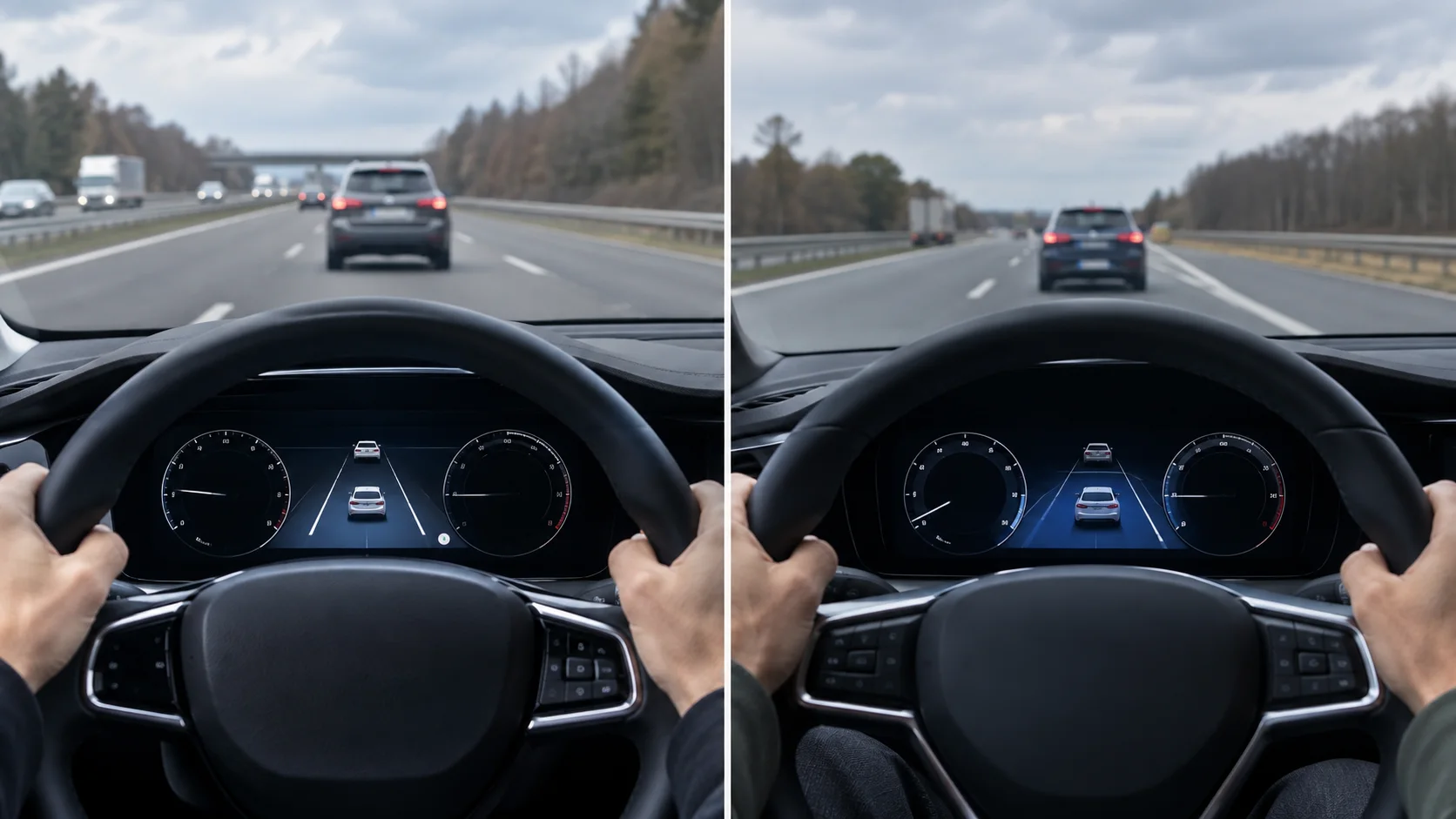
Adaptive cruise control builds upon BCC by incorporating sensors, typically radar or camera-based, to detect vehicles ahead. The driver sets both a desired maximum speed and a preferred time gap to the preceding vehicle. Common time gap settings range from approximately 1.0 to 2.5 seconds, often represented by multiple bars or segments on the instrument display.
When no vehicle is detected ahead, ACC functions like BCC, maintaining the set speed. However, upon detecting a slower vehicle within its operational range, ACC automatically reduces the vehicle's speed, applying engine braking or, if necessary, service brakes, to maintain the selected time gap. When the path ahead clears, either because the preceding vehicle accelerates or the driver changes lanes, ACC automatically accelerates back to the set speed.
Modern ACC systems often integrate with other driver assistance features. For instance, some systems can bring the vehicle to a complete stop in stop-and-go traffic and automatically resume travel when the vehicle ahead moves, a feature often termed "stop & go" functionality. The EU General Safety Regulation (GSR) mandates certain advanced driver assistance systems (ADAS) for new vehicle types, and while ACC is not universally mandated, its underlying sensor technology often supports other GSR-required systems like Forward Collision Warning (FCW) and Automatic Emergency Braking (AEB). Euro NCAP's Safety Assist protocols also evaluate the performance of ACC systems, particularly their ability to maintain safe distances and react appropriately to changing traffic scenarios.
Operational limits and driver responsibility
Both BCC and ACC are driver assistance systems, not autonomous driving systems. The driver remains responsible for monitoring the road and intervening when necessary.
BCC's primary limitation is its lack of awareness of other vehicles. Drivers must be vigilant and prepared to brake or accelerate manually. ACC, while more sophisticated, also has limitations. Sensor performance can be affected by severe weather conditions such as heavy rain, snow, or fog, potentially reducing detection range or accuracy. Direct sunlight or glare can also interfere with camera-based systems. The system may not detect stationary objects or vehicles that are partially obscured or in an adjacent lane. Drivers must understand that ACC is designed to react to moving vehicles within its detection zone and may not always react to sudden lane changes by other vehicles or unexpected obstacles.
The specified operational speed range is another critical limit. Many ACC systems operate effectively from a standstill up to typical motorway speeds, but some older or simpler systems may have a minimum activation speed, such as 30 km/h. Drivers should consult their vehicle's manual to understand the specific operational parameters, sensor limitations, and any conditions that may cause the system to disengage or perform suboptimally.
Scenarios favouring basic cruise control
Basic cruise control remains a viable and sometimes preferable option in specific driving scenarios. On long, uncrowded motorways or rural roads with consistent speed limits and minimal traffic, BCC can effectively maintain a set speed without unnecessary adjustments. For example, a hypothetical journey from Strasbourg to Munich during off-peak hours, where traffic flow is generally smooth and predictable, might see BCC perform adequately.
Drivers who prefer to maintain full, direct control over their vehicle's speed and distance to other traffic, or those who find the automatic speed adjustments of ACC distracting, may also prefer BCC. Its simpler operation means fewer settings to manage, which some drivers appreciate for its straightforwardness. Furthermore, vehicles equipped with BCC are typically less expensive than those with ACC, making it a cost-effective choice for drivers who do not require the advanced features.
Scenarios favouring adaptive cruise control
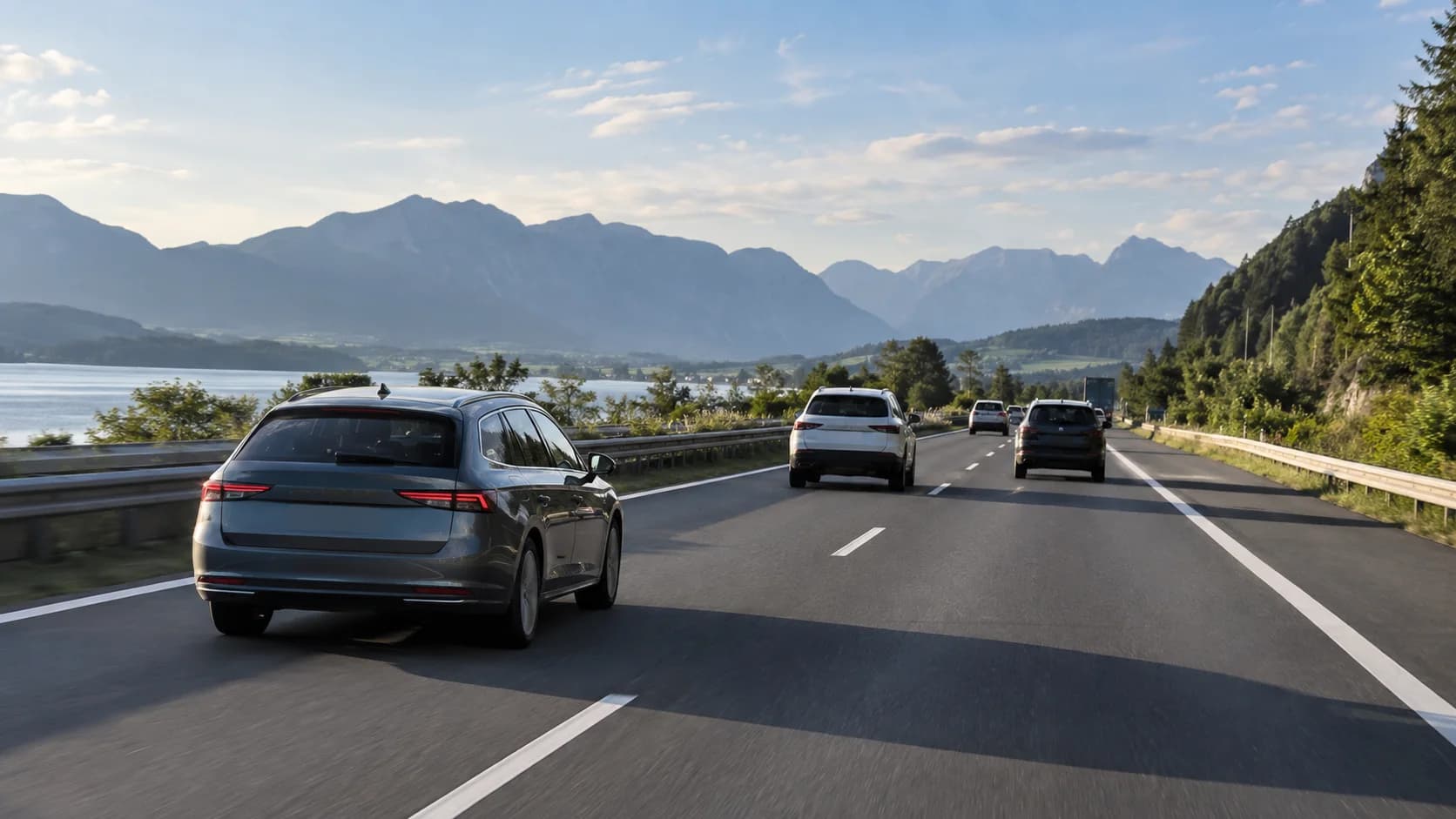
Adaptive cruise control excels in variable traffic conditions, particularly on motorways and multi-lane roads where traffic density fluctuates. Consider a hypothetical cross-border journey from Brussels to Amsterdam. This route often involves sections of heavy traffic, including stop-and-go conditions around urban areas, interspersed with periods of free-flowing motorway driving. In such a scenario, ACC significantly reduces driver workload. The system can automatically adjust speed, brake, and accelerate, maintaining a safe following distance without constant driver input on the pedals.
ACC is also beneficial in situations where maintaining a consistent speed is challenging due to frequent speed limit changes or varying traffic speeds, such as on some European secondary roads. The ability to set a maximum speed while the system manages the following distance allows the driver to focus more on steering and road hazards. For drivers who frequently undertake long journeys or commute in congested conditions, ACC can enhance comfort and reduce fatigue.
Verifying system compatibility and features
To verify the presence and specific functionalities of cruise control systems, a prospective buyer or driver should consult the vehicle's official documentation. The owner's manual provides detailed information on system operation, limitations, and troubleshooting. For new vehicles, the manufacturer's official website or brochure will list standard and optional features, often specifying "Adaptive Cruise Control" or "Intelligent Cruise Control" if present.
The vehicle's type-approval documentation, based on the EU WLTP procedure, primarily focuses on emissions and fuel consumption but implicitly confirms the vehicle's configuration. However, it does not detail specific ADAS features. For safety-related features, Euro NCAP ratings often provide an independent assessment of a vehicle's Safety Assist systems, including ACC performance. These ratings are publicly available and detail the capabilities of the tested systems.
When inspecting a vehicle, visual cues can also indicate ACC. Vehicles with ACC typically have a radar sensor located in the front grille or bumper, often behind a plastic cover. The steering wheel controls will usually include buttons for adjusting the following distance, in addition to the standard speed set/resume functions found on BCC systems. A test drive is the most direct way to experience the system's operation and confirm its suitability for individual driving preferences.