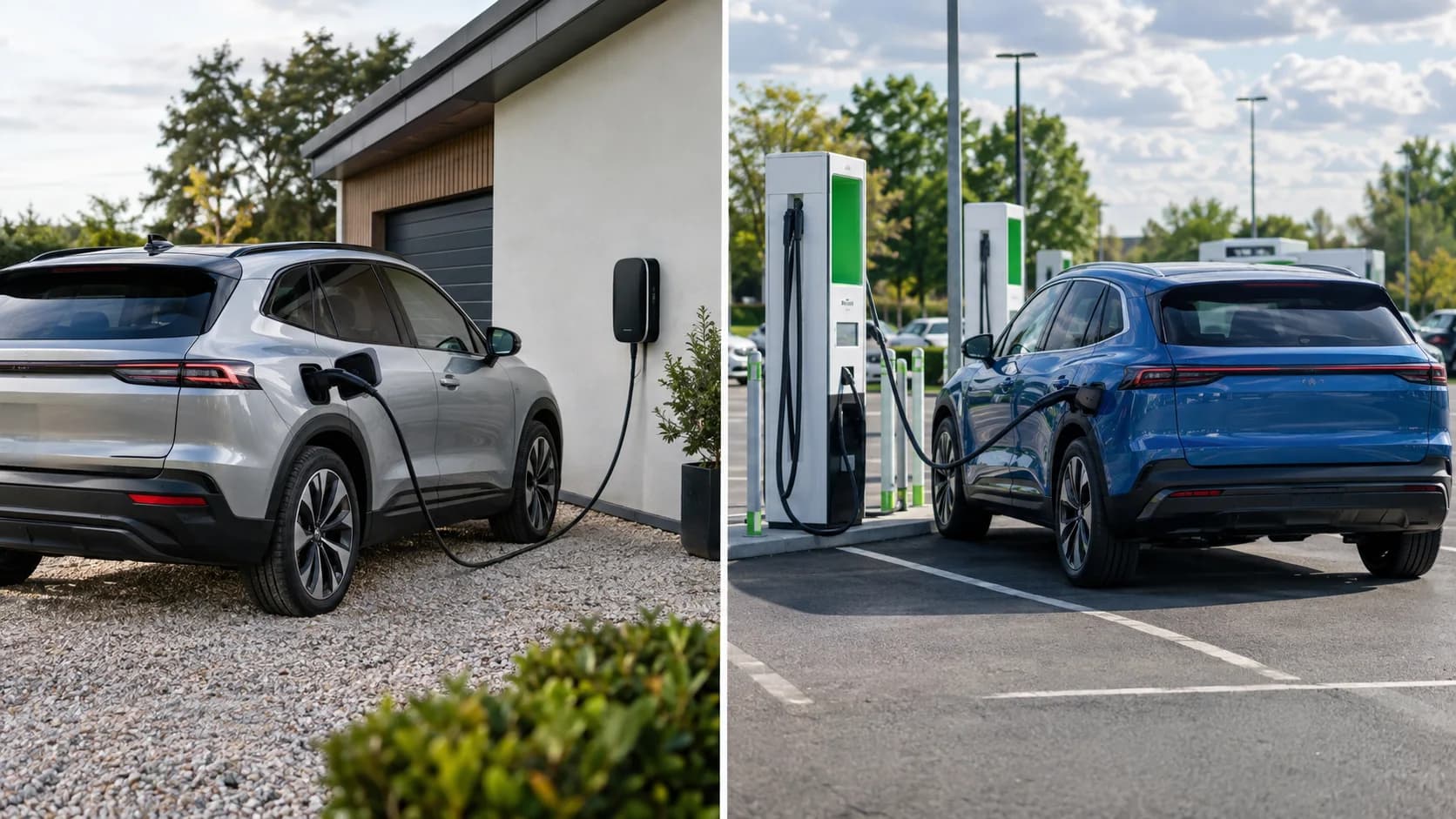
For most electric vehicle owners, home charging offers the lowest cost per kilowatt-hour and the greatest convenience for routine energy replenishment. Public rapid charging serves as a necessary supplement for longer journeys or when home charging is unavailable.
Understanding charging power and efficiency
Electric vehicle charging is categorised by power output, measured in kilowatts (kW), and whether the current is alternating (AC) or direct (DC). Home charging typically uses AC, converting it to DC within the vehicle's onboard charger. Common home AC charging power levels range from 2.3 kW (standard domestic socket) to 7.4 kW or 11 kW (dedicated wallbox installations, single-phase or three-phase respectively). Some installations can reach 22 kW AC, though this is less common for private residences.
Public rapid charging almost exclusively uses DC, bypassing the vehicle's onboard charger to deliver power directly to the battery. This allows for significantly higher power levels, commonly from 50 kW to 350 kW or more. The EU's Alternative Fuels Infrastructure Regulation (AFIR) mandates specific minimum power outputs for public charging points along the TEN-T road network, including at least 150 kW for light-duty vehicles every 60 km by the end of 2025.
Energy losses occur during any charging process. These include conversion losses (AC to DC), thermal losses in cables and the battery, and auxiliary power consumption by the vehicle's systems (e.g., battery thermal management). While home AC charging typically has lower peak power, the longer duration can sometimes lead to a higher overall efficiency due to less aggressive thermal management requirements compared to rapid DC charging. However, the specific efficiency depends on the vehicle's charging architecture, battery state of charge, and ambient temperature.
Home charging: convenience and cost benefits
Installing a dedicated wallbox at home offers significant advantages. It provides predictable access to charging, allowing owners to start each day with a full or sufficient charge. This eliminates range anxiety for daily commutes and local travel. The cost per kilowatt-hour for electricity supplied to a private residence is generally lower than public charging tariffs, especially for rapid charging. Many energy providers offer off-peak tariffs, enabling further cost savings by scheduling charging during periods of lower demand.
A typical home wallbox installation requires a qualified electrician to assess the existing electrical infrastructure and install a dedicated circuit. The vehicle's onboard charger rating determines the maximum AC charging power it can accept. For example, a vehicle with a 7.4 kW onboard charger will only draw 7.4 kW from an 11 kW wallbox. Owners should consult their vehicle's manual or technical specifications to verify its maximum AC charging capability.
The primary limitation of home charging is its power output. Fully recharging a large battery electric vehicle (BEV) from a low state of charge can take many hours, potentially overnight or longer, depending on the battery capacity and charger power. For instance, a 70 kWh battery charged at 7.4 kW would theoretically take approximately 9.5 hours from empty to full, excluding charging losses.
Public rapid charging: speed and accessibility
Public rapid charging is designed for speed, enabling drivers to add significant range in a short period, typically during a journey break. This is crucial for long-distance travel, allowing drivers to complete cross-border European journeys, such as from Amsterdam to Berlin, with minimal delay. The high power output of rapid DC chargers can replenish a substantial portion of a battery in 20 to 40 minutes, depending on the vehicle's maximum DC charging rate and the charger's available power.
AFIR aims to ensure adequate public charging infrastructure across the EU. This includes requirements for user-friendly payment options, transparent pricing, and reliable operation. Drivers can locate public chargers using in-car navigation systems or dedicated mobile applications.
The main drawbacks of public rapid charging are its higher cost per kilowatt-hour compared to home charging and potential availability issues. While infrastructure is expanding, queues can form at popular locations during peak travel times. Not all rapid chargers deliver their advertised maximum power to all vehicles; the actual charging rate is limited by the vehicle's maximum DC charging capability, the battery's state of charge, and its temperature. A vehicle's manual will specify its maximum DC charging rate. For example, a vehicle capable of 150 kW DC charging will not benefit from a 350 kW charger beyond its own limit.
Vehicle compatibility and charging curve
Every electric vehicle has a specific charging curve, which describes how its charging rate varies with the battery's state of charge (SoC). Rapid DC charging typically starts at a high power level when the battery is at a low SoC (e.g., 10-20%) and gradually tapers down as the SoC increases (e.g., above 80%). This tapering protects the battery and optimises its lifespan. Therefore, charging from 80% to 100% SoC using a rapid charger takes disproportionately longer than charging from 10% to 80%.
Drivers should consult their vehicle's manual for detailed information on its charging curve, maximum AC and DC charging rates, and recommended charging practices. This documentation will specify the compatible charging standards (e.g., Type 2 for AC, CCS Combo 2 for DC in Europe) and any specific requirements for optimal charging performance. Understanding these limits helps manage expectations regarding charging times, especially on long journeys.
Scenarios for optimal use
For daily commuting and routine local travel, home charging is almost always the most practical and cost-effective solution. Drivers can plug in overnight and wake up to a sufficiently charged vehicle, leveraging lower off-peak electricity tariffs where available.
Public rapid charging becomes essential for longer journeys that exceed the vehicle's practical range. For a hypothetical cross-border journey from Munich to Vienna, a driver might plan one or two rapid charging stops to replenish the battery quickly. It is also the primary solution for drivers without access to home charging, such as those living in apartments without dedicated parking or charging facilities. In such cases, drivers may rely on a combination of public AC chargers (e.g., at workplaces or supermarkets) for routine top-ups and rapid DC chargers for faster replenishment.
The decision between home and public rapid charging is not an either/or proposition but rather a complementary strategy. Home charging provides the foundation for daily electric vehicle use, while public rapid charging unlocks the potential for extended travel.