Choosing between a new car and a young used car involves balancing initial cost, depreciation, and access to the latest technology. The optimal choice depends on individual priorities regarding budget, desired features, and long-term ownership considerations.
Initial cost and depreciation
A new car typically incurs a significant depreciation in its first few years. This initial value loss is often the largest percentage of its total depreciation over its lifespan. A young used car, perhaps two to three years old, has already absorbed a substantial portion of this initial depreciation. Consequently, its purchase price will be lower than a new equivalent, and its subsequent depreciation rate in monetary terms may be less steep. This makes a young used car an attractive option for buyers seeking to minimise the financial impact of depreciation.
However, the lower purchase price of a used car does not necessarily translate to lower overall running costs. A new car benefits from a full manufacturer's warranty, covering potential defects for a specified period or mileage. This can provide financial security against unexpected repair costs. A young used car may have a limited remaining warranty, or none at all, depending on its age and the manufacturer's terms. Buyers of used vehicles should investigate the warranty status and consider the potential for out-of-warranty repairs.
Regulatory compliance and safety features
New cars sold in the EU must comply with the latest regulatory standards. For instance, the General Safety Regulation (EU) 2019/2144 mandates a range of advanced driver assistance systems (ADAS) for all new type-approved vehicles from specific dates. These include intelligent speed assistance, driver drowsiness and attention warning, and advanced emergency braking systems. While some of these features were already available on premium models, the regulation ensures their widespread adoption in new vehicles.
A young used car, manufactured before these regulations came into full effect, may not have the same suite of mandatory safety features. For example, a car type-approved before July 2022 would not be legally required to have intelligent speed assistance, even if it was sold new after that date. Buyers interested in specific safety technologies should consult the vehicle's original type-approval documentation or the manufacturer's specifications for the exact model year. Euro NCAP provides detailed safety assist protocols and ratings, which can help compare the performance of ADAS across different vehicles and model years.
Powertrain technology and emissions
The automotive industry is undergoing a rapid transition in powertrain technology, particularly towards electrification. New cars often feature the latest iterations of internal combustion engines (ICE), hybrid systems, or battery electric powertrains, designed to meet current WLTP (Worldwide Harmonised Light Vehicle Test Procedure) emissions standards. The WLTP procedure (EU) 2025/1706 provides a standardised method for measuring fuel consumption, electric range, and emissions, offering a basis for comparison between new vehicles. However, real-world consumption and range can vary significantly from these laboratory figures due to driving style, ambient temperature, and terrain.
A young used car might feature an older powertrain generation, potentially with different WLTP figures or even tested under the older NEDC (New European Driving Cycle) standard. While an older ICE vehicle might be less expensive to purchase, its fuel efficiency and emissions could be less favourable than a newer equivalent. For electric vehicles (EVs), battery technology advancements mean newer models often offer greater range and faster charging capabilities. Buyers considering a used EV should verify the battery's state of health, as degradation can reduce its usable capacity over time.
Charging infrastructure and long-distance travel
The Alternative Fuels Infrastructure Regulation (AFIR) (EU) 2023/1804 aims to ensure a sufficient public charging infrastructure across the EU. This regulation mandates minimum charging power requirements and interoperability standards for charging points, particularly along the TEN-T road network. New EVs are designed to be compatible with these evolving standards, often supporting high-power DC fast charging.
For a hypothetical cross-border journey, such as from Brussels to Berlin, a new EV with a larger battery and faster charging capability might offer a more seamless experience, requiring fewer and shorter charging stops. Its charging port and communication protocols are likely to be fully compatible with the latest public charging stations. A young used EV, especially an early model, might have slower charging capabilities or less common charging port types, potentially limiting its compatibility with newer high-power chargers or requiring more frequent stops. Drivers of used EVs should verify the vehicle's charging specifications in the owner's manual and research the compatibility with the charging networks they intend to use.
Infotainment and connectivity
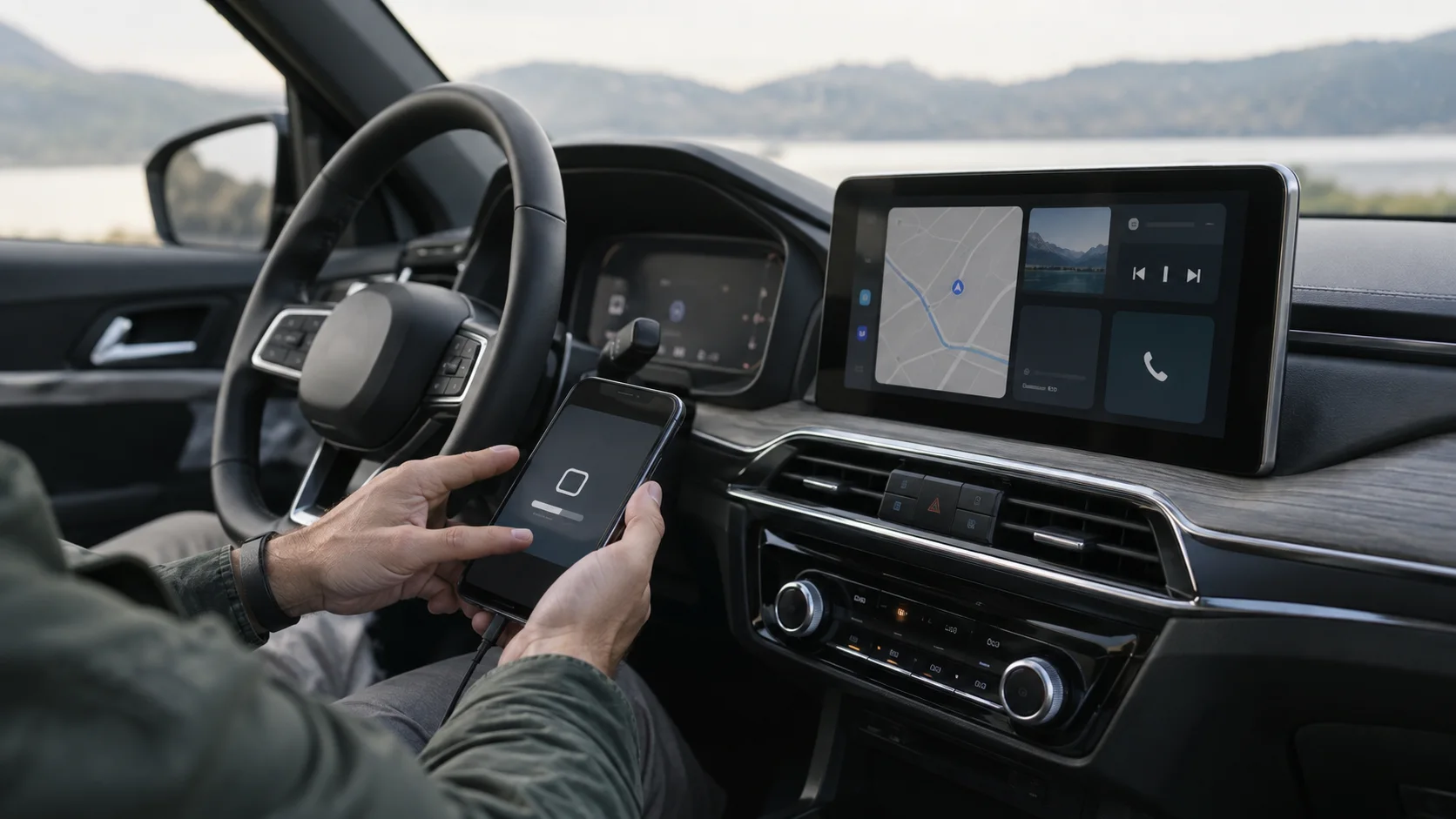
Modern new cars often integrate advanced infotainment systems, large touchscreens, and seamless smartphone connectivity through Apple CarPlay or Android Auto. Over-the-air (OTA) updates are becoming more common, allowing manufacturers to update software, add features, and even improve vehicle performance remotely. These systems can enhance convenience, navigation, and entertainment during a journey.
A young used car may have an infotainment system that, while functional, lacks the latest features or processing power. Software updates might require a visit to a dealership, or may no longer be available for older systems. While some aftermarket solutions exist for adding modern connectivity, they may not integrate as seamlessly as factory-fitted systems. For drivers who prioritise the latest digital experience and integrated services, a new car often provides a more up-to-date platform.
Verifying vehicle specifications
Regardless of whether a buyer chooses a new or used car, it is crucial to verify the specific features and compliance of the individual vehicle. For new cars, official brochures, manufacturer websites, and dealership staff can provide detailed specifications. For used cars, the vehicle's owner's manual is an invaluable resource, detailing installed features, technical specifications, and maintenance schedules. Service records can also provide insight into the vehicle's history and any past repairs or updates. In some cases, official documentation from the national type-approval authority or a vehicle history report can confirm the original specifications and regulatory compliance of a used vehicle.