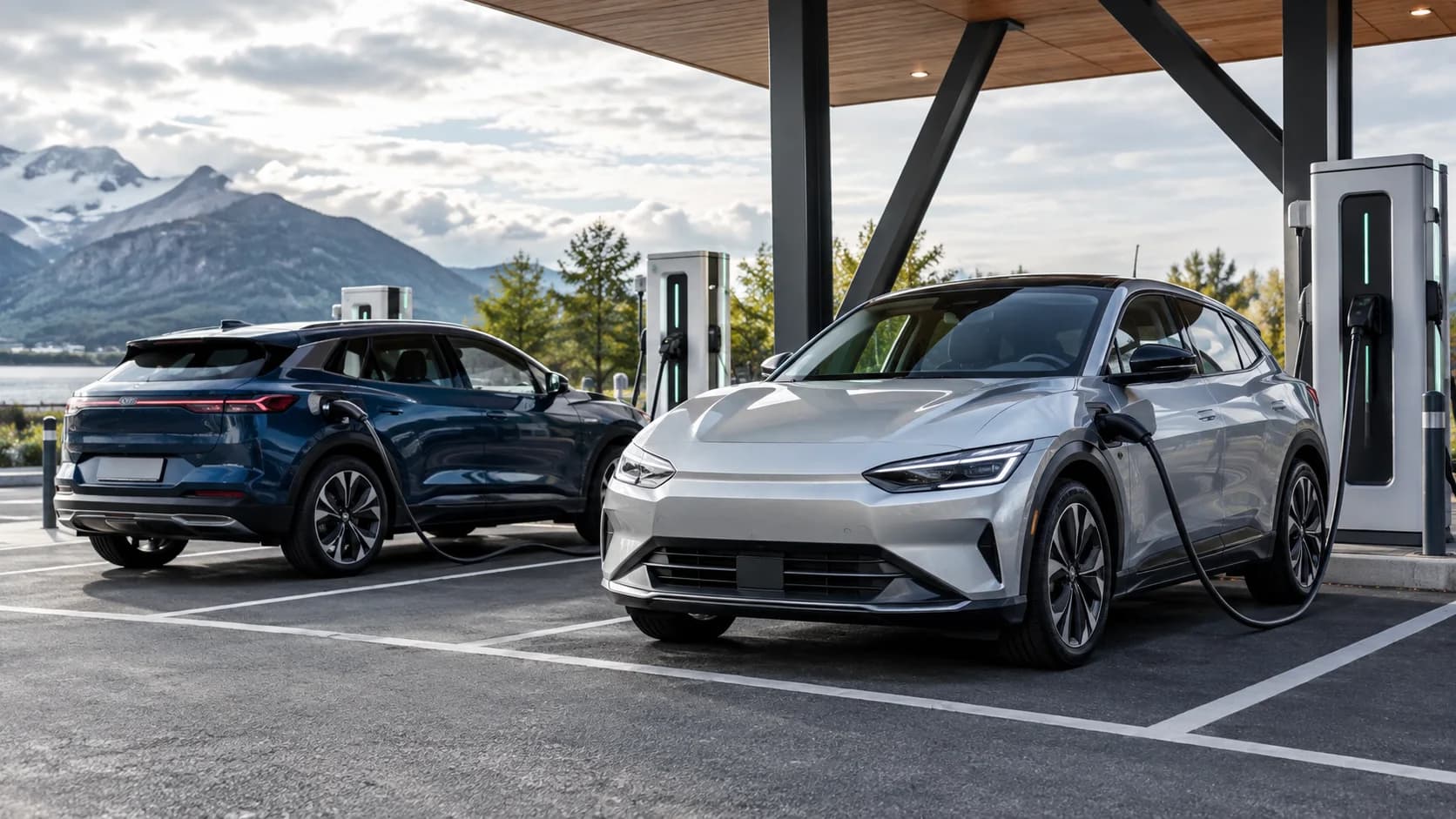
The choice between 400-volt and 800-volt electric vehicle (EV) platforms primarily affects charging speed and system efficiency, with 800-volt systems generally enabling faster DC charging and potentially lower energy losses. However, the practical benefits for a driver depend significantly on charging infrastructure availability and specific vehicle implementation.
Understanding the voltage difference
EV battery packs are composed of individual cells connected in series and parallel. A 400-volt nominal system typically arranges cells to achieve a voltage around 350-450 volts, while an 800-volt system aims for approximately 700-850 volts. This higher voltage allows for the same power (measured in kilowatts) to be delivered with half the current (measured in amperes) compared to a 400-volt system. Lower current reduces resistive heating losses in cables and components, potentially improving efficiency during both charging and discharge.
For example, delivering 200 kW of power to a 400-volt system requires approximately 500 amperes (A), whereas an 800-volt system needs around 250 A for the same power. This reduction in current can lead to lighter, thinner wiring within the vehicle and charging infrastructure, though the primary benefit for drivers is often perceived in charging speed.
Charging speed and infrastructure compatibility
The most direct impact of an 800-volt architecture is its potential for faster DC rapid charging. High-power DC chargers, often found along major European transport corridors, can deliver power exceeding 150 kW, with some capable of 350 kW or more. An 800-volt EV can theoretically accept higher power levels more efficiently from these chargers, provided the charger itself supports the higher voltage and current profiles.
The Alternative Fuels Infrastructure Regulation (AFIR) mandates minimum power requirements for public charging points along the TEN-T network, but it does not specify voltage compatibility. While many modern rapid chargers are designed to be voltage-agnostic within a certain range, an 800-volt vehicle might not always achieve its maximum theoretical charging rate if connected to a charger primarily optimised for 400-volt systems or if the charger's maximum current output limits the power at higher voltages.
Conversely, a 400-volt EV can charge at any public DC rapid charger, but its maximum charging power will be limited by its own architecture and the charger's capabilities. It will not be able to fully utilise the highest power outputs of an 800-volt-optimised charger.
Drivers can verify their vehicle's maximum DC charging power and voltage compatibility in the owner's manual or the vehicle's official technical specifications. These documents typically state the maximum DC charging power in kilowatts and the compatible voltage range. The charging station itself should display its maximum power output and voltage capabilities.
Efficiency and thermal management
Higher voltage systems can exhibit improved overall efficiency. Reduced current flow leads to less heat generation in the battery pack, power electronics, and cabling during both charging and driving. This can translate into slightly lower energy consumption in certain driving conditions and potentially less stress on the battery's thermal management system.
Effective thermal management is crucial for battery longevity and performance, as outlined in UNECE Global Technical Regulation No. 22 on battery durability. While both 400-volt and 800-volt systems employ sophisticated cooling and heating strategies, the inherent reduction in resistive losses in an 800-volt system can simplify the thermal management task or allow for more aggressive charging profiles without excessive heat build-up.
However, the real-world efficiency gains for a driver might be modest and depend heavily on driving style, ambient temperature, and the specific vehicle's overall design, including motor efficiency and aerodynamic profile. The WLTP type-approval procedure provides a standardised measure of energy consumption, but individual driving patterns can lead to different outcomes.
Component complexity and cost
Implementing an 800-volt architecture often requires more sophisticated and potentially more expensive power electronics, such as inverters and DC-DC converters, to manage the higher voltages. These components need to be designed to handle the increased electrical stress. The battery pack itself also requires careful design to ensure cell balancing and safety at higher voltages.
For example, a vehicle might need a booster to step up the voltage from a 400-volt charger to charge an 800-volt battery, or a converter to power 12-volt accessories from an 800-volt main battery. These additional components add complexity, weight, and cost.
While the initial purchase price of an 800-volt EV might reflect this increased complexity, the long-term operational costs, particularly for drivers who frequently use rapid DC charging, could be offset by faster charging times and potentially improved efficiency.
Practical scenarios for drivers
For a driver regularly undertaking long journeys across Europe, such as from Berlin to Rome, an 800-volt EV could offer a tangible advantage. If the route involves frequent stops at high-power DC rapid chargers (e.g., 250 kW or 350 kW), the ability to replenish a significant portion of the battery capacity in a shorter timeframe could reduce overall journey time. This is particularly relevant under the AFIR, which aims to ensure sufficient high-power charging along the TEN-T network.
Conversely, for a driver whose primary use case involves daily commutes and overnight charging at home or work using AC wallboxes (typically 3.7 kW to 22 kW), the benefits of an 800-volt system are less pronounced. AC charging is limited by the vehicle's onboard charger, which converts AC to DC, and this component's power output is largely independent of the battery's nominal voltage. Both 400-volt and 800-volt EVs can achieve similar AC charging speeds.
Therefore, a 400-volt EV might be a more cost-effective choice for drivers who rarely use public rapid DC charging and prioritise lower initial purchase costs. Its charging capabilities are sufficient for most common charging scenarios, and it benefits from widespread compatibility with existing charging infrastructure.
Battery degradation and longevity
The Batteries Regulation (EU) 2023/1542 sets out requirements for battery sustainability, including durability. While higher voltage systems can theoretically reduce thermal stress during charging due to lower currents, the impact on long-term battery degradation is complex. Factors such as charging frequency, depth of discharge, ambient temperature, and the battery management system's sophistication play a more significant role than the nominal voltage alone.
Both 400-volt and 800-volt batteries are designed to meet stringent durability standards. The key is how effectively the vehicle's battery management system (BMS) controls charging and discharging cycles, manages temperature, and balances cell voltages to maximise the battery's lifespan. Drivers should consult the manufacturer's warranty information regarding battery capacity retention over time and mileage, as this provides the most reliable indicator of expected longevity.