Audi has explained how the A2 e-tron’s high-voltage battery can be used beyond driving. Vehicle-to-Load can supply external devices, while Vehicle-to-Home can send stored energy into a suitably equipped household. Vehicle-to-Grid is also planned, but Audi describes it as a future capability whose availability depends on regulation, infrastructure and electricity tariffs.
The distinction matters because “bidirectional charging” does not describe one universal plug-and-play feature. Powering a laptop at a campsite and integrating a car into a home energy system require different equipment. Feeding energy into the public grid adds another layer of contracts and market rules. Buyers therefore need to look beyond the headline and establish which mode is supported in their country and configuration.
Vehicle-to-Load supplies equipment away from a socket
Vehicle-to-Load, or V2L, lets the A2 e-tron supply suitable external consumers. Audi gives examples including an e-bike, a laptop and a coffee machine. Depending on equipment, power can be accessed through a socket in the luggage compartment or through a discharge adapter at the charging port. This can be useful for camping, outdoor work or a temporary power requirement where no fixed outlet is available.
V2L does not turn the car into an unlimited generator. The device, adapter and cable must all be suitable for the available output, and owners must observe the car’s operating limits. Audi’s technical information says V2L requires the high-voltage battery to have at least a 20 percent state of charge. Below that level, the system preserves energy for the vehicle rather than continuing to run external loads.
Market equipment also matters. A statement that the model supports V2L does not confirm that every trim includes the relevant adapter, socket standard or cable. A customer should check the exact order specification and the permitted continuous output before relying on the car for tools or appliances.
Vehicle-to-Home needs more than an ordinary wallbox
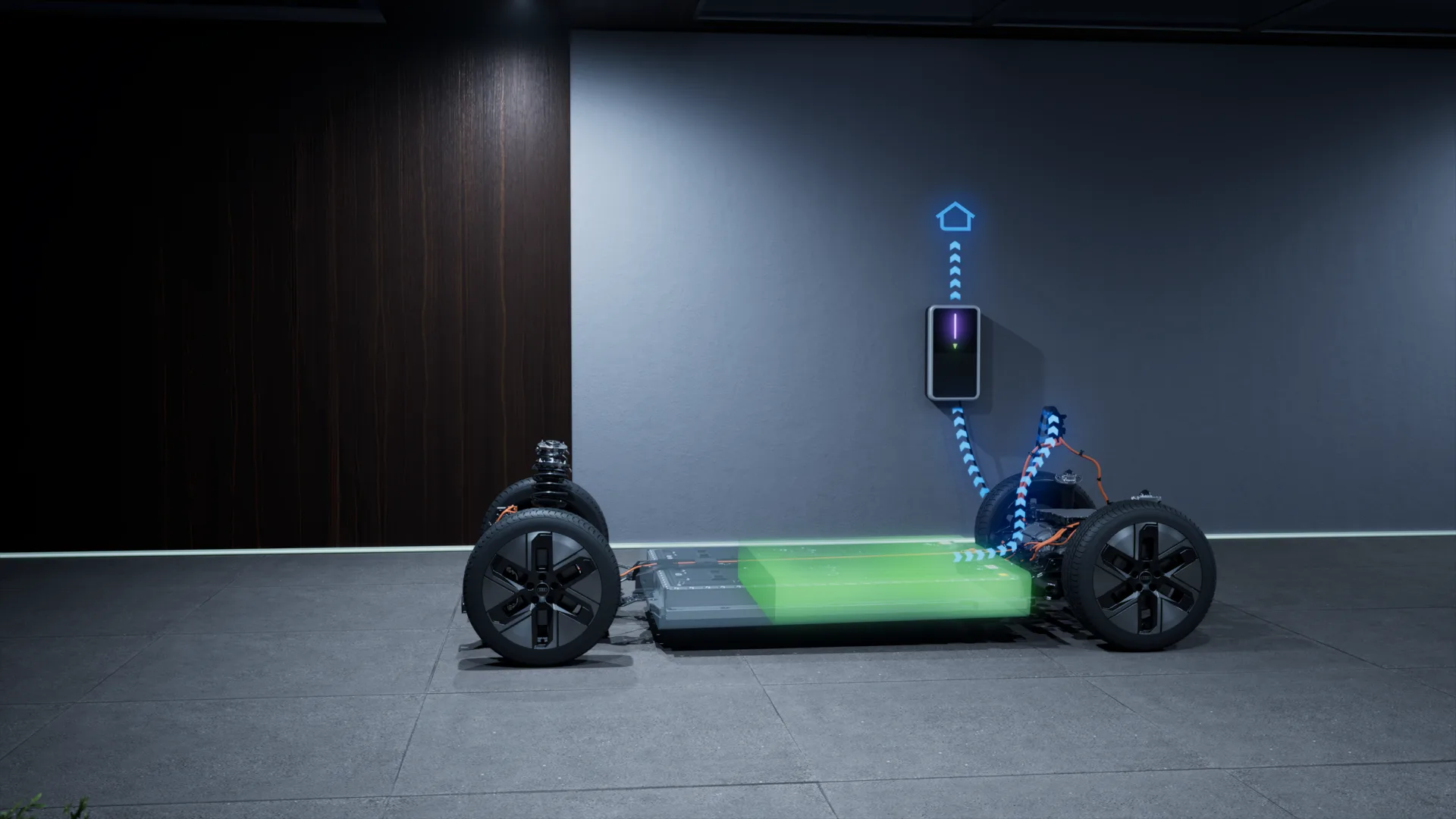
Vehicle-to-Home, or V2H, uses the car as storage for a compatible household energy system. Electricity held in the battery can be returned to the home, potentially shifting consumption from one time of day to another. In a house with solar panels, it could allow surplus daytime generation to be stored in the vehicle and used later, subject to the installation’s design and software.
This is not achieved by connecting the A2 e-tron to a conventional one-way AC wallbox. Audi specifies a compatible bidirectional DC wallbox. Additional home hardware, energy management and professionally installed electrical work may also be required. Audi initially describes V2H availability in Germany, Austria and Switzerland; it has not presented a single Europe-wide package that guarantees the same hardware, installation and service in every market.
Energy transfer for V2H is managed within a 20–80 percent battery window. Audi’s technology documentation says that below 20 percent the system only charges the car, while above 80 percent it only discharges energy to the home. Within the band, the controls can manage both directions. The owner still has to reserve enough charge for the next journey, since electricity used by the house is no longer available for driving.
Vehicle-to-Grid is not live everywhere
Vehicle-to-Grid would allow the battery to provide energy to the public network rather than only to the owner’s home. That could support grid balancing and, with a suitable commercial arrangement, compensate the vehicle owner. Audi says V2G will be enabled in the future depending on the market, vehicle equipment, compatible charging infrastructure, the home installation, regulatory requirements and an appropriate electricity tariff.
Those qualifications are central. A bidirectional vehicle alone does not create permission to export power, a meter that can account for it or a contract with an energy supplier. It would be premature to claim that an A2 e-tron bought today can sell electricity to the grid in any European country. The car is one component in a wider energy system, not a substitute for that system.
Three batteries and 24–29-minute DC charging claims
The A2 e-tron is offered with gross battery capacities of 52, 61 and 84 kWh. Audi says the two smaller packs use lithium iron phosphate chemistry, while the 84 kWh unit uses nickel-manganese-cobalt cells. The LFP packs use a cell-to-pack construction, integrating cells directly into the battery housing rather than grouping them in intermediate modules.
Maximum DC charging power ranges from 100 to 183 kW depending on the battery. Under Audi’s defined test conditions, a 10–80 percent charge takes 24 minutes with the 52 kWh pack, 26 minutes with the 61 kWh pack and 29 minutes with the 84 kWh pack. Battery temperature, starting state of charge and the charger’s available power can change the result in normal use.
Charging and discharging place demands on thermal and battery management. Audi says the system continuously coordinates temperature, current flow and state of charge. An adapted algorithm is used for the flatter voltage characteristic of LFP cells, which makes precise state-of-charge estimation more difficult. A component called OCDC 2.0 combines the onboard charger and DC/DC converter with revised software and output management.
These controls are relevant when the battery is expected to serve both mobility and household energy. Stable operation is more useful than a theoretical peak that cannot be reproduced, particularly when a homeowner schedules charging and discharge around solar production or electricity prices.
What a prospective buyer should verify
The A2 e-tron starts at €38,200 in Germany and €38,800 in Romania, but the base price should not be assumed to include every battery, adapter or bidirectional function. Buyers should obtain written confirmation of the battery, power output, V2L accessories, supported socket type, V2H wallbox, home hardware and local service availability.
The value proposition also depends on where the car is parked. An apartment resident without a private charging space may have no practical route to V2H. A homeowner with solar panels and off-street parking may find it more useful, but should calculate the total cost of the wallbox, installation and energy-management equipment. Audi’s announcement makes bidirectional energy a tangible feature on a compact EV; it does not remove the infrastructure between the charging port and the household switchboard.
Sources
- Audi – A2 e-tron as a mobile energy storage system
- Audi Technology Portal – battery technology and bidirectional charging
- Audi – A2 e-tron launch and technical data
- Motor1 – A2 e-tron bidirectional charging overview
Image: AUDI AG / Audi MediaCenter, official press photograph A265001, editorial use.