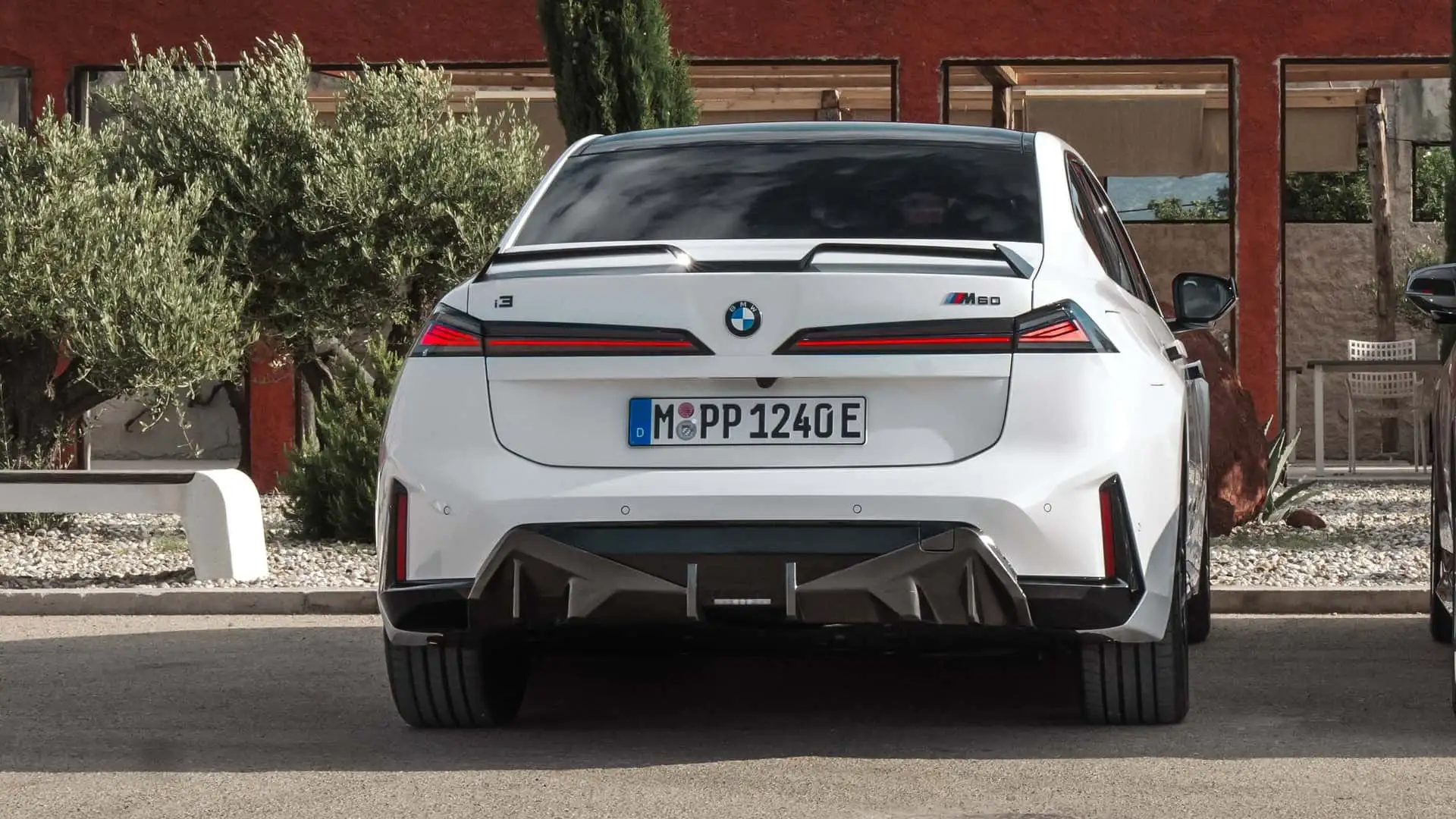
Image: BMW press photograph supplied through the source article. The vehicle shown is a pre-production car.
BMW will launch a paddle-operated simulated shift system on the i3 M60 xDrive in 2027. The company calls the virtual ratios “Stages”, a deliberate distinction because the electric sedan is not gaining a conventional multi-speed transmission. Software will instead create selectable steps and associated feedback around an electric drivetrain that still relies on a reduction gear.
The decision is notable because BMW initially saw Hyundai’s comparable technology as a “funny gimmick”. Christian Heiss, a senior BMW driving-dynamics engineer, described that internal reaction in an interview with Australian publication Carsales during the international launch of the new 3 Series and i3. He said the dynamics team later made the case that paddle shifts can provide useful information and improve controllability, particularly on a circuit.
That explanation turns an easy story about corporate inconsistency into a more interesting engineering question. An EV does not require several ratios to stay within a narrow engine speed band, so any simulated shift has to justify itself through the driver experience. BMW’s answer is not greater mechanical efficiency. It is a set of repeatable cues that can tell a driver more about speed, load and the approach to a corner.
Stages is a control feature, not a new gearbox
Most electric cars use one fixed reduction ratio because their motors deliver useful torque across a broad operating range. Adding six or eight physical ratios would increase weight, complexity and losses without necessarily improving the road car. The i3 M60’s Stages therefore sit in the control layer: accelerator response, sound, regenerative behaviour and paddle input can be coordinated to imitate the rhythm of changing gear.
BMW has not disclosed the number of Stages. It has also not published a technical description of torque intervention, virtual rev limits, automatic operation or the way the function interacts with the car’s driving modes. Reports that the BMW system will behave differently from Hyundai’s N e-Shift are credible, but the available interview does not support a complete feature-by-feature comparison.
One product boundary is clear. Heiss said the feature is intended for M Performance models, beginning with the i3 M60. The regular i3 40 xDrive and i3 50 xDrive lack the paddles and supporting hardware. Owners should not expect a later over-the-air purchase to turn either launch model into an M60-style experience.
What BMW learned from the Hyundai Ioniq 5 N
Hyundai’s official description makes the reference point unusually concrete. N e-Shift emulates an eight-speed dual-clutch transmission by controlling motor torque and power, creating a jolt between virtual changes and varying simulated engine braking through regeneration. It can operate automatically or accept manual paddle inputs, and it includes a hard virtual limiter.
Those effects intentionally surrender some of an EV’s seamlessness. Their purpose is to give the driver timing and load information that a continuously accelerating electric car may conceal. A rising sound, an approaching limiter and a distinct change event can serve as landmarks on a familiar section of track. Hyundai pairs the system with N Active Sound+, which offers several synthetic sound characters.
Carsales reports that BMW evaluated the Ioniq 5 N and other performance EVs while developing its response. Heiss characterised the result as close to a gearbox simulation but thought out differently. That remains a developer’s description rather than an independently demonstrated advantage. Until BMW reveals the calibration or allows back-to-back testing, it is safest to describe Stages as the same broad category of idea with an undisclosed implementation.
The M60 is not the four-motor electric M car
BMW had already committed to artificial shifts before this latest interview. In January 2026 it said its first fully electric BMW M models would arrive from 2027 with simulated gear changes and a newly developed M soundscape. The M Concept Neue Klasse shown at Le Mans in June also displayed steering-wheel paddles.
The i3 M60 occupies a different position. It is an M Performance derivative at the top of the i3 range, not the full BMW M model described with four electric motors, one at each wheel. BMW says those dedicated M cars will use a battery with more than 100 kWh of usable energy, an 800-volt architecture and a front axle that can be decoupled. Applying those details to the M60 would conflate two separate programmes.
BMW’s global 3 Series release confirms only that the “ultra-potent” i3 M60 xDrive will launch in 2027. The company still calls it a prototype and provides no official WLTP consumption or range figure. Carsales quotes 450 kW and 875 Nm for the Australian-market car, but BMW has not yet placed those numbers in its global specification table. They should therefore be treated as reported launch information, not final European data.
What is already known about the Neue Klasse i3
The regular i3 establishes the technical baseline. BMW rates the i3 40 xDrive at 275 kW. The i3 50 xDrive produces 345 kW and 645 Nm, uses a 108.7 kWh battery and carries a maximum WLTP range claim of 912 km. Its 800-volt system accepts up to 400 kW at a suitable DC charger, while the quoted 0–100 km/h time is 4.7 seconds.
None of those figures tells us the M60’s battery capacity, range or charging curve. BMW has not announced a European price, order date, final output or Stage count. The company has shown M-specific yellow lighting, an altered steering wheel with paddles and performance styling, but the most consequential dynamic specifications remain provisional.
For buyers, Stages will be a character feature rather than a reason to assume superior efficiency or acceleration. It may make repeated track laps easier to judge, and it could add involvement on a favourite road. It could also feel theatrical if the sound, torque response and paddle timing fail to agree. The engineering challenge is coherence, not spectacle.
BMW’s reversal consequently makes sense only if the finished system provides information. The brand can reasonably change its view after testing a rival’s idea; the difficult part is showing that its version improves the drive rather than merely following a trend. That verdict must wait for a production i3 M60 and for the details BMW has not yet released.