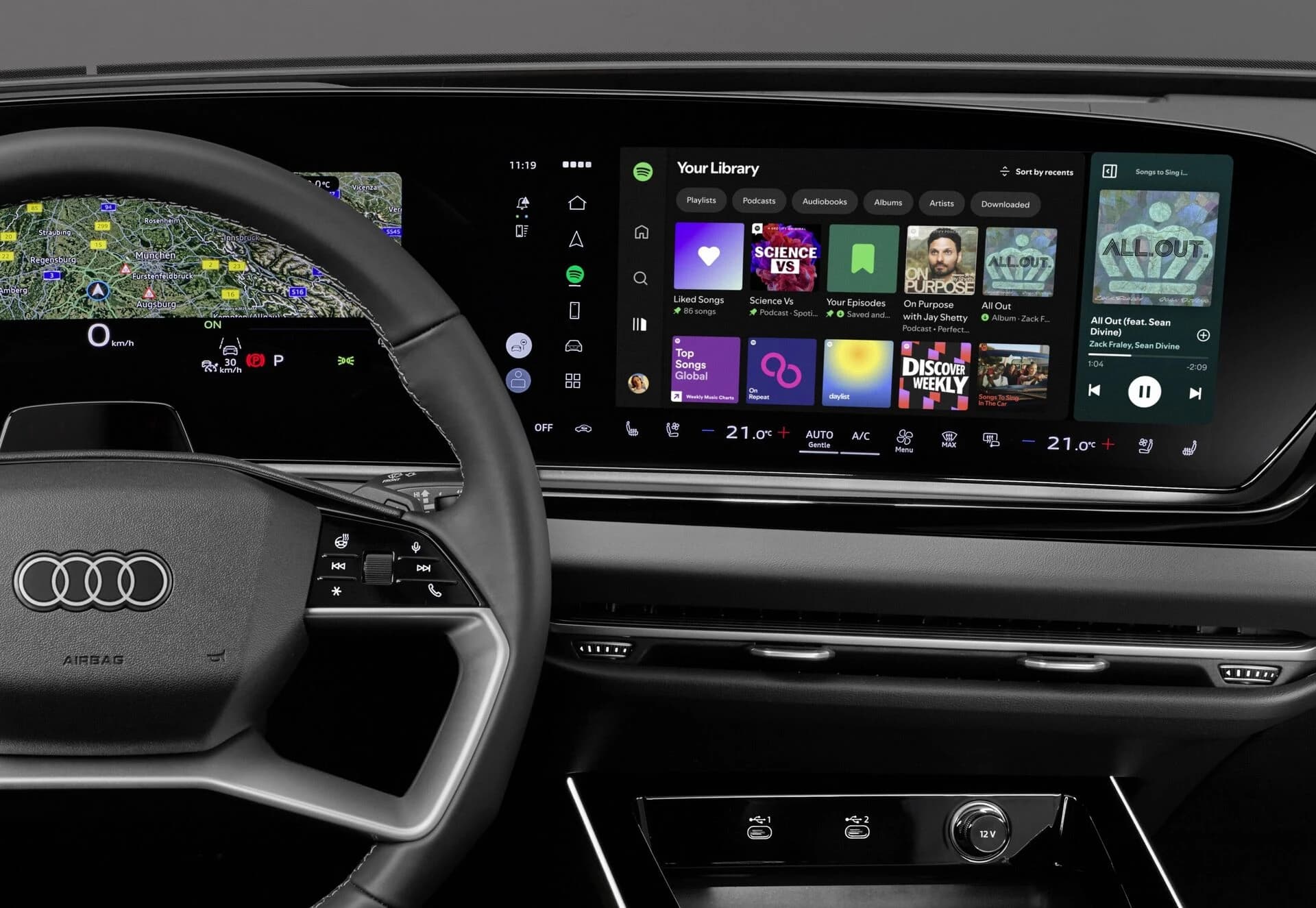
Audi has launched a fully native Spotify app for its MMI infotainment system. The app runs through Android Automotive OS inside the vehicle, so a smartphone does not need to be connected for the service to work. Audi announced the feature on 21 October 2026 and says it is the first car maker to integrate Spotify's full native in-car experience directly into a vehicle.
What native means in this case
The new app is installed through the Audi Application Store and runs in the car's own infotainment environment. That is different from Spotify used through Android Auto, Apple CarPlay or a Bluetooth connection, where the phone remains the source of the app and usually supplies the data connection. Audi says the native version was developed with CARIAD and Spotify for Android Automotive OS.
The application can be downloaded from the Audi store at no additional store charge, but a Spotify account is required. The subscription price still depends on the user's selected Spotify plan and the relevant market. Audi's announcement does not describe the service as a free replacement for a Spotify subscription. It only explains that the vehicle-side application itself is free to download.
Audi also describes a broader interface than the template-based versions previously used in some vehicle systems. The native app supports familiar Spotify navigation and adds music videos, real-time lyrics, Spotify Jam and Spotify DJ. The exact experience depends on the car's equipment, its display configuration and the software version installed in the vehicle.
Initial model coverage
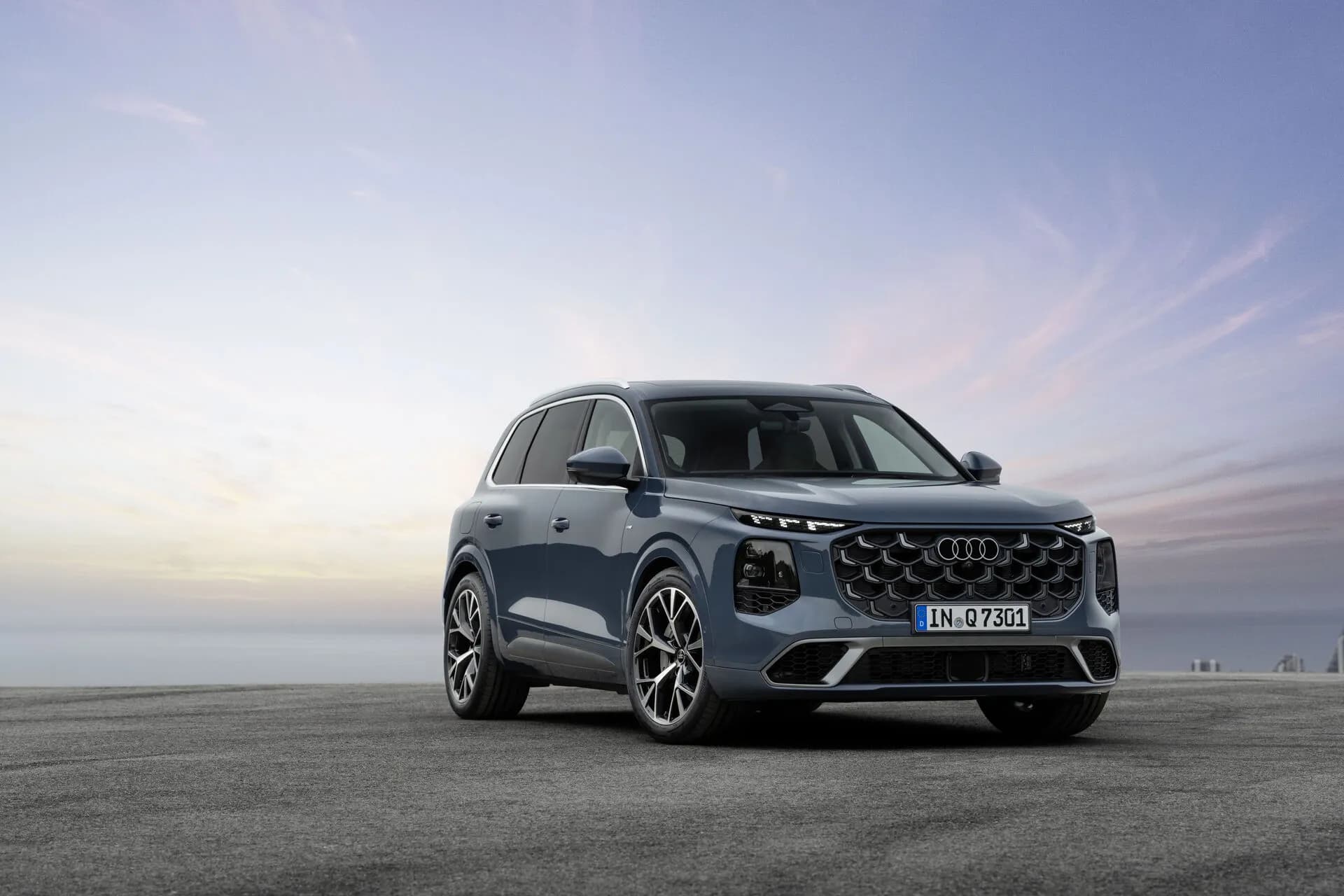
The first compatible vehicles listed by Audi are the A6 e-tron and Q6 e-tron, together with the A5, Q5 and A6 from model year 2026 onwards. Audi links eligibility to its newer Premium Platform Electric and Premium Platform Combustion architectures. The model badge alone is therefore not enough to confirm support; the electronics, software and equipment package also matter.
Audi says the native app will also be available in the Q7 and Q9 from their respective market launches. The global announcement does not provide a complete country-by-country list of trims or software versions. Owners should therefore check the Audi Application Store in the vehicle and the connected-car information associated with their myAudi account rather than assume that every example of a listed model has the same feature.
The rollout is planned for 47 Audi markets across Europe, North and South America, Asia, Africa and Australia. Audi's application portfolio is market-specific, so a service visible in one country may not appear in another. Audi also notes that the store needs compatible infotainment hardware, a myAudi account and an active data connection.
Different behaviour while driving
The app does not show its full interface in every driving situation. While the vehicle is moving, videos and real-time lyrics are hidden from the centre MMI display. Sign-in and settings functions are unavailable, and related controls are removed from the Now Playing view. These restrictions are applied automatically and are intended to reduce visual distraction for the driver.
Where the vehicle has a suitable front passenger display, supported video and lyric functions can remain available to the passenger while the car is moving. When the vehicle is parked, the full feature set and expanded browsing can be shown on the central MMI screen. Audi therefore treats the passenger display and the driver-facing display as separate use cases rather than mirroring the same content everywhere.
Spotify Jam is designed for shared listening. Passengers can join a session by scanning a QR code and add tracks to a common queue. This does not mean that every Spotify menu is available to the driver in motion. The safety restrictions described by Audi continue to apply, and the feature set is still tied to the equipment of the individual vehicle.
Voice control remains available for supported actions. Audi specifically mentions “Hey Audi” and Spotify DJ. The company does not claim that every part of the app can be controlled by voice, and it states that account and settings actions remain blocked while driving.
The role of the Audi Application Store
Audi introduced its in-car application store on selected models in 2023. The earlier system was built around the third-generation modular infotainment toolkit and let customers install applications directly into the MMI over the vehicle's data connection. Audi said the store was developed with CARIAD and would cover music, video, gaming, navigation, parking and charging, productivity, weather and news.
The store has since become a way to connect third-party digital services to the car's own displays and controls. Audi's newer infotainment systems use Android Automotive OS, while the familiar smartphone interface remains available as a separate route for Android Auto and Apple CarPlay. The native Spotify launch uses the former approach: the service is designed around the vehicle rather than simply projected from a phone.
That distinction matters for updates and compatibility. Audi can distribute the application through its own store, apply driving-state restrictions and make use of multiple displays. It also means that older cars cannot automatically be assumed to qualify through a software download. The 2026 announcement is tied to newer PPE and PPC vehicles, and Audi has not announced a universal retrofit path for earlier hardware.
Owners of an older compatible Audi may still have Spotify through Android Auto, Apple CarPlay, Bluetooth or an earlier store application. Those options are useful, but they should not be described as the same full native integration. The practical check is the store shown in the car, the installed software and the vehicle's equipment list.
Audi has not published a single price for every country, a complete list of accepted Spotify plans or an identical activation procedure for all models. The confirmed points are narrower: the app is distributed through the Audi Application Store, the download is free, a Spotify account is required, and support is limited to compatible vehicles and markets.