Image: Mercedes-Benz Group AG, official press image. The image is used editorially; rights remain with Mercedes-Benz.
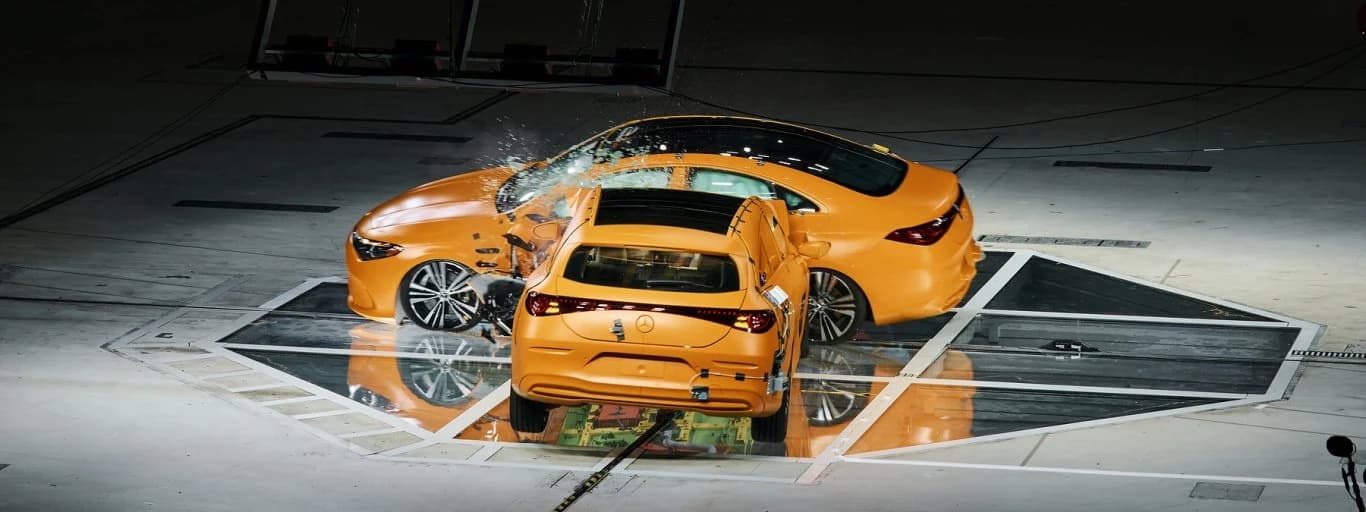
Mercedes-Benz has staged what it describes as the world’s first public high-speed side-impact crash test involving two moving production cars. The event, presented on 20 October 2026, used a CLA Shooting Brake with an electrified combustion engine and a fully electric CLA. Both vehicles were travelling at 56 km/h, and the test was carried out without braking beforehand.
The manufacturer says the two passenger compartments remained intact, the readings from eight crash-test dummies stayed below the relevant biomechanical limits, and the high-voltage battery in the electric CLA was not damaged. Those are Mercedes-Benz results from its own demonstration. They are not an independent Euro NCAP rating and do not represent a universal result for every CLA version or every real-world collision.
A moving vehicle struck the electric CLA
The test was designed to resemble a serious junction collision. The CLA Shooting Brake drove directly into the driver’s side of the electric CLA. Mercedes-Benz says each car weighed more than two tonnes. The impact therefore involved two complete production vehicles rather than a vehicle hitting a fixed barrier or a laboratory trolley designed to reproduce the front of another car.
Mercedes-Benz chose 56 km/h for both vehicles. Its accident research places that speed at the upper end of junction crashes observed in real traffic, while the company also notes that it is above the speed normally found in central urban streets. The manufacturer has not presented the event as a mandatory regulatory test. It is a company demonstration based on a scenario selected from its own accident research.
Side impacts are difficult because there is less structure between the collision point and the occupants than in a frontal crash. A front end can use its length, crash beams and controlled deformation zones to absorb energy before the passenger cell is reached. A side structure has less room. The door, sill, pillars, floor and restraint systems must work within a narrow package, and an electric vehicle must also protect a battery mounted in the underbody.
What Mercedes-Benz says the dummies showed
The test used eight dummies representing four adults and four children. Mercedes-Benz says each dummy supplied data from up to 150 measurement points. The recorded values remained below the biomechanical limits used by the industry to assess occupant protection, according to the company. Mercedes-Benz says the readings indicate a low risk of serious or life-threatening injury in the tested configuration.
The wording matters. A dummy result is not a medical outcome and a manufacturer’s press release is not the same as a public independent laboratory report. The statement describes a controlled test with known vehicles, speeds, impact direction and seating positions. It cannot predict every outcome when vehicle masses, overlap, occupants, restraint use, road surface, impact angle or post-impact events change.
Mercedes-Benz also says both passenger cells remained stable and that the safety systems worked as intended. The high-voltage battery in the electric CLA remained intact after the direct side impact. The company’s published summary does not provide every individual dummy value, the full deformation map or a separate long-term assessment of the battery after the crash. The most precise conclusion is therefore limited to the manufacturer’s stated result: the battery was undamaged in this test.
Why this is outside normal ratings
No law or safety-rating programme requires a side-impact crash test between two real moving production vehicles in this exact configuration. Standard procedures use fixed barriers, deformable barriers or controlled impact vehicles under specified conditions. The advantage is repeatability. A regulator or independent organisation can compare cars using the same speed, overlap, barrier and measurement rules.
Mercedes-Benz chose a more realistic-looking junction scenario. The mass, body shape and structure of the other car become part of the event, as they would in traffic. The trade-off is that one spectacular demonstration cannot replace a complete safety programme. Real crashes involve many combinations of angle, speed, overlap, vehicle type and occupant position.
Mercedes-Benz says around a quarter of injury crashes are side impacts. That figure appears in the company’s own presentation and is used to explain its “Real-Life Safety” approach. The published material does not provide a full independent dataset or methodology alongside the number, so it should be read as manufacturer context rather than as a universal road-safety statistic.
Research, simulations and physical testing
Mercedes-Benz says it has investigated and reconstructed real crashes since 1969. Research teams in Germany, China and India have analysed about 6,000 crashes, according to the manufacturer. The findings are fed into body structures, restraint systems and internal requirements for new vehicles.
The company also says a new model completes around 15,000 virtual crash simulations during development. Artificial intelligence is used to make the predictions more precise. Alongside the simulations, Mercedes-Benz says it carries out about 150 physical crash tests for each new model, well beyond the minimum legal requirements.
Virtual analysis lets engineers test many combinations before destroying a vehicle. Physical tests are still needed to check how the complete structure, airbags, belts and battery respond in reality. The two-car CLA demonstration adds a public example of a moving vehicle striking the side of another moving production car, but it does not reveal all of the engineering data generated during the programme.
Rescue Intelligence is planned from 2027
Mercedes-Benz used the event to present Rescue Intelligence, a system the company says will be introduced gradually from 2027. It is intended to connect crash-involved vehicles with emergency services and provide accident information while rescue crews are still travelling to the scene.
Depending on technical availability and the situation, the information may include the number of occupants, airbag and seat-belt status, open doors, battery temperature and the state of the high-voltage system. Mercedes-Benz says this could help firefighters prepare the right equipment earlier.
The announcement does not yet specify which countries will receive the system first, what communications infrastructure it will use, or what local emergency-service integration will be required. The real-world benefit will depend on data transmission after a crash, network coverage, vehicle connectivity and the procedures followed by the responding service.
For electric vehicles, early information about the high-voltage system can help responders prepare. It should not be confused with a guarantee that every accident will be automatically understood before crews arrive. The deployment details remain to be confirmed.
What the test means for buyers
The demonstration gives a useful view of Mercedes-Benz’s development process: the company combines real-crash research, virtual simulations and physical tests. Buyers should still read the result alongside independent ratings, the exact body style and the equipment fitted to the vehicle they are considering.
A side-impact test between two CLAs cannot guarantee the same outcome in every collision. The presentation does not publish Romanian pricing, repair costs, market availability or a complete independent score for every CLA derivative. It also does not confirm when Rescue Intelligence will be available in Romania.
The verifiable point is narrower and more useful: two production CLAs were driven into a severe side-impact scenario at 56 km/h, and Mercedes-Benz reports that the passenger compartments, occupant-protection measurements and the electric CLA’s high-voltage battery met the company’s objectives for that test. The result is a manufacturer demonstration, not a replacement for independent safety evaluation.