
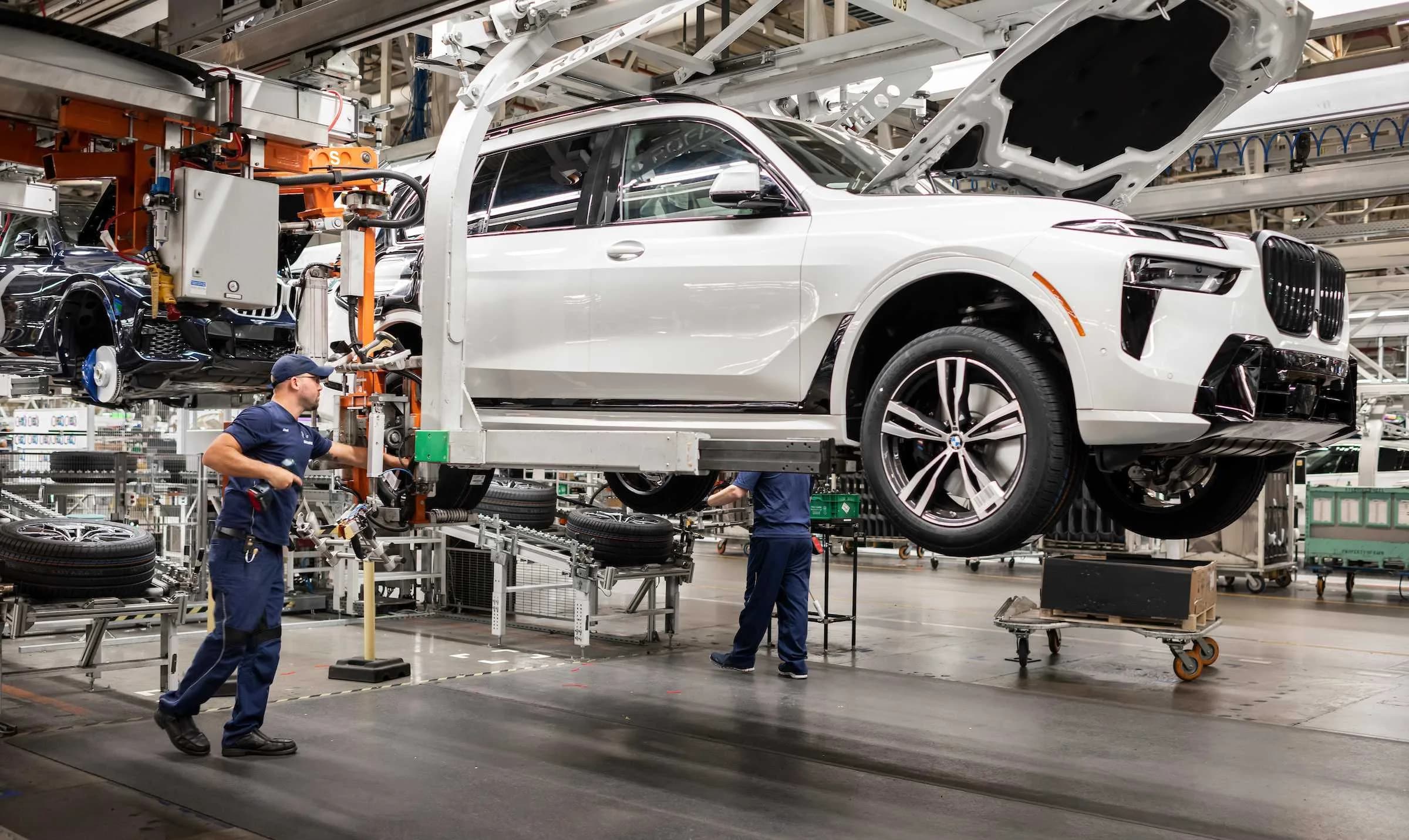
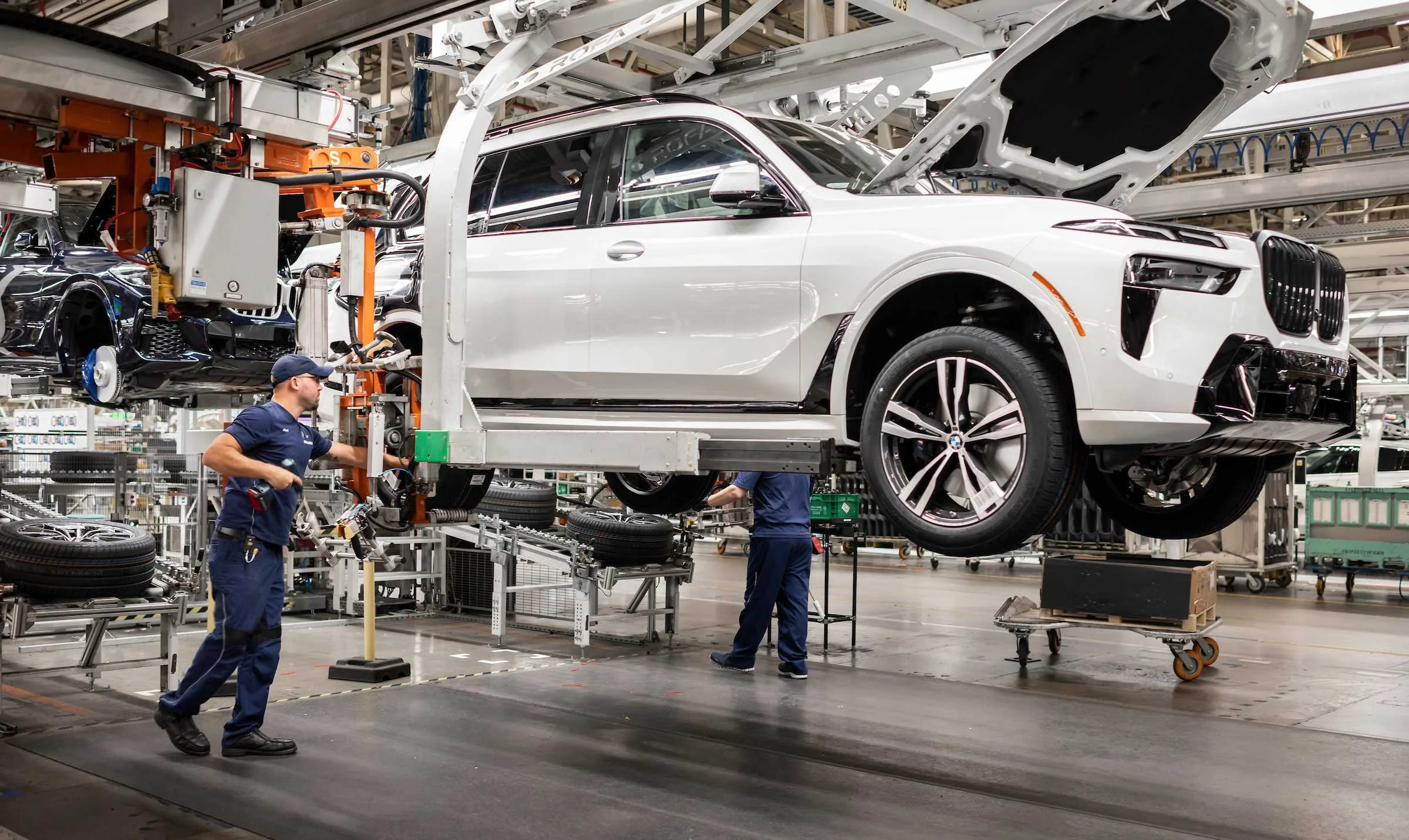
Photo: BMW Group PressClub. BMW X7 in assembly at Spartanburg in 2026. Official image converted locally to WebP, 2400 × 1431 pixels.
BMW is reviewing its global product range and considering an additional Sports Activity Vehicle above the X7 for customers in the United States. The company has not confirmed a name, price, dimensions or launch timing. The informal “X8” label used in discussion around the project is therefore not an official model announcement.
At the same time, BMW says it will review and reduce the number of variants in its portfolio. One confirmed example is the BMW 2 Series Active Tourer, which will not receive a successor. The stated objective is a more focused range, with products adapted to regional demand and selected for their long-term contribution to profitability.
A larger SUV is still only under consideration
BMW describes the new vehicle as an additional offering in its Sports Activity Vehicle line-up, rather than a direct replacement for the X7. It would be aimed specifically at the US market, where large premium SUVs are an important part of the customer mix. BMW has not shown a production design or disclosed a platform, powertrain, wheelbase or seating layout.
It is therefore too early to describe the vehicle as a confirmed X8. The source article uses that name as an editorial shorthand, but BMW has not adopted it. The company has also not explained how the vehicle would be positioned against the X7 or the Rolls-Royce Cullinan.
The proposal is tied to demand for large SUVs and to capacity at BMW Group Plant Spartanburg in South Carolina. BMW says the facility, known as the “home of X”, is currently operating at full capacity. More regionalised production would allow the group to expand global output of X models and supply sales regions more directly.
Why BMW is reducing variants
The additional SUV does not mean BMW intends to expand the range indefinitely. The company says it will review the number of variants across the portfolio and focus on vehicles that deliver the strongest long-term returns in each market. Fewer combinations of body style, equipment and drivetrain can reduce development, purchasing, production and distribution complexity.
The 2 Series Active Tourer is the clearest example BMW has provided. The model remains in the autumn 2026 product information with petrol, diesel and plug-in hybrid versions depending on market. Saying that it will have no successor does not mean production or sales stop immediately; BMW has not announced a withdrawal date.
BMW has not confirmed that other models such as the i4 or iX will be discontinued. Those possibilities have appeared in outside speculation, but the official announcement discusses a portfolio review and gives one specific example rather than a complete list of models to be removed.
China gets a more local product strategy
Portfolio streamlining also applies to China, where BMW plans a much stronger local footprint. The group wants at least 95% of the vehicles it sells in China by 2030 to be locally manufactured and developed with Chinese customer preferences in mind.
That target covers more than final assembly. BMW says local development activity will be expanded and that vehicle features should respond more closely to the Chinese market. High-volume models linked to Neue Klasse technology will benefit from local production, while imports will be limited to products with the highest margins.
BMW is also reviewing exports of China-built vehicles to Southeast Asian markets. The company has not published a final list of models or volumes. The approach could help it use regional factories and supply chains more efficiently, but the result will depend on costs, trade rules and local demand.
A separate US strategy
The US plan is not limited to a larger SUV. BMW wants greater regionalisation of SUV production and more global capacity for the X family. Spartanburg already builds X3, X4, X5, X6 and X7 vehicles for international markets, and BMW describes the plant as its competence centre for Sports Activity Vehicles.
The vehicle above the X7 could be produced there, but BMW has not confirmed that decision. It has also not stated whether the model would use a combustion engine, plug-in hybrid system, battery-electric drivetrain or several options. The only confirmed positioning is that the offering would be closely tailored to US customer needs.
The lack of specifications matters. There is no confirmed power figure, range, wheelbase, seating capacity, towing rating or cargo volume. Any renderings or model names published outside BMW should be treated as speculation until the manufacturer releases further information.
Neue Klasse also moves down the range
Alongside the potential US flagship SUV, BMW plans another fully electric entry-level model for Europe in 2028. It will use Neue Klasse technology and bring the architecture’s features into a higher-volume part of the BMW range. The source article suggests that the vehicle could be related to the 1 Series, but BMW has not confirmed that name.
Battery capacity, range, price and production location are also unknown. The plan does not mean BMW is abandoning compact cars. It means the group may remove selected models or variants while adding new products where it sees demand and a path to acceptable returns. BMW says Neue Klasse technologies will eventually spread across every vehicle segment.
BMW ALPINA expands the upper end
BMW Group says the first model under the new BMW ALPINA structure will arrive in 2027. Inspired by the 7 Series, it will sit between the regular BMW range and Rolls-Royce in the company’s luxury hierarchy. BMW has not published its powertrain, output, dimensions or price.
The ALPINA project serves a different purpose from the large US SUV. The SUV would respond to regional demand for large vehicles, while ALPINA would add a more clearly defined product at the top of the BMW Group portfolio. Both projects are part of the same broader approach: every model should have a clearer position and a stronger financial case.
AI and organisational changes
BMW also wants artificial intelligence to be used in development, purchasing, manufacturing, sales, marketing and aftersales. In vehicle development, AI agents may help with technical requirements, testing and release processes. In production, systems can process data and automate repetitive tasks.
The workforce restructuring programme includes a 20% reduction in the number of divisions and associated management roles. BMW has reached an agreement with employee representatives covering the programme, including voluntary severance packages. A final number of affected employees has not been published.
These measures support BMW’s profitability target. The group expects the Automotive segment EBIT margin to reach 3–5% in 2028, before returning to its longer-term 8–10% target range early in the next decade. A shorter range, regional production and faster processes may reduce costs, but the final financial effect is not yet measurable.
Confirmed facts and open questions
BMW has confirmed a review and reduction of model variants, no successor for models such as the 2 Series Active Tourer, an additional US-focused SUV above the X7 under consideration, a target of at least 95% locally manufactured and developed Chinese vehicles by 2030, a compact European EV for 2028 and a first BMW ALPINA model for 2027.
The name X8, the design, price, dimensions, powertrains, seating and launch date of the larger SUV remain unconfirmed. Until BMW releases those details, the vehicle should be described as a proposal under consideration rather than a launched model.


