
Brazil has become one of the most useful test beds for Chinese carmakers moving from vehicle exports to local production. BYD is developing an industrial complex in Camaçari, Bahia, while Great Wall Motor is producing vehicles at Iracemápolis in São Paulo. The projects are not identical, but together they show how Chinese manufacturers can test technology, suppliers and regional export strategies in a large market with needs that differ from Europe.
Why Brazil matters
Brazil has an established automotive industry, a large domestic market and a supplier base capable of supporting local production. It is not simply a destination for imported cars. Local manufacturing can reduce the dependence on shipping from Asia, help a manufacturer meet local-content requirements and create a base for exports to other Latin American markets.
The technical environment is also distinctive. Brazil has a long history of using ethanol and flex-fuel vehicles. For a Chinese manufacturer, the country can therefore test combinations of batteries, electric motors and combustion engines that run on locally available fuels. BYD has presented a plug-in hybrid flex-fuel vehicle at Camaçari, showing that electrification in Brazil does not necessarily mean an immediate switch to battery-only cars.
BYD's Camaçari project
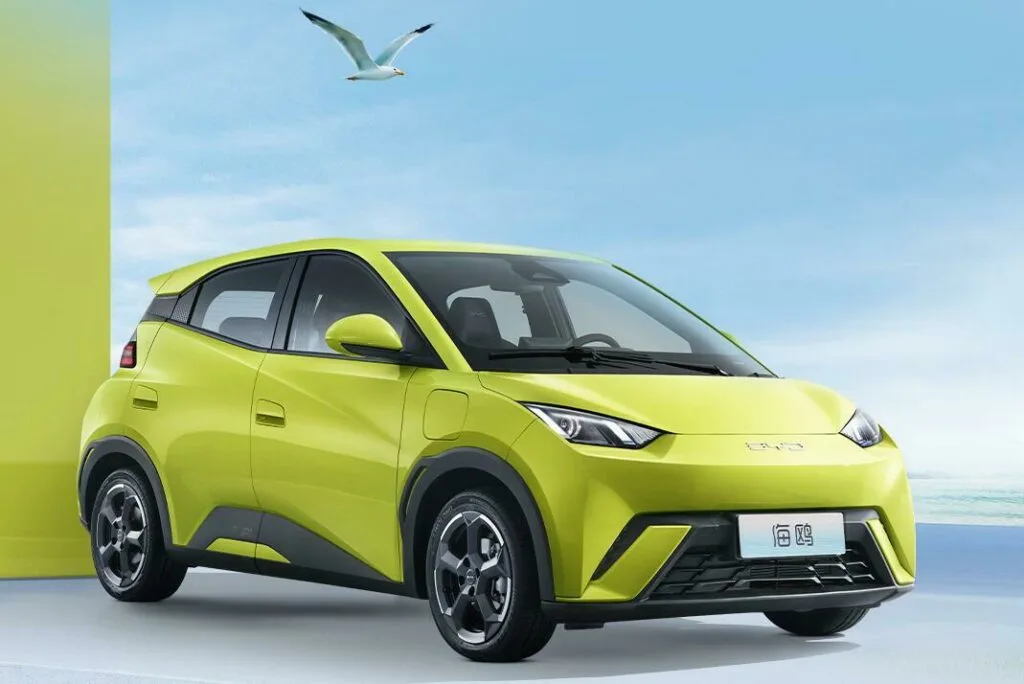
BYD acquired the former Ford complex at Camaçari and announced an investment of about 5.5 billion Brazilian reais for its Bahia operation. The company describes the site as its largest industrial hub outside China and says it will produce electric and hybrid vehicles. The first locally produced electric car was a Dolphin Mini, known as the Seagull in China and the Dolphin Surf in Europe.
The initial phase used assembly processes, while the plan for 2026 includes more complex operations such as stamping, welding and painting, together with a higher share of locally produced components. That progression matters for exports. A plant assembling imported kits has a different industrial role from a factory integrating more stages of the supply chain.
GWM's Iracemápolis factory
Great Wall Motor acquired the Iracemápolis plant, formerly operated by Mercedes-Benz, and prepared it for local production. GWM has worked on recruitment, training and the adaptation of assembly lines, and the project is linked to Brazil's Mover industrial programme. The company produces electrified vehicles in Brazil and intends to use the factory for the domestic market as well as Mercosur and other American markets.
The contrast with BYD is useful. BYD entered Brazil with a new complex built around electric vehicles and batteries, while GWM purchased an existing plant and adapted it for SUVs and pick-ups with electrified powertrains. Both routes can shorten the path to production, but they carry different risks related to suppliers, labour and the pace of localisation.
What the Chinese manufacturers are testing
Brazil allows the companies to test several things at once. First is the commercial acceptance of electric and hybrid vehicles in a country where charging infrastructure is uneven across its territory. Second is the ability to adapt products to ethanol, high temperatures, long distances and different road conditions. Third is the performance of a local service and supplier network.
A car designed for China cannot simply be transferred to Brazil unchanged. Battery calibration, software, suspension, climate control and corrosion protection must suit local conditions. Buyers may also prefer a plug-in hybrid or flex-fuel vehicle when home charging is not available. Those lessons are relevant to any market where electrification is gradual rather than uniform.
What Europe can learn
Europe has different safety, emissions and data rules, so Brazil is not a direct copy of the European market. Some industrial lessons are transferable, however. A manufacturer that learns to localise components, train staff and support a dealer network in a distant market is building capabilities that can help when it enters another region. Brazil is a laboratory for industrial flexibility, not a template that can be copied without changes.
The relationship between local production and price is another lesson. Manufacturing closer to the customer can reduce logistics costs and exposure to import duties, but it does not automatically make a car cheaper. Investment, wages, exchange rates, imported components and local-content rules all affect the final price. Europe can watch whether Brazilian production makes the vehicles more competitive in the region and how exports are organised.
The limits and risks
Brazil should not be treated as proof that every Chinese carmaker will quickly succeed in Europe. Its industrial policy, fuel mix and geography are different. Factory projects can also be delayed, and a capacity target announced by a company is not the same as actual production.
There are social and governance risks as well. In the case of BYD's Camaçari construction site, Brazilian authorities investigated the working conditions of workers hired for construction, and the company became involved in litigation reported by international media. The episode is a reminder that an automotive investment must be assessed not only by jobs and planned capacity, but also by labour-law compliance and transparency in the subcontracting chain.
A regional production base
The Brazilian plants also matter because the products are not limited to one national market. A locally assembled car can be adapted to neighbouring countries, and a plant can help a brand understand regional certification, service and distribution. That does not remove the need for country-specific approval, taxes or customer support, but it gives the manufacturer a starting point closer to Latin American buyers.
For European observers, this is relevant when assessing future export strategies. A company may first use Brazil to prove a production process, then decide whether a similar model should be made in Europe, imported, or adapted for local regulations. The direction is not automatic, and the presence of a Chinese-made vehicle in Brazil does not confirm a European launch.
Conclusion
Brazil matters to Chinese manufacturers because it offers market scale, suppliers, industrial experience and regional access. BYD is testing electric, hybrid and flex-fuel production at Camaçari, while GWM is adapting an existing factory in Iracemápolis for electrified vehicles. Europe can learn from the localisation and service challenges, while remembering that the two regions have different rules and customer needs. Brazil is a useful laboratory, but not a model that can be copied without modification.


