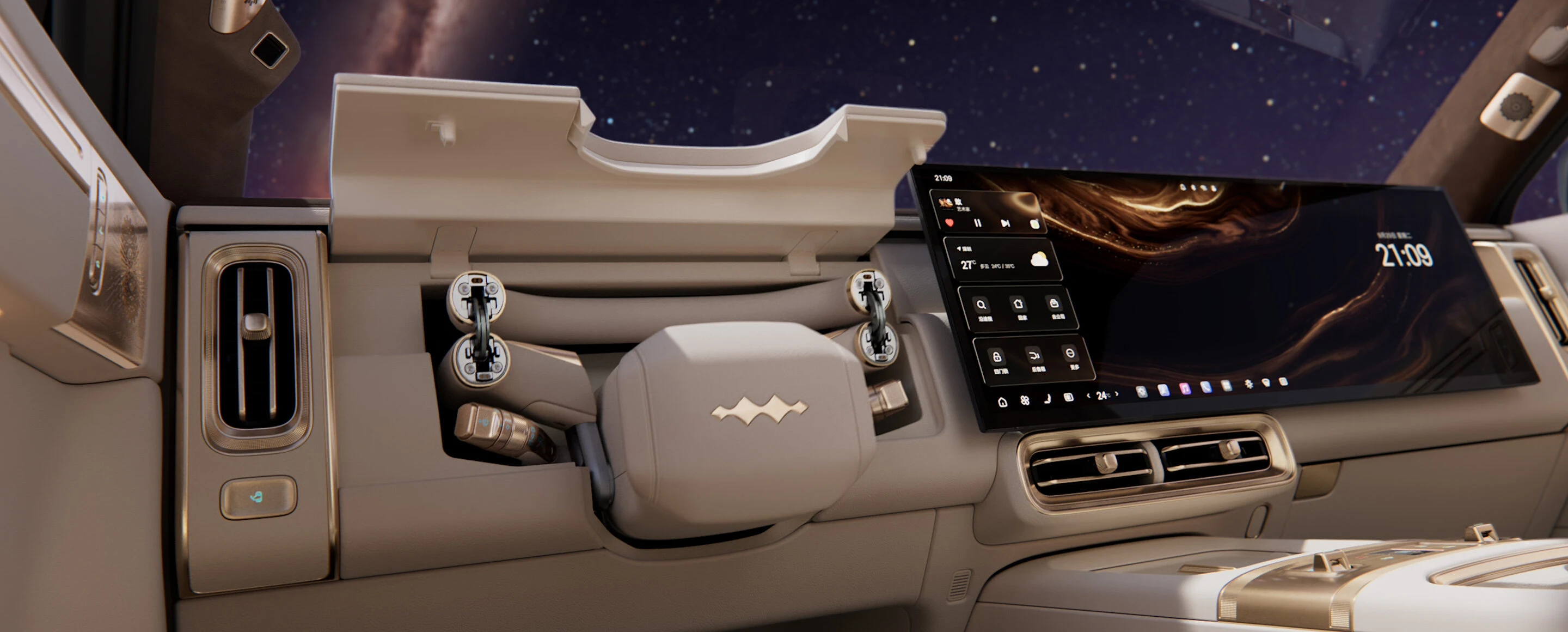
BYD's Fangchengbao brand has put a folding steering wheel into a production SUV. On the top Tai 9 version sold in China, the complete rim folds through as much as 180 degrees and the assembly moves into a dashboard compartment in a claimed 10 seconds. It is a real customer specification rather than a motor-show prototype, but it is not standard across the Tai 9 range and it does not make the car autonomous.
The enabling hardware is steer-by-wire. Driver inputs are measured electronically and sent to the steering actuators instead of passing through a conventional continuous mechanical column. Removing that fixed link creates room for the wheel to move out of the driver's way while the vehicle is parked. It also makes electrical redundancy, failure behaviour and type approval central to the design.
A full rim, not a yoke
Fangchengbao's official photographs show the two sides of the rim folded inside an open dashboard recess while the central module remains visible during the movement. Once deployed, the driver gets a complete circular rim. That distinction matters because the feature is not achieved by simply cutting away the upper half, as on some yoke-style controls.
BYD says the mechanism is designed for 80,000 opening and closing cycles. That is a manufacturer durability claim, not an independently verified Carboratory result. The company also says the stowed wheel raises the usable share of the driver's space to 80 per cent. A small table can occupy the cleared area, while the driver's seat moves into a rest position in 20 seconds. Official specifications quote a maximum 165-degree backrest angle and 18-way adjustment.
The intended use is a stationary cabin mode: charging stops, breaks or time spent waiting in the car. BYD presents the layout as hardware prepared for possible future Level 3 and Level 4 driving automation. The production Tai 9, however, is not advertised as a fully driverless vehicle. A steering wheel that disappears when parked is not evidence that the car may legally or technically drive without supervision.
The feature sits at the top of a three-model range
Fangchengbao launched the Tai 9 in China on 19 November 2026 in Max, Ultra and Folding Smart Cabin forms. The first two retain a conventional wheel. The retractable system and steer-by-wire architecture belong to the flagship specification, priced at the equivalent of about €45,000. The entry version works out at roughly €38,100. These conversions use the European Central Bank reference rate of CNY 7.3388 to one euro on 20 November and are only a way to understand the Chinese prices; they are not European retail quotes.
There is no confirmed Tai 9 launch for Romania or the wider European market. Fangchengbao primarily addresses Chinese buyers, and BYD has not published European homologation, timing or euro pricing for this model. Import tax, VAT, local equipment and certification would prevent a straight conversion from becoming a meaningful European list price.
This market boundary is especially relevant for the steering system. Type approval would need evidence covering control after electrical faults, actuator redundancy, the folding mechanism and occupant protection. The official model page describes a horizontally collapsing structure intended to improve safety, but it does not provide a European safety dossier or a Euro NCAP result.
The rest of Tai 9 is a large plug-in hybrid
Tai 9 is a three-row, six-seat plug-in hybrid SUV built around BYD's new DMS platform. The official description lists a 1.5-litre petrol engine and two electric motors, with 400 kW quoted for total electric-motor output. BYD claims 0–100 km/h in 4.8 seconds. Those are manufacturer figures, not figures measured by Carboratory.
A 66.5 kWh battery supports a maximum claimed electric range of 400 km under China's CLTC procedure. CLTC is not interchangeable with the European WLTP cycle, so 400 km should not be read as an expected WLTP number. BYD also quotes up to 1,630 km with the fuel tank and battery full, plus 6.4 l/100 km in its charge-depleted test condition. Real consumption will depend on speed, temperature, charging habits and the test definition.
The DMS pitch combines elements associated with BYD's DM-i, DM-p and DMO systems. Fangchengbao lists a normal turning radius of 4.95 metres and a minimum of 3.55 metres on a low-grip surface, where torque-vectoring can influence the vehicle's rotation. The smaller number is a special manoeuvre, not the everyday dry-road turning circle.
What a road test would still need to establish
The headline numbers do not answer the practical questions. A useful long-term assessment would need to time the folding sequence in hot and cold conditions, examine noise and movement after repeated use, and establish what happens if the wheel cannot return to the driving position. It would also need to evaluate steering feedback, response consistency and the backup strategy when one part of the electronic path fails.
Airbag integration is another key issue. The official image shows the centre section separate from the folding rim during stowage, but photographs alone cannot establish crash performance. Certification authorities will need the complete restraint-system data if BYD decides to sell this specification outside China.
The Tai 9 therefore deserves attention for turning an old concept-car idea into orderable hardware. The accurate version of the story is narrower than the spectacle: one top-trim Chinese SUV can hide its full steering-wheel rim while parked, using steer-by-wire, and BYD has not announced that version for Europe.